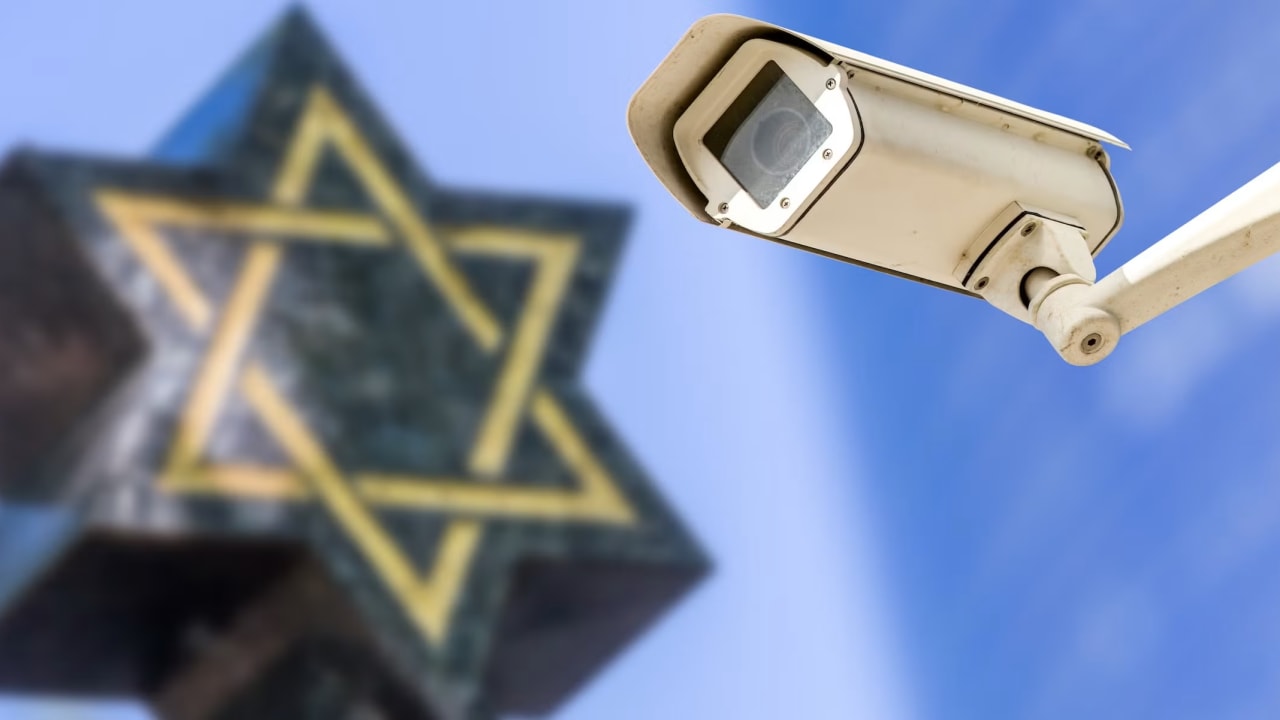
The occupation of Minneapolis by ICE is terrifying and ominous. Last month, 1,000 clergy from around the country traveled to the Twin Cities to witness how armed agents daily sweep through neighborhoods, setting up checkpoints, abducting people, tear-gassing witnesses, and threatening everyone’s safety. Houses of worship have gone into lockdown, transforming their sanctuaries into private spaces, putting a locked door between them and their neighbors.
As rabbis, one question has become urgent and immediate: What will we do when ICE comes to our door?
For hundreds of synagogues across the United States, that question may well already have been answered. They just don’t know it yet.
This year, as in years past, hundreds of synagogues across the country are set to receive grants through the Nonprofit Security Grants Program, a Department of Homeland Security initiative administered by FEMA. The program offers between $60,000 and $100,000 (sometimes more) in security funding to houses of worship and other nonprofits.
The money goes toward security cameras, armed guards, and physical enhancements and more. For many synagogues facing antisemitic threats and stretched budgets, that’s a transformative amount of money that would be hard to turn down.

Many progressive communities like ours have long believed that depending on DHS to keep us safe is a problem, owing to the department’s surveillance of Muslims and the fact that the grants strengthen infrastructure that puts some community members at risk.
But in 2025 the mismatch between Jewish communal values and practices and resources to ensure our safety became even more stark when the Trump administration slipped new language into the terms of the grant. The money now appears to come with strings that should alarm any Jewish community.
The grant now requires participating organizations to cooperate with ICE operations, forbids participating organizations from engaging in Diversity, Equity and Inclusion programming, and bars participation in any kind of “discriminatory prohibited boycott” (an apparent reference to boycotts of Israel). To access the Nonprofit Security Grants, synagogues all over the country have agreed to become extensions of the apparatus now raiding American cities.
It’s not yet clear how many synagogues have applied for the grants with these terms or have gotten them. It’s also not clear whether many synagogues are even fully aware of what they’ve signed on to.
Especially before Minneapolis, “cooperation with immigration enforcement” may have seemed like an abstraction or even acceptable to many communities, and perhaps they didn’t really expect their diversity programming to be audited.
Think of it as the Terms of Service problem. How many of us actually read what we’re agreeing to when we click “accept” on Apple’s terms? We know there’s something in there we probably wouldn’t like, but we need the phone.
It’s possible many synagogues did the same calculation with DHS money. They assumed the restrictions wouldn’t really matter, whereas tens of thousand dollars in security money was a concrete and pressing need. Never mind the fact that for years Muslim organizations have been sounding this alarm.
Last August, my congregation in Philadelphia, Kol Tzedek, joined with dozens of synagogues and Jewish organizations along with over 100 communal leaders to refuse this funding, and we tried to sound the alarm.
We signed a letter explaining why we couldn’t in good conscience trade security dollars for collaboration with an agency whose mission conflicts with our values. But many other synagogues applied to take the money anyway. They need the cameras. They need to keep their members safe. What choice did they have?
It didn’t help that the umbrella organization for Jewish federations urged synagogues to apply, assuring them that it believed the terms would not be applied to them and noting that they could always turn down the funds once offered.
But now the federations group is sounding the alarm about a continued lack of clarity around the terms, and those congregations are in a terrible situation, one they may not even realize they’re in.
Houses of worship are some of the most powerful sites of resistance to ICE operations precisely because we can provide sanctuary. For centuries, religious communities have stood between state violence and vulnerable people. DHS understood this threat to its mission, and that’s exactly why they attached these strings to their security money.
It’s a clever and effective scheme: The Trump administration leveraged our real security fears to neutralize an institution that historically has had the moral and legal standing to say no to state violence and provide actual sanctuary to refugees and immigrants.
If your synagogue, nonprofit or community center received a grant from the $270 million federal budget for this program (and statistically, it probably did) you need to know what you’re on the hook for. More importantly, you need to know you have a choice about what comes next.
The only moral choice is noncompliance when ICE comes knocking
When ICE comes to your city and demands your cooperation the only moral choice is noncompliance. Thirty-six times the Torah instructs us to protect the ger – the sojourner, the immigrant, the most vulnerable in our midst. So when the time comes, refuse to cooperate, even if you signed that agreement and risk losing tens of thousands from your budget.
But it’s not too late. There are things you can and should do now. Find out if your congregation or organization sought or took this money. Ask for transparency about where your community stands. Tell your leadership that you didn’t sign up for this, that collaboration with ICE operations is not compatible with your community’s values, that there are opportunities for community safety that don’t require collaboration with the apparatus being used to terrorize and punish American cities.
To my fellow rabbis, synagogue executive directors and board presidents, I truly understand the impossible calculations you have to make and why the money seems irresistible. But this is the moment to make a different choice, even if it’s costly.
Consider the alternative: What happens when ICE shows up in your town and at your door, and your contract obligates you to cooperate? What happens when your own congregant is targeted? Or when a congregant learns their synagogue helped enable a raid on their neighbor’s family, their school, a place of worship? What happens when history looks back at this moment and asks what we did?
Jewish federations, and specifically the Secure Community Network, bear a lot of responsibility here. They put us in this position by lobbying for this fund’s creation and tying themselves to DHS. They facilitated these agreements, distributed this money, made it seem normal and necessary. They could have made a different choice: They represent billions of dollars in assets that could have chosen a different security model for our communities, and they still can.
The federations should bail out congregations that choose noncompliance by creating a fund for synagogues that refuse or break their DHS contracts. They should work to build the security infrastructure we actually need, one that protects us and our neighbors.
This moment is a test of our values. The question isn’t whether you took the money last year (many did, for reasons that made sense at the time). The question is, knowing what you’re on the hook for, and knowing after Minneapolis what ICE is about, what will you do now? Will you comply when ICE comes knocking? Will you check their paperwork, provide access, facilitate raids?
Or will you remember why houses of worship exist in the first place? We are here to be places where the vulnerable find protection, where we are accountable to each other, where we answer to something higher than federal enforcement agencies.
Sanctuary means something, or it means nothing. This is the moment to decide which it will be.
The views and opinions expressed in this article are those of the author and do not necessarily reflect the views of JTA or its parent company, 70 Faces Media.