Last Shabbat, as I stood in the synagogue for the reading of the 10 Commandments, a sudden thought crossed my mind: Something is missing here!
The custom of reading aloud the 10 Commandments – the Decalogue – goes back to ancient times. In the Temple in Jerusalem, the 10 Commandments were part of the morning prayer service and were recited just before the saying of the “Shema.” Thus the two essential signposts of Jewish practice – the belief in one God and the essential moral and spiritual code of Judaism – were broadcast on a daily basis.
But at some point, the rabbis decided to eliminate the 10 Commandments from the liturgy. This was a reaction to the heretics, who pointed to the prominence of the Decalogue as proof that this is the only truly important part of the Torah that need be followed. While the 10 Commandments still can be found in many siddurim, and some people do still read them every morning, the architects of the prayer book concurred that we must indeed be wary of overemphasizing the 10 Commandments.
This was clearly the view of Maimonides. He strenuously objected to the widespread custom of congregants standing up for the readings of the 10 Commandments, in both the Exodus and Deuteronomy versions. His responsum on this subject is quite adamant:
“It is proper to abolish this minhag wherever it has taken hold, and to teach the people to sit, as they usually do, in order that there should not result a belief that one part of the Torah is superior to another; this is a belief that is wrong and evil and deplorable in the extreme.”
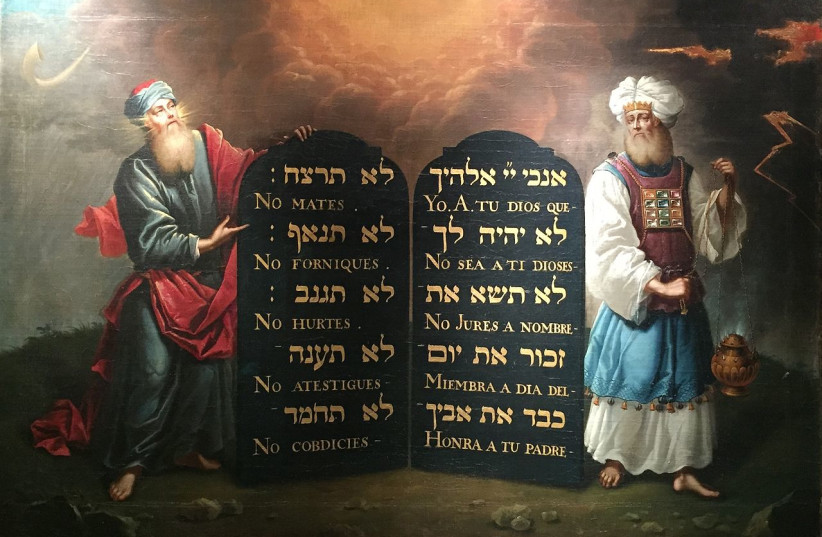
The rabbinic response to Maimonides notes that the flash and flourish of the giving of the Torah on Mount Sinai, amid the fearful display of thunder and lighting, certainly play to the uniqueness of these powerful words written in stone. But the rabbis suggest that this is precisely because the Decalogue is much, much more than just 10 mitzvot, basic as they may be; they contain, in capsule form, all the 613 commandments that are to be found in the entire Torah.
So, for instance, “Thou shall not steal” also includes the prohibition of kidnapping, charging usurious interest, graft, influence peddling, and even gneivat da’at, “misleading others.”
“Thou shall not commit adultery” takes into account incest, immodesty, sexual abuse, and all forms of moral corruption. And the commandment to observe Shabbat? That includes all the many, many mitzvot that are connected to each of the Jewish holidays.
Spiritual portal that opens a connection with god
The 10 Commandments are, in effect, a spiritual portal that opens the door to a connection with God, but it is the greater body of the mitzvot that walks one through that pathway. In fact, the Hebrew word for Jewish law is Halacha, closely connected to halacha, “walking.” As a graphic illustration of this notion, there are exactly 620 Hebrew letters in the 10 Commandments; they represent the 613 mitzvot, plus the seven universal Noahide laws (sheva mitzvot bnei Noah).
But I want to suggest that there is an unwritten, 11th commandment that hovers above all the others: the mitzvah to live in the Land of Israel. This is a pervasive, all-encompassing Divine directive – a mitzvah “that is equal to all the Torah” – that permeates and activates the life of the Jewish people. Just living in Israel, at any level of observance, elevates the Jewish soul and automatically, even without our awareness, imbues within us a spirit of godliness and holiness. We walk the streets named for the prophets; we feel the festivals in the air. We not only study Jewish history; we live it. It is what I call “Moses by osmosis.”
Even in the most difficult of times, Israel inspires and nurtures us. When our son Ari fell in battle, the remarkable Rabbi Shlomo Riskin was the first rabbi to come to our shiva. He consoled us with the well-known prayer “Hamakom y’nahem et’hem b’toch she’ar aveley Tziyon v’Yerushalayim” (“May God comfort you among all those who mourn for Zion and Jerusalem.”) “Why is God referred to here as Hamakom – ‘the place’?” he asked. “It is because the place itself – Israel – will assuage your pain, knowing that Ari gave his life in order to defend and protect our holy land and all its citizens; there is no act of heroism greater than that.”
The very first time that God speaks to Abraham, Isaac, and Jacob individually, He intimates to them that Israel is our natural habitat, given to the Jewish people for an eternal inheritance, and that the mitzvot cannot reach their fullest observance outside of Israel.
Each and every sidra (“portion”) in the Torah contains a reference to Israel, and the Talmud says explicitly that redemption can come only when we achieve three primary goals: sovereignty in the land; the obliteration of evil that endangers ourselves and all good people; and the rebuilding of the Temple. We’ve accomplished the first; we’re working hard on the second even as you read this; and the third, we pray, is just around the corner.
Why, then, does the Torah not explicitly spell out the obligation for every Jew to come to live here?
Some suggest it is because it is such an obvious, essential part of Jewish life that to enunciate it would be superfluous. But I have another idea.
I suggest that while the other commandments are obligatory – “forced” upon us from Sinai, whether we like them or not – this one imperative is there for us to voluntarily embrace. Like wise parents, who at times hold themselves back and allow their children to make decisions on their own, as an important part of their maturation, God is placing this long-awaited opportunity before us, carefully watching and waiting to see what we do: Will we choose it, or will we lose it?
The writer is director of the Jewish Outreach Center of Ra’anana. rabbistewart@gmail.com