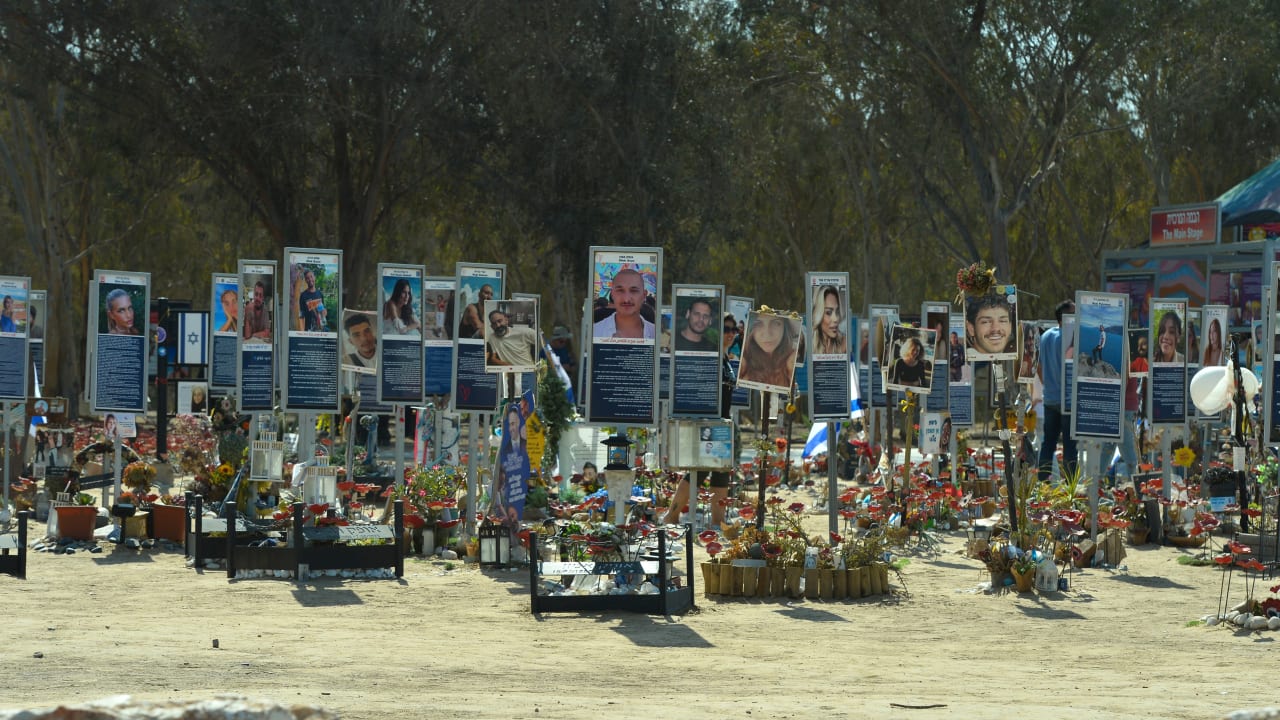
The Prime Minister’s Office decided to remove the word “massacre” from the title of a bill establishing a national day of commemoration for October 7, 2023.
The title should use the more neutral terms “events” and “incidents,” the office explained, arguing that “it wasn’t only a massacre,” that the word still appears in the body of the bill, and that “remembrance builds resilience,” adding that the “1929 events” are commonly described in a similar fashion.
Hila Abir, the sister of Lotan Abir, who was murdered at the Supernova music festival, expressed outrage over the decision.
“Where is the death of our brothers and our children? You are erasing it,” she said.
“This law will pass over my dead body,” she added.

“It doesn’t make sense for the Prime Minister’s Office to manage the event while it prevents investigation into the attacks,” Abir said.
The Jerusalem Post sees this as more than a semantic adjustment. We see it is a colossal failure.
The October 7 terrorist attack was the largest massacre of Jews since the Holocaust. Avoiding that word blurs the truth and diminishes the memory of those who were murdered.
What happened in the communities surrounding Gaza on October 7, 2023, was a coordinated, premeditated slaughter of civilians in their homes and at a music festival. Entire families were executed. Children and elderly people were shot at close range. More Jews were killed that day than on any single day since 1945.
Calling it anything less than a massacre distorts the historical record. Full stop.
Not an event, not an incident - a massacre
An “event” is a wedding. An “incident” is making a small mistake. October 7 was neither. It was a massacre by any accepted definition.

Many “events” were taking place simultaneously during World War II, yet no one would dare to refer to the Babyn Yar massacre as the “incident that happened in the woods somewhere.”
To put this into perspective, in 2019, US Rep. Ilhan Omar sparked bipartisan backlash after referring to the September 11, 2001, terrorist attacks during a speech about civil liberties. “CAIR was founded after 9/11, because they recognized that some people did something, and that all of us were starting to lose access to our civil liberties,” she said.
Critics argued that describing coordinated terrorist attacks that killed nearly 3,000 people as “some people did something” erased both perpetrators and victims.
Whatever one thinks of Omar or her politics, the controversy emphasized a simple truth: Atrocities demand precise words. When language becomes a soft landing, reality becomes easier to evade.
Substituting with neutral language, such as “events” or “incidents,” does not promote the historic accuracy of what took place on that day.
This lesson is a recurring one, and it is one that Israel itself is usually very vocal about.
Israel has long insisted that the Holocaust be described clearly, with Jews identified as its primary victims and Nazis as its perpetrators. We do not press for that focus out of pedantry, but rather because ambiguity is where denial grows.
Holocaust denial did not emerge overnight. It grew through years of minimization and the steady sanding down of facts into something contestable. Today, we already see Holocaust denial, and we already see October 7 denial too – claims that the slaughter was exaggerated, fabricated, or misrepresented.
Language is dramatically important
In that environment, the official Israeli language is dramatically important. If Israel minimizes this massacre, so will those who have already claimed that it wasn’t that dramatic. It may also affect those who were on the fence, without clear opinions on the matter.
This newspaper recently applied that same principle in criticizing US Vice President JD Vance for omitting the words “Jew” and “Nazi” in a Holocaust Remembrance Day message. The point was not partisan. If Jews worldwide hold everyone else to this standard, we should apply this to our own government.
Removing the word “massacre” from legislation that enshrines national remembrance signals hesitation at the very moment coherence is most needed.
Some may argue that broader terminology avoids inflaming tensions or keeps commemorations focused on unity. But the victims of October 7 were not killed in an abstract “event.” They were murdered in a targeted massacre that included rape, torture, kidnapping, and the deliberate slaughter of civilians.
Precision should reinforce resilience. A nation honors its dead by naming it plainly as it is: a massacre.