The Jewish internet lost its collective mind over Robert Kraft's "Sticky Note" Super Bowl ad. A scrawny Jewish kid. A "Dirty Jew" Post-it. A tall Black classmate named Bilal steps in to cover the slur with a blue square. Cue the outrage.
Tablet Magazine called it the worst Super Bowl ad in history. The Free Press said it made antisemitism harder to take seriously. Shabbos Kestenbaum wrote an open letter to Kraft, calling his staff "morons." Liel Leibovitz suggested the $15 million would have been better spent on footage of exploding beepers and hot Israeli girls with guns. The IDF even released a counter-video during Super Bowl weekend — muscular soldiers set to Bad Bunny — as if to say: this is what Jewish strength looks like.
And I get it. I run an organization that trains Jewish teens to stand tall, speak clearly, and fight back with knowledge and confidence. So yes — as a Jew watching the ad, I cringed. The sticky note felt like a relic from a 1990s after-school special. Today's antisemitism doesn't arrive on a Post-it; it arrives as "genocide enabler," "Zio," and "Free Palestine" screamed in your face on a college quad. Our teens aren't quietly targeted in hallways — they're publicly attacked in classrooms, on social media, and by their own professors.
But here's the thing we keep forgetting: we are not the audience.
When we stopped being the center of the universe
I did something the Jewish commentariat apparently didn't think to do. I asked my non-Jewish friends and neighbors to watch the ad.
Their reactions were remarkably consistent: "Oh — now I understand more about what you do, Masha." "I had no idea this was such a problem." "That's really happening to kids?"
These are good, decent people. Educated. Engaged citizens. And antisemitism simply wasn't on their radar. Not because they don't care, but because nobody had ever put it in front of them in a language they could understand.
This is exactly what the data shows. Blue Square Alliance's research found that over 100 million Americans are "unengaged" on antisemitism — they don't see it as a significant problem, don't see it as their problem to solve, and don't believe they can have an impact. Nearly half of Americans don't personally know any Jewish people, or don't realize that they do. Only 15% say they're even familiar with recent antisemitic incidents.
The ADL ran an independent randomized experiment with about 1,000 viewers: after watching the ad, respondents were 8 percentage points more likely to view antisemitism as a serious problem and significantly more likely to say they'd speak up if they witnessed it. Blue Square's own testing showed that unengaged viewers became 41% more likely to see antisemitism as a major issue and 27% more likely to say they would intervene.
The ad was never designed to make Jews feel powerful. It was designed to make non-Jews feel responsible. And on that metric — the only metric that matters for a Super Bowl audience of 100+ million — it worked.
Could it have been better? Of course.
Let's be honest about the ad's shortcomings without pretending those shortcomings invalidate the entire effort.
The hallway scenario is dated. The physical sticky note doesn't reflect the digital reality where most teens encounter hate today. The Jewish kid could have been shown with more backbone — and in the longer, 60-second version available online, he actually balls his fists and prepares to confront his bullies before his friend redirects him. That nuance mattered, and it was cut for the 30-second broadcast version. The portrayal leans heavily on victimhood in a moment when many Jews are hungry for images of strength.
All fair criticisms. But here we are. A Jewish billionaire spent $15 million of his own money to put antisemitism in front of the largest television audience in American history. He did it for the third year in a row. Nobody else is doing that. The critics savaging the ad from their keyboards are welcome to raise their own $15 million and produce a spot that NBC will approve for broadcast during the Super Bowl. I suspect they'll discover that images of exploding beepers don't pass the network standards department.
So let us stop with the attacks.
The real problem: "Stand Up to Jewish hate"
Where I part ways with Kraft's operation is not in the ad itself, but in something far more consequential: the messaging infrastructure.
The slogan "Stand Up to Jewish Hate" has been a liability since its inception. It is routinely read — by exactly the kind of unengaged Americans the campaign is trying to reach — as a call to stand up against hate committed by Jews, not hate directed at Jews. Avi Mayer, the former editor of the Jerusalem Post, publicly noted the confusion. It's a branding problem that has undermined the campaign's own goals: when your target audience misunderstands your tagline, the message never lands.
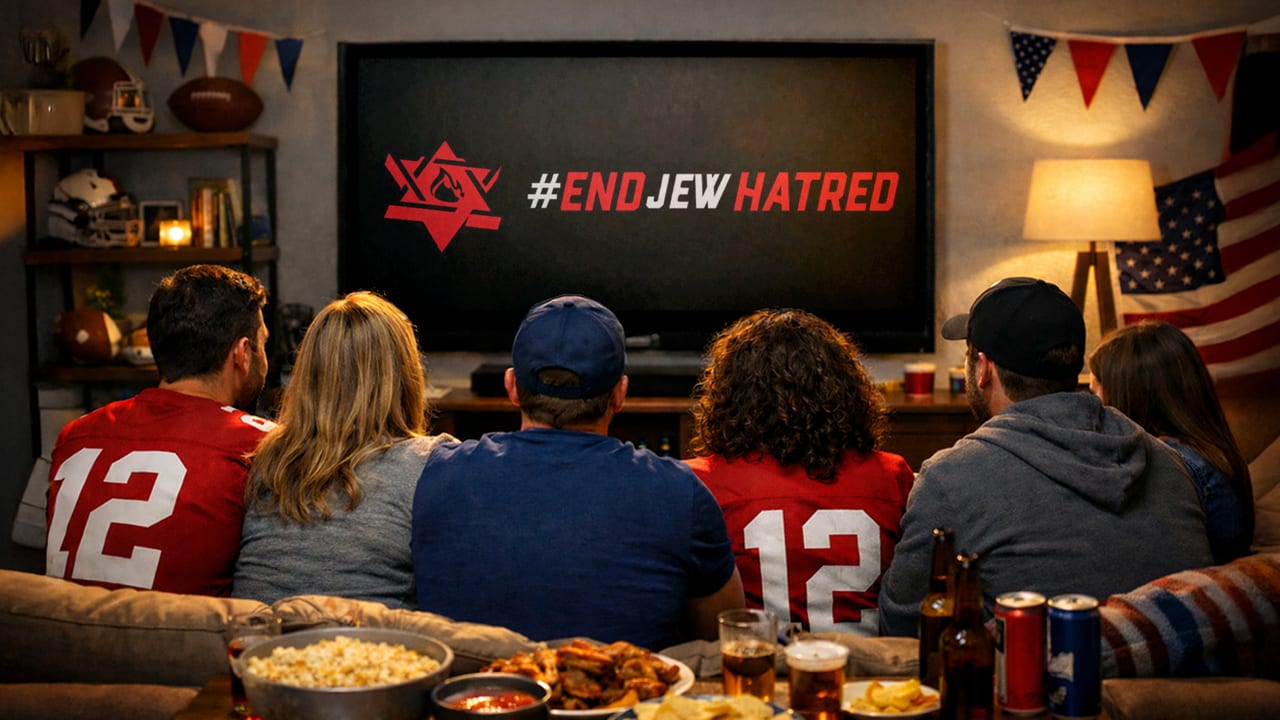
Here's what's maddening about this: there is already a clear, unambiguous phrase that the grassroots Jewish community has been using for years. "End Jew Hatred." Three words. No confusion about who is hating whom. The End Jew Hatred movement, founded in 2020, has secured official proclamations from dozens of elected officials and organized rallies across the country. The terminology has been adopted by activists on the ground who do this work every day.
Why create a whole new slogan — one that confuses people — when an existing one already works? Why not row in the same direction as the rest of us who are on the ground, fighting the fight?
The deeper pattern: when good intentions get lost in infrastructure
This brings me to something everyone in the Jewish nonprofit world knows, but no one says out loud — because you don't bite the hand that might fund you. So let me be the one to say it.
Robert Kraft is a good man. He cares about the Jewish people, and he's put his money where his mouth is in a way that very few others have. I am grateful for his desire to address the problem. But his approach follows a pattern familiar across Jewish philanthropy: when you have the resources to build, the instinct is to build — even when the smarter investment might be in what already exists.
So instead of surveying the landscape, identifying the grassroots organizations already producing results, and writing checks to scale their impact, the staff built a new organization. They created a new brand. They designed a new logo, a new slogan, and a new campaign. They spent millions on focus groups and testing. They rebranded from the Foundation to Combat Antisemitism to the Blue Square Alliance Against Hate. They produced ads. They hired more people. The operation grew.
This is the cycle I see repeated across Jewish philanthropy: a wealthy donor wants to make a difference. They hire staff. The staff creates programs and campaigns. Those programs and campaigns may or may not address the actual problem, but they take on a life of their own, consuming resources that could have gone directly to impact. Meanwhile, the people actually doing this work on the ground are overlooked. Here's a radical idea: before building the next campaign, ask them. Not the foundation staff you see at the same elite conferences and convenings — but the educators and organizers who do this day in and day out because they cannot not do it. They know what works.
The question isn't whether Kraft's heart is in the right place. It is. The question is whether $15 million spent on a 30-second ad produces more impact than $15 million invested in the organizations already doing the work: training teens who can articulate their identity with confidence, educating young Jews who transform their school environments rather than hide from them, and building the pipeline of leaders who show up on college campuses already prepared for the fight.
The ADL's testing showed that 8% more people now believe antisemitism is a serious problem after seeing the ad. That's something. But what happens after they believe it? Where do they go? What do they do? There is no infrastructure waiting for them — because the infrastructure money went to ad production, not to the organizations that could actually channel that awareness into action.
A final word
To the Jewish critics who savaged the ad: you made some valid points, and then you kept going. Some of you let the criticism get personal. Some of you were more interested in performing your own sophistication than in honestly evaluating whether the ad accomplished its stated goal with its intended audience. It did.
To Robert Kraft: thank you. Genuinely. You are one of the very few people with both the resources and the willingness to put this issue on a national stage. But your team would benefit from getting out of the offices, the conference rooms, and the convenings — and into the communities where this fight is actually playing out. They'd see that the slogan confuses people, that the grassroots already has language that works, and that the greatest return on your investment isn't another campaign — it's funding the people who are already producing the results your campaigns are trying to inspire.
The ad reached 100 million Americans and told them antisemitism is real. That matters. Now the question is whether the Jewish philanthropic world will invest in what comes next — or whether it will spend another $15 million next year telling them again.
Masha Merkulova is the CEO of Club Z, a Jewish youth leadership organization that trains teens to advocate for themselves and their community with knowledge, confidence, and clarity.
This op-ed is published in partnership with a coalition of organizations that fight antisemitism across the world. Read the previous article by Nigel Goodrich.