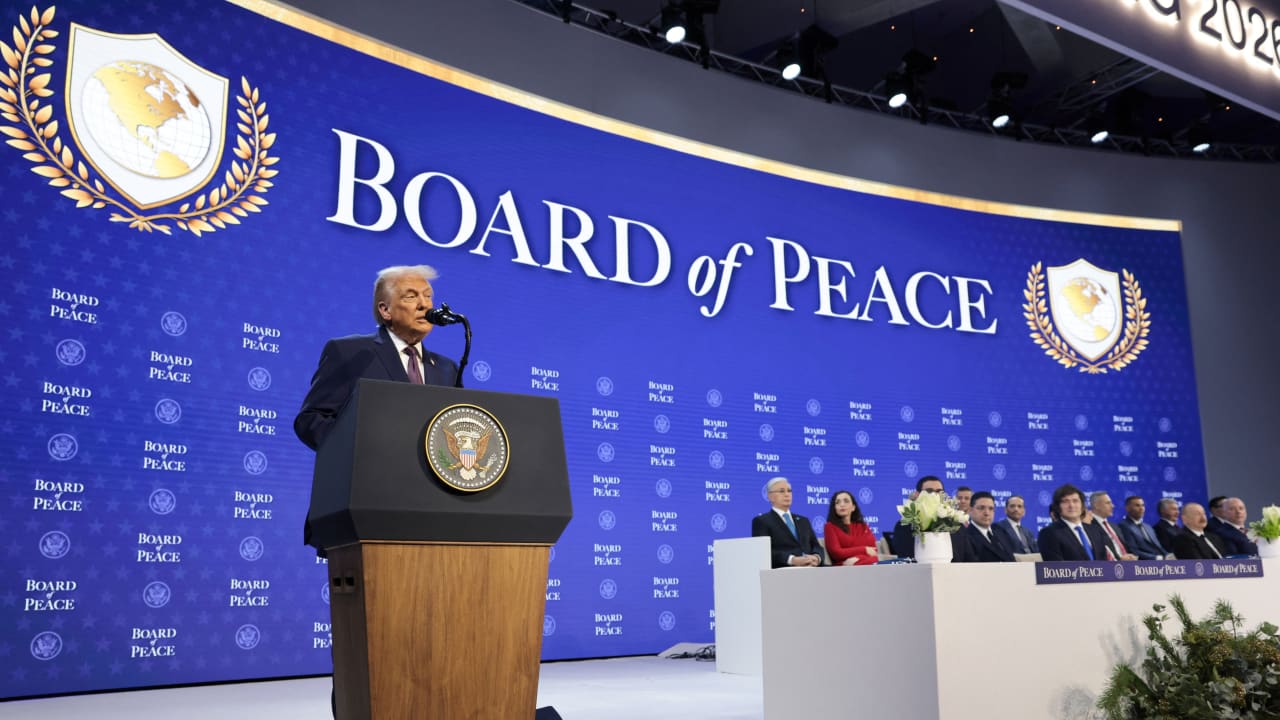
In the final analysis, Donald J. Trump’s “Board of Peace” will not benefit Israel. Among other things, this is because the American president’s cobbled-together peace plan is oriented only to superficial remediation. In essence, Trump’s “Board” deals with symptoms of the terrorism “disease,” but ignores critical root causes.
Terrorism is never comparable to a real-estate problem. It is not made solvable by alleged personal relationships or money-centered “deals.” Though not understood by Trump, jihad terror groups have loftier goals than transforming devastated habitats into luxury beach resorts. These insurgent adversaries, both Sunni and Shi'ite, focus more determinedly on transcendent goals than tactical advantages. To the main point, the ultimate goal of jihadi groups is neither territorial nor financial, but “power over death.”
There are many pertinent clarifications. Jihadi orientations to terror-violence are continuously configuring and re-configuring; nonetheless, all jihadi terror-organizations have much the same overarching objective. Though preposterous prima facie, this objective is personal immortality acquired via the violent “sacrifice” of “unbelievers.”
In every geographic domain of faith-based mystifications, there arise various catastrophic explosions of anti-reason. Still facing seductive jihadi ideologies that promise eternality to “the faithful,” Israel needs to remain wary of projecting only ordinary political and economic preferences onto its jihadi foes. This is not meant to suggest any uniform Islamist irrationality, but only to underscore that loudly-proclaimed secular preferences (e.g., “Palestinian self-determination”) are generally just secondary goals.
For the most part, projections of rationality on enemy decision-making processes make good sense. But there are enough significant exceptions here to temper any hope-based generalizations. To wit, if Israel’s national leaders were to appraise current jihadi terrorist organizations (Sunni and Shi'ite) from a refined analytic standpoint – one that would acknowledge the impact of “power over death” – the nexus between “martyrdom operations” and “life-everlasting” could be acknowledged.

Jerusalem national security planners could place themselves in a better position to deter Islamist murderers, hostage-takers, and suicide-bombers. Under pertinent international law, such outlaws are known as hostes humani generis or “common enemies of mankind.” They include both individual terror-criminals and state terror-patrons.
There is more. Jihadi insurgents seeking to justify murderous attacks on Israeli noncombatants act in contravention of international law. In law, all law, rights can never stem from wrongs.
Whatever the cause, violence becomes terror-criminality whenever insurgents intentionally kill or maim noncombatants. Under the law, it is irrelevant whether the cause of terror-violence is just or unjust. By definition, any intentional use of political violence against noncombatants is an egregious crime.
Contrived rejection of legal authority
In law, unjust means, even on behalf of allegedly just ends, are impermissible. One oft-favored jihadi mantra (“by any means necessary”) is nothing more than a contrived rejection of legal authority. At best, it is an empty witticism. Recalling Hague Convention No. IV, which codifies pre-existing customary international law, “The right of belligerents to adopt means of injuring the enemy is not unlimited.”
On occasion, martyrdom-seeking jihadi terrorists advance a supposedly legal argument known as tu quoque. This already discredited argument stipulates that because the “other side” is guilty of similar, equivalent or greater criminality, “our” side is innocent. Jurisprudentially, such an argument is always wrong and always invalid. This is especially apparent following the post-war legal judgments of the Nuremberg and Tokyo international tribunals.
In Israel's no-choice war against assorted jihadists, the death and injury of noncombatants generally remain the legal responsibility of “perfidious” enemies. Because these adversaries place terror-fighters in protected places (e.g., schools, hospitals, mosques), such locations are no longer off-limits to defensive military actions by Israel. For any state, enemy use of “human shields” is always exculpatory for the unintended consequences of one’s own defensive operations. A closely related and reinforcing legal principle is called “military necessity.”
Though Israel’s bombardments of Gaza produced numerous Palestinian casualties, legal responsibility for these harms lay with the Jewish state’s “perfidious” foes. While Israel-inflicted Palestinian casualties were inadvertent and unintentional, Israel-suffered civilian deaths and injuries were the result of intentionally indiscriminate jihadi terror. In legal terms, only the Palestinian side displayed mens rea or “criminal intent.”
There is more. Insurgent movements that fail to meet the test of “just means” can never be considered lawful. Even if relevant law could accept the argument that designated terror groups fulfilled all valid criteria of “national liberation,” these groups would not satisfy the equally important expectations of distinction, proportionality, and military necessity.
Historically, these critical standards of humanitarian international law have been applied to insurgent or armed sub-state organizations by the common Article 3 of the four Geneva Conventions of 1949 and by the two 1977 Protocols to these conventions. Moreover, for the state defending itself against terror-crimes, “proportionality” does not mean an equivalent or symmetrical level of armed force, but rather a level required for indispensable military remedies.
Standards of “humanity” remain binding on all combatants by virtue of customary and conventional international law, including Article 1 of the Preamble to the Fourth Hague Convention of 1907. This rule, called the “Martens Clause,” makes “all persons” responsible for the “laws of humanity” and “dictates of public conscience.” There can be no allowable exceptions to this universal responsibility, except in cases where enemy perfidy would endanger a state’s right to self-preservation.
There is one final point to make about Israel and its jihadi foes. Whatever form of military power US President Donald Trump might use against Iran, it will have little if any effect on terrorist enemies of Israel. In this case, a
“Board of Peace” failure to understand vital linkages between jihadi terror-violence and adversarial promises of immortality could strengthen Tehran’s war-making capacities.
Moreover, even while remaining non-nuclear, the Islamic Republic could act militarily against Israel as a jihadi terrorist writ large. In that Trump-ignored scenario, simultaneous state and sub-state jihadi attacks against Israel could be force-multiplying and unprecedented.
The author is an emeritus professor of international law at Purdue University and has written many major books and articles dealing with war, terrorism, and international law.