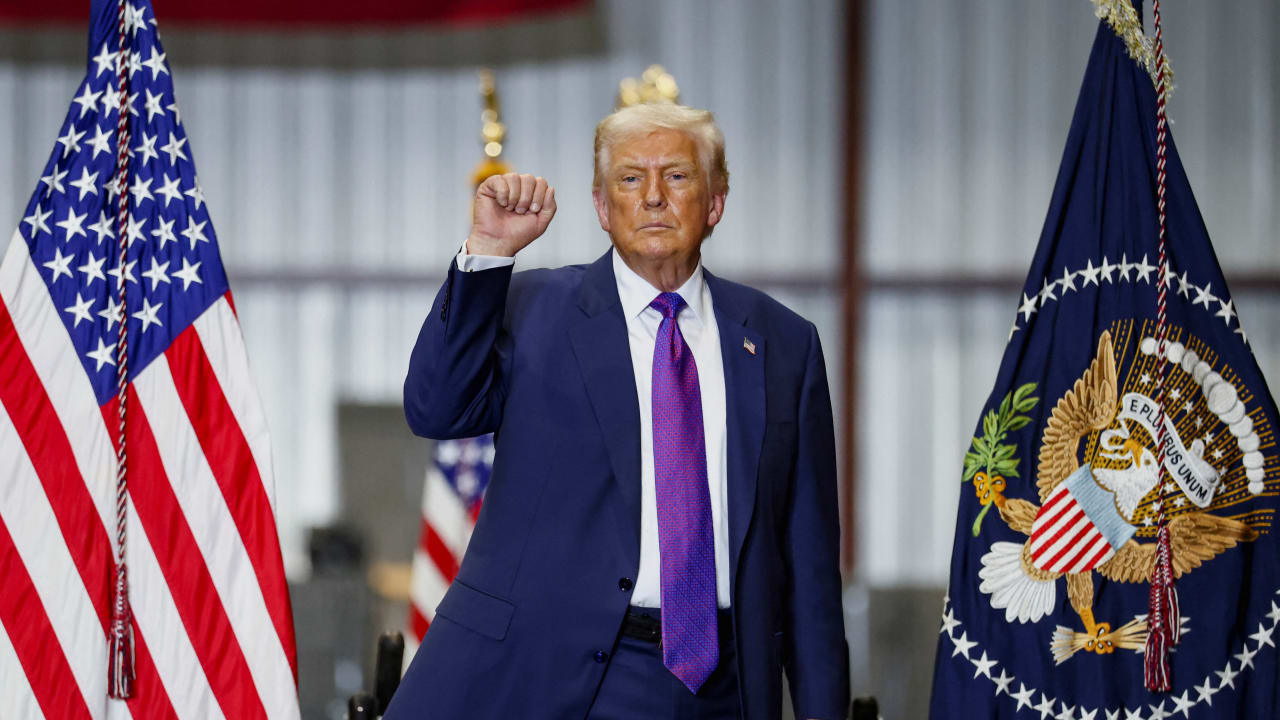
On January 27, US President Donald Trump declared on his Truth Social media platform that Iraq would be making a “disastrous mistake” if Nouri al-Maliki was reinstalled as prime minister. He argued that “last time Maliki was in power, the country descended into poverty and total chaos” and that this “should not be allowed to happen again.”
Trump, typically riding roughshod over accepted practice, was openly seeking to influence the election of Iraq’s future prime minister. To whom was he offering his advice?
Iraq’s constitution specifies that following parliamentary elections, the parliament – known as the Council of Representatives – elects the president of the republic. Within 15 days of being elected, the president appoints as prime minister-designate the candidate nominated by the parliamentary bloc with the largest number of seats. The prime minister-designate then has 30 days to propose a cabinet and present it to parliament. He becomes prime minister only if parliament grants him and his government a vote of confidence.
Trump was therefore speaking directly to the 329 parliamentarians elected to the Council of Representatives in the poll held on November 11, and especially to the Shia parties, which took nearly 200 seats in those elections and form the majority bloc that will nominate the prime minister-designate.
Since the elections were held in November and the prime minister is not yet in post, the constitutional timetable has clearly slipped. But the blockage is further up the line. Parliament has not yet been able to elect a president. The Kurdistan Democratic Party (KDP) and Patriotic Union of Kurdistan (PUK) have repeatedly failed to agree on a consensus Kurdish candidate for the presidency (a post traditionally held by a Kurd), and they have formally asked for more time.
Assuming the logjam is eventually cleared, Trump has warned Iraq’s parliamentarians that if Maliki were to be elected prime minister, the US will no longer help the nation, “and without our support, Iraq has zero chance of success, prosperity, or freedom.” American officials believe that Maliki is too closely aligned with the Iranian regime, and regard his possible return as an attempt to bolster Iran’s Shi’ite Crescent in the Middle East.

Maliki and his allies have, of course, condemned Trump’s comments as unwarranted American interference in Iraq’s internal political process. Maliki was indeed proposed in January as a candidate for prime minister by the Shia Coordination Framework and allied lists.
His election is not a foregone conclusion, though. Some Shia figures (for example, leading Iraqi cleric and politician Ammar al-Hakim) have not endorsed his nomination, while parts of the Sunni and Kurdish camps are openly opposed to him. These negative factors, allied to Trump’s warning, might be sufficient to swing majority opinion against him, so at the moment it is uncertain whether his nomination will survive the government-formation bargaining.
A return to power by Maliki would not, on the evidence, augur well for Iraq.
From 2006 to 2014, he served two four-year terms as Iraq’s prime minister. His performance over that period is generally considered to have deeply damaged the country’s stability, institutions, and social cohesion.
Maliki’s second tenure in office, from 2010-2014, in particular, was marked by internal instability and increasing authoritarianism. He began accumulating power in his own hands. By personally holding a number of key security and economic portfolios, he was able to evade scrutiny. He was also widely criticized for using security forces and state institutions to support his political allies, marginalizing and antagonizing many Sunni and some Kurdish groups.
Inability to combat ISIS forces
His fall from power resulted from his inability to combat the forces of ISIS and its allied militias as they overran Iraqi army units and, as government forces withdrew in disarray, seized control first of Fallujah and then of Nineveh and surrounding areas.
On June 10, 2014, Mosul, Iraq’s second city, fell after large numbers of Iraqi troops abandoned their positions – around 1,500 ISIS fighters routed an estimated 60,000 government soldiers and police, leaving vast stocks of weapons and equipment in the jihadist group’s hands.
The same offensive saw ISIS and allied insurgents seize Tikrit and other towns along the Tigris corridor, while Iraq simultaneously lost control of border crossings with Syria and Jordan.
These catastrophic defeats at the hands of ISIS were unsustainable politically, and on August 14, 2014, Maliki was pressured to resign.
According to Iraqi and international reports, his years in power saw politically sanctioned corruption flourish. Human rights groups and policy institutes link his period in office to dishonest practices such as ghost soldiers on payrolls and fictitious contracts.
In a speech to the Iraqi parliament reported on October 28, 2015, Iraq’s Commission of Integrity spokesman Adil Nouri claimed that roughly half of reconstruction funds and a similar share of oil revenues – some hundreds of billions of dollars – had, in effect, been stolen. He said explicitly that the money went missing “during the eight-year period of office of former prime minister Nouri Maliki,” noting that Iraq’s oil income “between 2006 and 2014 alone was only $822 billion.” The presumption is that it should have been double that.
While Maliki initially pledged to reconcile Sunnis and Shiites, his later approach relied heavily on Shia-dominated security forces and militias, deepening Sunni grievances. His crackdown on Sunni protest movements in 2012–2013, and his dictatorial style, helped foster the unstable internal situation that led to the collapse of Iraqi army units in 2014, enabling ISIS’s rapid expansion.
Maliki publicly emphasizes Iraqi sovereignty but, especially worrying in present circumstances, he maintains a very close relationship with the Iranian regime. “Since leaving office,” the trustworthy policy forum Chatham House notes, “Maliki has kept close relations with Iran.” Tehran backed his return as a prime-ministerial candidate in 2026, it says, because it sees him as a “trusted figure” who can impose order on Iraq’s fragmented security landscape. Moreover, Iraq “serves as a critical security buffer closely entwined with Iran’s own domestic stability.”
Given Maliki’s record in office, his close Shi'ite connections, and his strong association with the Iranian regime, Trump’s opposition to his return to power makes sense. Will Maliki succeed in out-maneuvering him?
The writer, a former senior civil servant, is the Middle East correspondent for Eurasia Review. Follow him at: www.a-mid-east-journal.blogspot.com