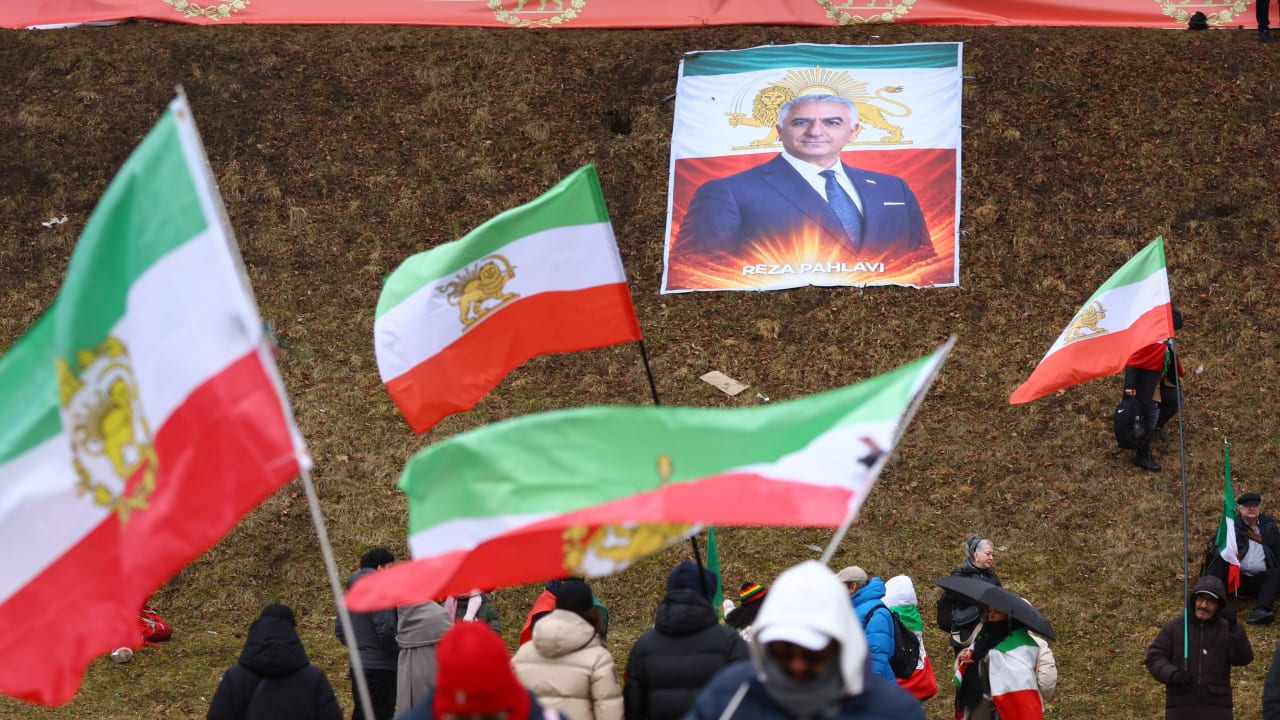
Israel and America have brought happiness to Iran. The death of Ali Khamenei and his commanders is a devastating punch to the regime’s foundation. But the regime hasn’t been overthrown yet. The final battle is still to come. Some people wonder if there’s a plan for transition.
Opposition leaders of despotic regimes speak in general vague terms about freedom and equality. A risky business, because no one knows exactly what those opposition leaders are planning to do.
Nelson Mandela had no plan for a transition period. No one knew exactly what Mandela wanted to do. Even Mandela himself did not know. He discovered this in consultation with the apartheid regime. It was the apartheid government that invited him to work together to make a transition possible. Mandela negotiated in freedom with all parties for a provisional constitution. This led to the peaceful abolition of the apartheid regime.
Saddam Hussein’s Iraqi opposition had no plan for the transition period. It turned into chaos. Prince Reza Pahlavi, as the opposition leader of Iran, has presented a defined and detailed roadmap (Emergency Phase Booklet, Iran Prosperity Project) for the transition. This is unique.
Reza Pahlavi's roadmap for Iran
Six months ago, Pahlavi presented a draft version of a roadmap (Emergency Phase Booklet) for the transition period. This triggered a public debate in Iran and beyond about those plans. Do you know of any opposition leader who asks the people for their opinion in a detailed plan for transition? I don’t.

All constructive criticism and proposals were then discussed and incorporated into the final version. Dissident movements such as 7-Aban Front were also invited to express their opinions in writing, and 7-Aban did so. I was asked to collaborate as an adviser on the constitutional aspects of the transition. The final version was presented by Pahlavi this week.
After the fall of the regime, the executive body led by Pahlavi will become the provisional government. So, before the fall of the regime, there is already an executive body. The provisional government is responsible for creating conditions for security, foreign policy, and organizing referendums and elections. In short, the provisional government ensures the proper functioning of the state.
The IRGC will be dissolved as an organization. The non-oppressive divisions will be incorporated into the Iranian national army. The National Guard, which is to be established, will ensure security during the transition. It will then be part of the Iranian army. It will be a kind of gendarmerie. The ayatollahs’ nuclear project will be dismantled under the supervision of international organizations.
The provisional government will immediately restore diplomatic ties with Israel and America. Talks will also be held with Arab countries and neighboring countries to establish friendly relations. With the abolition of the IRGC, all ties with the ayatollahs’ proxies and criminal organizations will be terminated.
Statement of principles for Iran's future
There is also an advisory council that functions as a provisional parliament after the fall of the regime. Four months after the fall of the regime, a referendum will be held to determine whether the state will be a monarchy or a republic. In order to safeguard the democratic values shared by both systems of government, the following statement will be included on both the ballot for a parliamentary monarchy and for a republic:
“Regardless of the nation’s choice (parliamentary monarchy or republic), the following seven principles shall be immutable foundations of Iran’s future legal system and shall remain enshrined and inviolable in the new Constitution and all laws of the country:
• The territorial integrity of Iran and the unity of the Iranian nation;
• Human dignity and fundamental individual rights and freedoms, inspired by the Cyrus Cylinder and grounded in the Universal Declaration of Human Rights (1948);
• Democracy through free, fair, and periodic elections, based on the principle of ‘one citizen, one vote’;
• The rule of law;
• The complete separation of religion from the state (secularism);
• The separation of powers; and
• The independence and impartiality of the Divan (the judiciary).”
This is a moving passage, written by victims of a totalitarian regime. This beautiful eternity clause goes far beyond that of the post-war German constitution. Citizenship, regardless of religion or political beliefs, gender or ethnic origin, assumes a central position in the legal and political future of Iran.
At the same time, the future constitution will include a security wall against Islamists, Marxists, antisemites, fascists, and other enemies of democracy. It is not a guardrail but a Chinese wall in the future constitution of Iran.
Two months after voters determined the form of government in a referendum, elections were to be held for the constitutional assembly. Once the constitutional assembly has drafted the constitution, it is submitted to the Iranian people in a referendum. Once it has been approved by the people, elections will be held for parliament, marking the end of the transition period.
Those who are not afraid of the ballot box should see this roadmap as a fantastic path to a better future. Pahlavi dared to explain exactly what he intends to do in 156 pages. Meanwhile, the last stronghold of Marxism and Islamic fundamentalism has also fallen. The Iranian students did indeed reject the traditional Left (anti-capitalism, anti-Americanism, antisemitism, anti-Western sentiments).
Last week, despite the regime’s mass slaughter of the population, students took to the streets to demonstrate against the regime. They chanted: “Javid Shah [Long live the king],” and “This is the final battle, Pahlavi will return.” It all started in the 1960s in Western universities. They infected Iranian universities with Marxist leftist beliefs. There, slogans such as “Death to Shah, death to America, and death to Israel” were commonplace. Now, they say on campus: “Javid Shah; death to Khamenei; neither Gaza nor Lebanon; my life for Iran.”
Pahlavi’s realistic democratic roadmap (Emergency Phase Booklet) deserves the support of Western countries and Israel. Not the Islamic Republic, but Iran must rise from its ashes.
The writer is professor of jurisprudence (legal theory and legal philosophy) at the Faculty of Law, Leiden University.