
Eighty years ago, as the spring of 1946 arrived across a shattered Europe still drenched in blood, the Jewish people prepared to celebrate Passover under circumstances almost beyond human comprehension.
World War II had ended less than a year earlier. The crematoria had gone silent, and the concentration camps had been liberated. But for the survivors – the shattered remnants of European Jewry – freedom was still fragile, uncertain, and deeply scarred.
And yet, when the night of the Seder arrived, the first since their liberation, they did something extraordinary. They sat down to recount the story of the Exodus.
It was, in every sense, an act of defiance.
Across displaced persons (DP) camps in Germany, Austria, and Italy, tens of thousands of Holocaust survivors gathered around makeshift Seder tables. Many had lost entire families. Entire worlds had vanished. Still, they chose to celebrate.
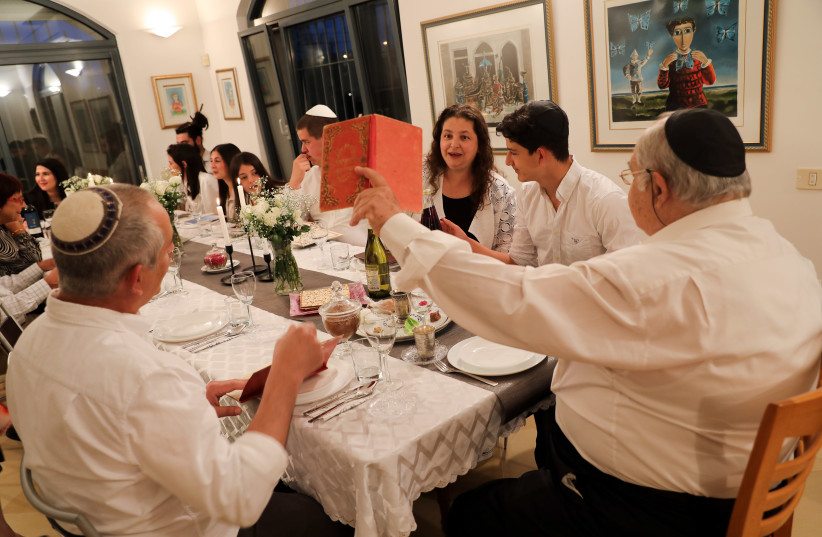
Among the most remarkable of these Seders was the one led by Rabbi Yekusiel Yehuda Halberstam, the Klausenberger Rebbe, in the Feldafing DP camp located 20 miles (32 km.) southwest of Munich. Having lost his wife and 11 children to the Nazis, the Rebbe had survived Auschwitz and Dachau, yet emerged determined to rebuild.
Food was scarce and supplies were minimal. But he insisted on dignity – on matzah, on wine, on ritual, and on meaning.
When those gathered recited “In every generation, a person is obligated to see himself as though he personally left Egypt,” the words were no longer metaphorical. Those seated around the Seder table that night had emerged from a modern-day house of bondage whose cruelty exceeded even that of Pharaoh.
The story of Passover 1946 extends further, into the haunting and heroic efforts of an American army chaplain who would become known as the “Survivors’ Rabbi.”
When Abraham Klausner, the Reform Jewish chaplain for the US Third Army, first entered Dachau shortly after liberation, he was overwhelmed. The stench, the skeletal figures, the degradation – it seemed impossible to comprehend.
But then came a voice. A survivor, frail and weeping, approached him with a simple question: “Do you know my brother?”
In that moment, Klausner understood his mission.
He would reconnect the fragments of a shattered people. He would restore names, identities, and hope. He would become, in time, a father figure to tens of thousands of survivors in and around Dachau.
Seder night more than a ritual
As Passover 1946 approached, he recognized that the Seder would be more than a ritual. It would be a moment of national resurrection.
On the evenings of April 15 and 16, 1946, hundreds of survivors and American soldiers gathered in Munich for a Seder unlike any other in Jewish history.
The setting itself was laden with symbolism: an elegant dining hall that had once hosted Nazi elites was now filled with Jewish survivors reclaiming their dignity. Tables were covered with white cloths. Wine bottles stood ready.
Flowers adorned the room. For a few brief hours, those who had been treated as less than human were restored to their full humanity.
But beneath the surface, the pain was overwhelming.
When the moment came for the “Ma Nishtana?” – the Four Questions – one survivor later recalled the most painful truth of all: There were no children to ask them. The Germans had murdered them.
The absence was deafening.
And so, A Survivors’ Haggadah, written by Holocaust survivors themselves, was used. It transformed the ancient narrative into something immediate and raw.
“We were slaves to Hitler in Germany,” it declared. Pharaoh became Hitler. Egypt became the camps. Redemption, though begun, was incomplete.
Even the familiar “Dayenu” was recast in haunting terms, listing not miracles but horrors, such as ghettos, gas chambers, crematoria. It was a chilling text, bordering perhaps on blasphemy, but it gave voice to those present to protest the enormity of what had been lost. And in any event, who are we to judge those who went through the camps? Despite it all, they continued.
Elsewhere, numerous Passover Seders were held. In Bergen-Belsen and across the DP camps, survivors gathered in the very places where death had reigned, transforming them into spaces of renewal.
Photographs from that time capture hollow faces etched with grief, yet illuminated by quiet determination. In some camps, banners proclaimed “Am Yisrael chai” – the people of Israel lives.
It was more than a slogan. It was a declaration of survival.
The Passover of 1946 was not merely a commemoration of the Exodus from Egypt. It was a reaffirmation of Jewish continuity in the face of annihilation. It was proof that even after the Holocaust, the Jewish spirit remained unbroken.
Eighty years later, as we celebrate Passover, it is difficult to fully grasp what those survivors accomplished.
We live in a transformed world. The State of Israel has been reborn, with Jerusalem at its heart. Jewish communities flourish across the globe. Jewish life, though challenged, is vibrant and resilient.
And yet, the echoes of 1946 still resonate. For even today, the Jewish people faces threats, both old and new.
Antisemitism is once again on the rise. Israel confronts enemies who openly call for its destruction.
It is precisely for this reason that the legacy of that first post-Holocaust Passover remains so profoundly relevant.
The survivors of 1946 did not wait for ideal conditions. They did not say, “Let us rebuild first, and only then celebrate.” They understood that the act of celebrating – of affirming Jewish identity, faith, and continuity – was itself a crucial step in rebuilding.
They chose life. They chose faith. And they chose the future.
The Klausenberger Rebbe would go on to rebuild a world of Torah. Rabbi Abraham Klausner would help tens of thousands rediscover their identities and reconnect with what remained of their families.
But perhaps their greatest legacy was that singular moment: to sit down, amid the ruins, and tell the story of our people’s redemption.
As we mark the 80th anniversary of that extraordinary Passover, we would do well to remember what it teaches.
The survivors of 1946 did more than endure – they reclaimed their past and, in doing so, secured our future. Sitting at those makeshift tables, surrounded by loss, they chose to bind themselves once more to the story of our people.
That choice echoes across the generations. It obligates us not only to remember but also to live as they did – with courage, with faith, and with an unshakable commitment to the destiny of Israel.
The writer served as deputy communications director under Prime Minister Benjamin Netanyahu.