
As Israel and the US head to the polls, perhaps in both countries it’s time to stop asking which side we’re on – and start asking what will bring us together.
I was born and raised in Canada, met my American husband in Israel, spent the first 13 years of our marriage in Toronto, where all five of our children were born, and then moved to the US.
I got my green card, our children received dual citizenship, and I looked forward to becoming an American citizen. I ordered the forms and began studying. But then we moved to the Washington, DC, area, and something changed: I no longer wanted to become American.
Don’t get me wrong. I’m not anti-American. That citizenship is one people risk their lives to obtain. And as a dear friend once told me, “When you’re a Jew, you can never have too many passports.” Her father survived World War II because he had the right one.
As a Jewish educator in Washington, I learned Torah with adults from both sides of the political aisle. Some were staunch Republicans; others were committed Democrats. Whenever an election approached, everyone wanted to know: Who are you voting for?
“I can’t vote,” I would answer. “I’m Canadian.”
I loved being neutral. After all, there are two things you’re not supposed to discuss with friends: politics and religion. Since I spent much of my time discussing religion, avoiding politics was a welcome relief.
My husband, however, strongly wanted me to become an American citizen.
“Why?” I asked. “What does it matter?”
“What if you’re accused of a crime, found guilty, and deported away from the kids and me?”
“Yakov,” I replied incredulously, “what are the chances of that happening?!”
Still, for the sake of shalom bayit, peace in the home, and to make my very patriotic American mother-in-law happy (how often does one get that opportunity?), I gave in. I dug out the citizenship test-preparation books, studied, passed the test, answered questions about whether I was a prostitute or wanted to overthrow the government, and became a bona fide American.
Then came my trip to the Maryland Department of Motor Vehicles to obtain my driver’s license.
“Which political party would you like to register with?” the clerk asked. “Democrat or Republican?”
“I have to choose? Today, at the DMV?”
“That’s how we do it here.”
“And those are my only choices?”
“Well, you can register as an independent.”
“Fine. Put me down for that.”
Growing up in Toronto, I had never needed to declare a party affiliation. But one thing was certain in our family: you voted. No excuses.
Canada has three major political parties, and my parents illustrated the beauty of democracy right on our front lawn. My mother voted for the NDP; my father voted Liberal. Every election, we displayed two different party signs.
Whether it was a municipal, provincial, or federal election, voting was a privilege and a responsibility. I remember after one local election, which included candidates for everything from mayor to school board, comparing notes with my parents and siblings. None of us knew much about the school-board candidates, but it seems we all voted for the one with the Jewish name.
Not exactly a model of informed voting, perhaps – but we showed up!
When our children were old enough to understand politics, we watched presidential debates together, sometimes in our sukkah. We encouraged them to vote as soon as they were eligible. Our family rule was simple: If you don’t vote, you forfeit the right to complain about how things are run.
So vote!
Yet when people asked whom I supported, I sometimes reverted to my old answer: “I’m Canadian.” Technically, I still was. I hadn’t needed to surrender my Canadian citizenship to become American.
But there was another reason for my reluctance. I feared that revealing my political views would cause half my students to stop learning with me. They might dismiss the Torah I taught because they disagreed with my vote. That’s how divisive politics can become: We stop listening to one another and start reducing people to labels.
When asked whether I was left-wing or right-wing, I developed a different answer:
“I’m not Left or Right. I’m up.”
Some of my views might be considered left-wing: I support universal health care and gun control. Others might be considered right-wing, particularly on issues of immigration or support for Israel. I refuse to squeeze my beliefs into a political box. I want to support what I believe is right and good, regardless of which side proposes it.
Keeping the family together
Throughout our years in America, I reminded our children that, as Jews, we must never take our place in any country for granted. Our true home is Israel, and I never abandoned the dream of making aliyah.
Eight years ago, that dream came true. My husband and I moved to Israel, joining two of our young-adult children, with a third following soon afterward.
Remember those two subjects you’re not supposed to discuss with friends – politics and religion?
In Israel, those are the only subjects anyone discusses! Your friends, your neighbors, even your taxi driver want to know: Are you smol (Left) or yamin (Right)?
My answer remains the same: I’m up.
For me, the most urgent issue is sinat chinam – baseless hatred between Jews.
In my experience, Jews in North American communities can disagree fiercely, criticize, gossip, or even undermine one another, but it is not hatred. They can’t afford to hate one another. But the hatred I have witnessed in Israel is beyond words. Whether political or religious, they seem to think they can afford, and have the right, to hate one another.
The destruction of the Second Temple was because of sinat chinam, senseless hatred. Today that lesson should haunt us, as it, more than anything, threatens our very future.
Everyone says they want unity – as long as everyone else votes the same way, practices Judaism the same way, and thinks the same way.
But that isn’t unity. It’s uniformity.
Our goal must be achdut v’lo achidut, unity without uniformity. We don’t need to agree on every policy or religious practice. We do need to recognize and appreciate the humanity, dignity, and goodness of those with whom we disagree. We need to counter sinat chinam with ahava b’kavana – to see what it is to love about the other, even with their mistakes.
There are 340 million Americans who have two dominant political parties. In this election, tiny Israel has 38 choices; likely 11-15 parties will be in the government. Jews have opinions – lots of them. The downside is conflict. The upside is that we care; we care deeply about the issues shaping our lives.
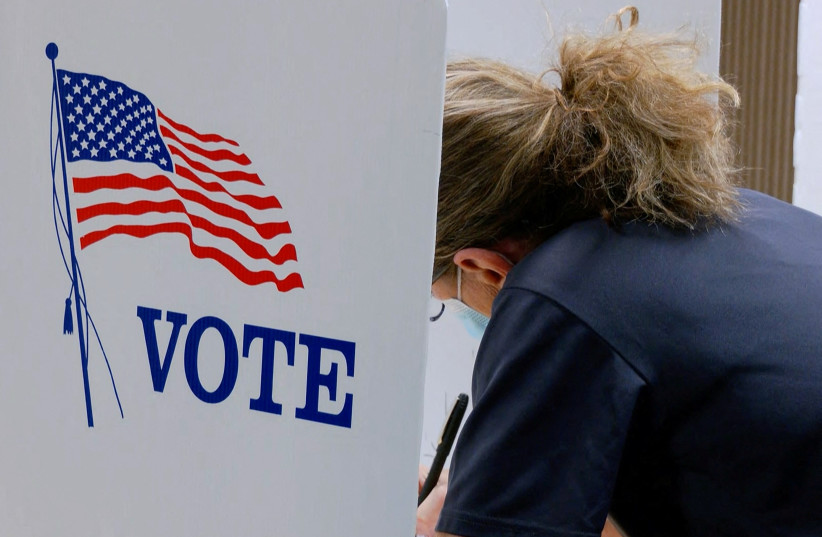
So, as we head to the polls in Israel and America, let’s exercise our democratic privilege. Let’s vote thoughtfully, passionately, and according to our consciences.
But let’s also ask ourselves a more important question: Are we voting to defeat the people on the other side, or to help build a better future?
Religious or secular. Conservative or progressive. We can disagree and still be family. As the UK Chief Rabbi Ephraim Mirvis said, “We may be the smallest nation, but we are the biggest family.”
The challenge is to rise above the labels and keep the family together.
This election season, let’s continue to care – and start looking up.
The writer is the founding director of Momentum and lives in Jerusalem.