
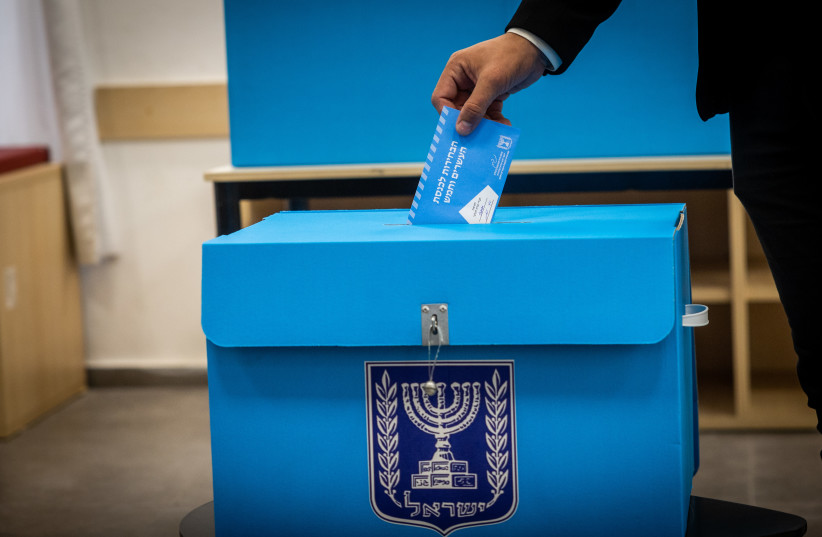
There is not much time left to decide on which party deserves your vote.
Some party leaders have changed over the years – a factor which may play an influential role in your decision.
Some new parties have emerged. Are any of them offering what appeals to you?
With few issues to distinguish one right-wing party from another, which one should right-wing voters choose – and why?
Perhaps it’s easier to decide why not.
Then again, there is the age-old issue of politicians not keeping their campaign promises. The excuse given by the late prime minister Ariel Sharon was “What you see from there is not what you see from here.”
That particular aphorism applies to almost everything. Even a slight change of position presents a different view.
So now we have to think about which campaign promises are most likely to be kept.
Legislation to make national service compulsory for all
The most common promise – Right and Left – is enacting legislation that will make national service, be it military or civilian, compulsory for all.
But a lot will depend on the strength of the ultra-Orthodox parties, which have so far succeeded in blocking such a law.
Then again, the ultra-Orthodox are squabbling among themselves over military service, core education, allowing females with political aspirations into their parties, plus a host of other issues.
Some political parties which initially signify great hope for the future may fall by the wayside sooner than is anticipated. The most recent example is Benny Gantz, who six years ago founded the Blue and White Party, and was considered to be a potential new prime minister.
Over time, his popularity diminished and surveys indicated that he would not pass the election threshold. Gantz doggedly insisted that he would continue campaigning till the end, but just over a week before the elections, he announced that he was stepping out of the race.
Whether this was due to his wife’s illness, or because he did not want to face utter defeat, remains anyone’s guess, but the fact is that he’s no longer running, and that this may change voting dynamics.
Then there was the announcement by long-time Likud loyalist and former minister Tzachi Hanegbi that he will not vote for Likud this time around because of the types of some of its leading members who have distorted the party’s principles. Instead, he will vote for Avigdor Liberman’s Yisrael Beytenu.
Hanegbi is not the only former or current politician to defect from Likud; Dan Illouz is another example.
On the Left side of the political aisle, the Labor Party no longer exists in name. Current leader Yair Golan changed it to the Democrats, but this has not contributed much help toward improving its standing with the general public. Meretz, which might still be around if former Labor Party leader Merav Michaeli had agreed to a merger, is part of the dust of history – and so, for that matter, is Michaeli.
There are a vast number of other parties that once existed and are now no more. Most of these defunct parties were led by highly respected men and women, who had been great achievers in their respective professional fields in the army, and in politics for a time, but could not emulate their professional success – though some did for one or two terms in the Knesset. Some of those who lasted longer had started out with other parties before forming their own or moving to another. However, none had the political stamina of Shimon Peres or Benjamin Netanyahu.
Deciding which party deserves one’s vote is very confusing unless one has a specific reason. One new immigrant who has been to several events in which panelists represented different parties, and has given serious thought to all she heard, is thrilled to be voting in Israel for the first time. In the final analysis, she has no problem deciding for whom to cast her vote. She has grandchildren in the army, so she is voting for the Reservists.