
■ AMERICAN EXPATS in Israel can be proud of the fact that one of their numbers was this week appointed Deputy President of the Supreme Court. The appointment ceremony at the President’s Residence was somewhat different than usual. Supreme Court President Esther Hayut was the only familiar face in relation to such events and Justice Neal Hendel was the sole new appointee
Generally speaking, there are somewhere between 14-20 judges appointed to various courts of Israel at any one time. The appointments are made to the Supreme Court, District Courts, Magistrates Courts, Family Courts, Traffic Courts and Labor Courts in different parts of the country. In some cases, the appointees are first-time judges, and in others, such as Hendel’s, they receive a raise in status. The ceremony is held in the main hall of the President’s Residence and is attended by close relatives of the newly appointed judges, members of the Supreme Court and various other dignitaries. Addresses are delivered by the President of the State, the President of the Supreme Court, the Minister of Justice, and if there is an appointee to the Labor Court, there is also an address by the President of the Labor Court. Hayut was the only constant presence this week. Since the last swearing-in ceremony, there has been a change of presidents of the state as well as a change of ministers of justice. In fact, in just over two years, there have been five ministers of justice, with Ayelet Shaked serving for the longest period. She was followed by Amir Ohana, Avi Nissenkorn, Benny Gantz and present incumbent Gideon Saar.
Under the circumstances, the ceremony took place in a small reception hall. In congratulating Hendel, President Isaac Herzog told him that he was very pleased to have had the privilege of signing his appointment as Deputy President of the Supreme Court because when Hendel was sworn in as a judge in the Beersheba Magistrate’s Court, which was his first judicial appointment in Israel, his appointment was signed by former president Chaim Herzog, the father of the current president.
A former New Yorker, Hendel graduated from the Yeshiva of Flatbush in 1969, and later attended New York University from which he received a BA in sociology and Jewish studies. He also studied Talmud at Yeshiva University with Rabbi Joseph B. Soloveitchik, after which he studied Law at Hofstra University, completing his law degree in 1976. Following his admission to the New York State Bar Association, he worked in the Legal Aid Office and in private practice. He moved to Israel in 1983 and spent five years working in the southern district prosecutor’s office before receiving his judicial appointment.
■ FOR HERZOG, Hendel’s appointment was not the only reminder he had of his father that day. When Japanese Foreign Minister Toshimitsu Motegi paid him a courtesy call, he brought with him an original photograph of Herzog’s father with Emperor Hirohito.
Coincidentally, only two days earlier, Herzog had hosted Israel’s Olympic team on its return from Tokyo.
Herzog told Motegi how appreciative Israel was that at the Tokyo Olympics, there was finally an official reference to the massacre of Israeli athletes at the 1972 Munich Olympics.
Motegi congratulated Herzog on his becoming president and on Israel winning two gold medals in Tokyo.
The two discussed Middle East peace. Motegi reiterated Japan’s support for a two-state solution and also spoke of Japan’s contribution to the peace effort through initiatives such as the Corridor for Peace and Prosperity which promotes exchanges between Israeli and Palestinian youth. He also voiced his expectation that Israel would continue to cooperate in various areas of assistance to the Palestinian Authority. Herzog responded that he valued Japan’s initiatives
On a slightly different track, Motegi spoke of Japan’s s efforts toward a Free and Open Indo-Pacific (FOIP). Herzog agreed on the importance of FOIP and expressed the hope that Japan and Israel would be able to coordinate in this regard.
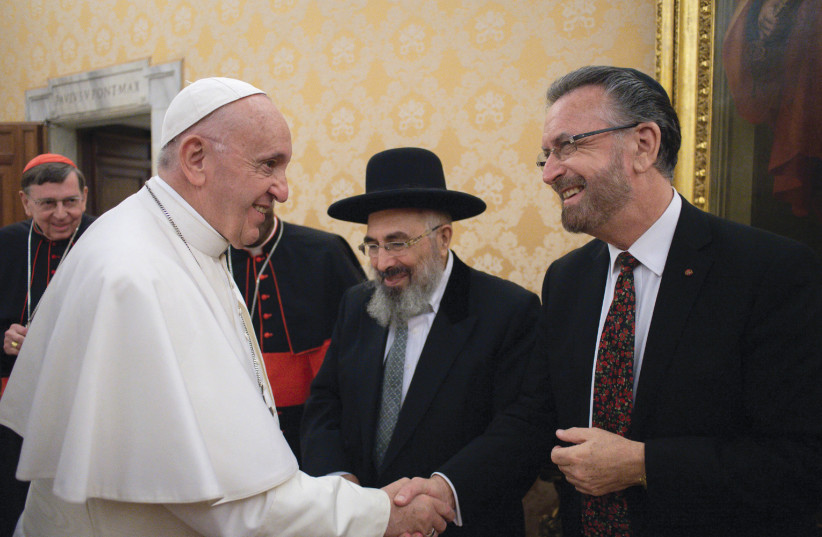
■ TIME MARCHES on. Rabbi David Rosen this week celebrated a milestone birthday, leaving his sixties behind as he turned 70. The Jerusalem-based director of International Interreligious Affairs of the American Jewish Committee, as well as the director of AJC’s Heilbrunn Institute for International Interreligious Understanding, the British-born Rosen, before making aliyah more than thirty years ago, was the Chief Rabbi of Ireland, and before that the senior rabbi of the Green and Sea Point Congregation in Capetown, which is the largest Orthodox congregation in South Africa. Arguably, the most well informed and most closely related Israeli Orthodox Jew to leading clerical figures in the Christian and Moslem worlds, Rosen is a member of the Chief Rabbinate of Israel’s delegation for relations with world religions and is international president of Religions for Peace; honorary president of the International Council of Christians and Jews; and the Jewish representative on the Board of Directors of the King Abdullah
International Center for Interreligious Dialogue. He was part of the Israeli team that negotiated full relations between the State of Israel and the Holy See, and is a past chairman of the International Jewish Committee for Inter-religious Consultations, the Jewish umbrella organization for interfaith relations. In 2005, the Pope made Rosen a Knight Commander of the Order of St. Gregory the Great in recognition of his contribution to Catholic-Jewish reconciliation. In this respect, he is in all probability the only Orthodox Rabbi who can claim to be a Papal Knight. In 2010 Rosen was named a Commander of the British Empire by Queen Elizabeth II for his interreligious work. His work has also been recognized by the Archbishop of Canterbury who presented him with the Hubert Walter Award for Reconciliation and Interfaith Cooperation. He has received many other awards – too numerous to mention.
Rosen has spent more than forty years building bridges of understanding between people of different faiths. His work involves mediation and peace building as well as multireligious engagement on ecological issues.
He is also a confirmed vegetarian, not only in what he eats but also in what he wears. He absolutely refuses to wear leather garments or footwear. He is the honorary president of the International Jewish Vegetarian and Ecology Society.
In February last year, he was the first Israeli rabbi to be hosted at the Saudi palace. After having hosted an interfaith group of senior Moslem clerics at a prayer meeting in January in Auschwitz, Rosen later addressed them at the Nozyk Synagogue in Warsaw.
■ NOTWITHSTANDING THE bad blood that exists between Jerusalem and Warsaw, or Foreign Minister Yair Lapid’s message to Polish ambassador Marek Magierowski to extend his vacation in his home country, Magierowski this week tweeted a reminder that the Jewish Culture Festival – Singer’s Warsaw – will be held for the 18th time in the Polish capital, beginning this Saturday, August 21, and running through till August 29. Founded by screen and stage actress and singer Gloria Tencer, the festival is named in memory of Yiddish writer and Nobel Prize laureate Isaac Bashevis Singer. The festival traditionally opens with a havdalah service at the Nozyk Synagogue, which this year will be led by two young Israeli cantors, Chaim Stern and Israel Nachman. The festival includes theater, concerts, workshops and more.
Tencer, who was married to the late Szymon Szurmiej, the long-time director of the Warsaw Jewish Theater, took over its direction following Szurmiej’s death in 2014. Their children and grandchildren are nearly all involved in film or theater or both.
■ APROPOS YIDDISH, Bella Bryks Klein, a Yiddishist from birth and the daughter of Yiddish writer and Holocaust survivor Rachmil Bryks, has resumed her monthly newsletter Vos Ven Vu (What When Where) that contains information about Yiddish events around the country.
Bryks Klein is well connected to Yiddish theater, and various Yiddish institutions and organizations, and is happy to share data about them.
■ AT AGE 50, popular singer Eyal Golan has lost none of his verve, and this week managed to complete a six-concert summer season with a mega audience in Caesarea just a couple of days ahead of the new regulations limiting the size of audiences. The program included new arrangements of old favorites, as well as all the different genres that have marked his career – Mizrachi, R&B, Reggae, Hip-Hop and more. The thousands of people in the audience went wild, standing up and singing along with him, applauding and cheering. In a spontaneous gesture to his friend and fellow singer Moshe Peretz who was sitting in the audience, Golan descended from the stage and serenaded him.
Golan, who was accompanied by a 20-piece band throughout, also sang a duet with Avner Gadassi.
■ THE ZIONIST Federation of Australia will host a Zoom meeting with Likud MK and former Health Minister Yuli Edelstein who has been billed as Soviet refusenik and former Speaker of the Knesset. Led by the late Isi Leibler, Australian Jewry was intensely involved in activities aimed at liberating Soviet Jewry, and Edelstein was among the Jewish personalities within the Soviet Union whose stories were well known to Australian Jews. Given that so many Australian Jews had planned to be in Israel for family celebrations and/or Jewish High Holy Days, but were prevented by COVID-19 restrictions from leaving the island continent, it is more than likely that the conversation with Edelstein will focus on the pandemic and the new virus variants. The event is scheduled for this coming Sunday, August 22 at 1 p.m. Israel time, 8 p.m. Australian time. Registration is at www.zfa.com.au/conversations
greerfc@gmail.com