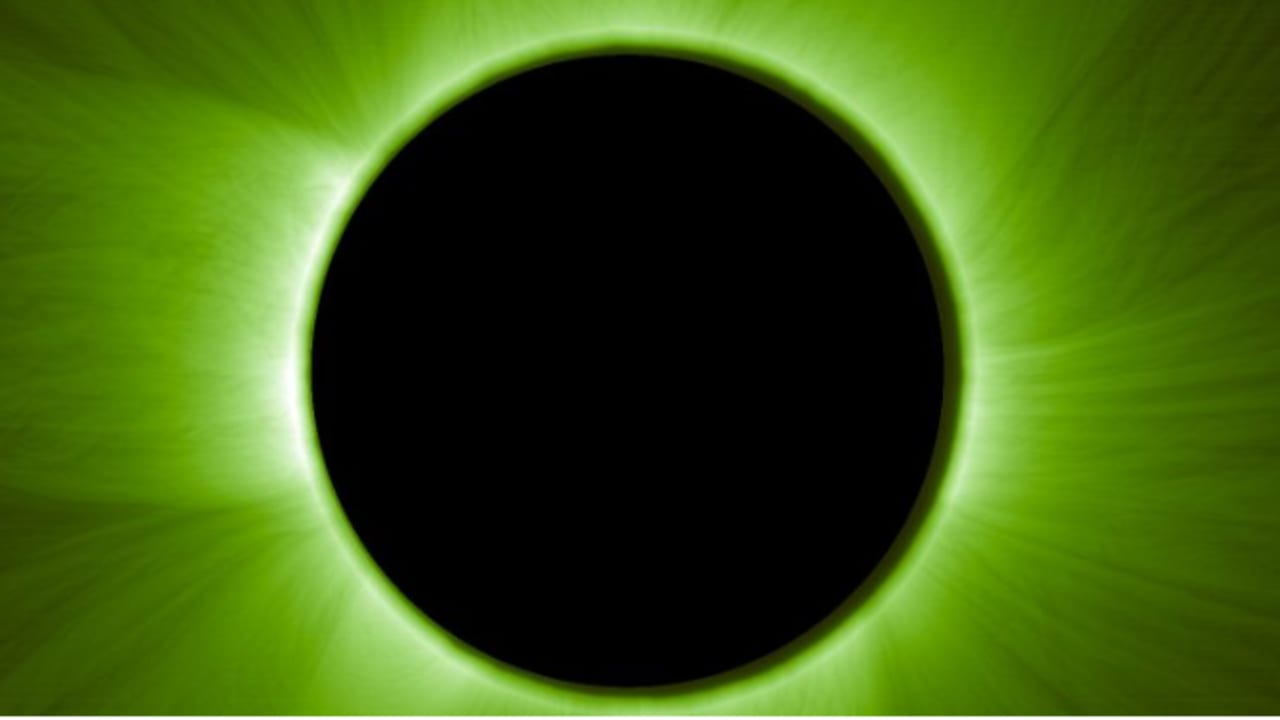
On Monday, the European Space Agency (ESA) unveiled images of an artificial total solar eclipse, revealing the solar corona—the outermost part of the Sun's atmosphere. The images were captured by the Proba-3 mission, which was launched at the end of last year. The two European satellites involved have been progressing over Earth at tens of thousands of kilometers since March, performing artificial solar eclipses.
The Proba-3 mission consists of two satellites, the Occulter and the Coronagraph, flying in a precise formation 150 meters apart. One satellite blocks the Sun, much like the Moon does during a natural solar eclipse, while the other points its telescope toward the solar corona. This alignment allows for a detailed observation of the Sun's outer atmosphere, which is typically obscured by the Sun's bright light.
On March 23, the satellites achieved a milestone by creating the first artificial total solar eclipse in orbit. The Occulter's 1.4-meter disk covered the bright disk of the Sun, casting an approximately eight-centimeter-wide shadow onto the Coronagraph's optical instrument, ASPIICS, which stands for Association of Spacecraft for Polarimetric and Imaging Investigation of the Corona of the Sun. This formation enabled the Coronagraph to capture images of the solar corona with very low levels of stray light.
The images recently published by ESA were taken between March 23 and March 25. In one image, the solar corona appears in violet, while in another, it is shown as the human eye would perceive it during a real solar eclipse through a green filter. These images reveal structures known as helmet streamers and offer valuable data for scientists studying the Sun's atmosphere.
"I was absolutely thrilled to see the images, especially since we got them on the first try," said Andrei Zhukov, Principal Investigator for ASPIICS at the Royal Observatory of Belgium, according to Space.com. He added, "Our 'artificial eclipse' images are comparable to those taken during a natural eclipse. The difference is that we can create our eclipse once every 19.6-hour orbit, while total solar eclipses occur naturally only once a year, and very rarely twice. Moreover, natural total eclipses last only a few minutes, while Proba-3 can maintain its artificial eclipse for up to six hours."
The Proba-3 mission's ability to observe a solar eclipse every 19.6 hours allows scientists to capture the solar corona with higher frequency and detail than previously possible. Over its two-year mission duration, Zhukov expects to achieve an average of two artificial solar eclipses per week, totaling about 200 eclipses and over 1,000 hours of totality. This extended observation time provides a unique opportunity to study phenomena such as coronal mass ejections (CMEs) and solar storms, which can disrupt satellites and impact communication systems on Earth.
"We are extremely satisfied with the quality of these images, and again this is really thanks to the formation flying with unprecedented precision," said Damien Galano, ESA's mission manager. The two satellites maintain a distance of 150 meters from each other to within less than one millimeter, requiring extreme precision in their flying accuracy. This precise formation is autonomously achieved through innovative navigation and positioning technologies, including GPS navigation, star trackers, lasers, and radio links.
The successful formation flying demonstrates the potential of this technology for future space missions. "The precision achieved is extraordinary. It validates our years of technological development and positions ESA at the forefront of formation flying missions," said Dietmar Pilz, ESA's Director of Technology, Engineering, and Quality.
The Proba-3 mission aims to address one of the great mysteries of the Sun: why the solar corona is much hotter than the surface of the Sun. Observations of the corona are crucial to understanding phenomena such as the solar wind and CMEs. The corona reaches temperatures exceeding two million degrees Fahrenheit (over 1.1 million degrees Celsius), much hotter than the photosphere. By studying the corona close to the solar surface, scientists hope to uncover the mechanisms behind this temperature discrepancy.
The mission also has practical implications for life on Earth. Space weather phenomena, including CMEs and solar storms, can disrupt satellites and impact communication systems. Understanding these events is essential for preparing for extreme space weather conditions and protecting modern technologies.
The images captured by Proba-3 offer an unprecedented view of the solar corona, showing different properties such as temperature and chemical composition. Using advanced instruments like ASPIICS, scientists can analyze different aspects of the corona, including the hottest areas identified by ionized iron that has lost electrons due to the high temperatures.
The preparation of this article relied on a news-analysis system.