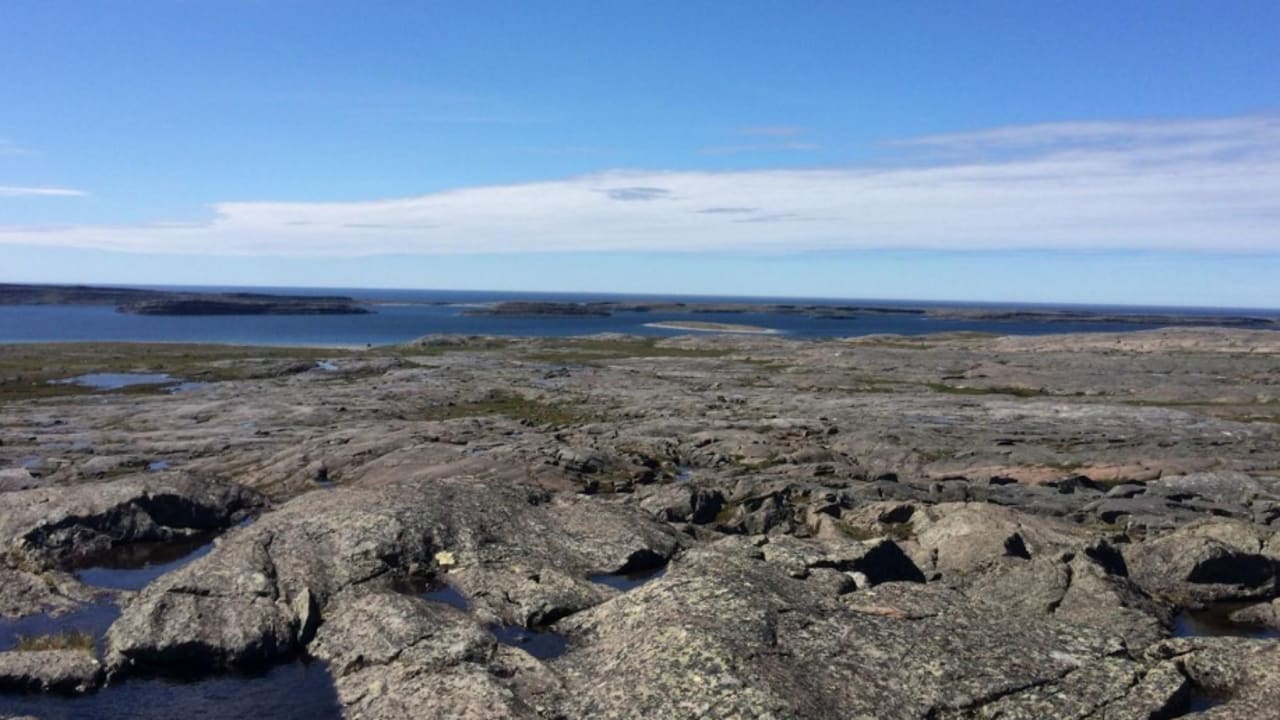
Two different testing methods have revealed that rocks from the Nuvvuagittuq Greenstone Belt in northeastern Canada date back to 4.16 billion years ago, reinforcing their status as the oldest reliably dated rock formations on Earth.
"The different methods gave exactly the same age," said Jonathan O'Neil of the University of Ottawa, according to the Los Angeles Times.
Previously, the Acasta Gneiss Complex, located about 300 kilometers north of Yellowknife in northwestern Canada, was recognized as the oldest confirmed geological formation on Earth, with rocks dated at approximately 4.03 billion years old.
The dating of the Nuvvuagittuq Greenstone Belt was previously disputed, primarily due to the absence of zircon minerals in the volcanic rocks, which are commonly used for dating.
To settle the debate over the age of the rocks, a team of researchers performed new datings on samples from a different section of the Nuvvuagittuq Greenstone Belt, using the decay of samarium into neodymium.
The research team used two dating methods based on radioactive isotope decay to determine the age of ancient magma trapped in the rocks.
The new research, published in the journal Science, strengthens a controversial study from 2008 that proposed the Nuvvuagittuq rocks dated back 4.3 billion years.
Other scientists contested the 4.3 billion-year age finding, arguing that long-ago contaminants were skewing the rocks' age and that the Nuvvuagittuq rocks were actually slightly younger, at about 3.8 billion years old.
"Understanding these rocks is going back to the very origins of our planet. This allows us to better understand how the first continents were formed and to reconstruct the environment from which life could have emerged," said O'Neil, according to Popular Science.
Because almost all rock from the Hadean eon has been destroyed or altered by tectonic processes, the period has largely remained a blind spot in geological science, with few rocky witnesses preserved.
The Nuvvuagittuq Greenstone Belt opens a unique window into Earth's early history, providing insights into how the Earth's first crust formed, as explained by geologists in the journal Science.
These findings push back the timeline of Earth's known crust into the Hadean eon, offering a glimpse into the planet's fiery beginnings, when Earth was a molten world.
"Rocks are books for geologists. Right now, we're missing the book on the Hadean. The Nuvvuagittuq Greenstone Belt would be at least one page of that book," said O'Neil, the lead researcher of the study and a geologist at the University of Ottawa, according to The Economic Times.
To determine the age of the rock, researchers focused on metagabbros—ancient igneous rocks—within the Nuvvuagittuq Greenstone Belt.
"Some rocks from the Nuvvuagittuq Greenstone Belt formed from precipitation of seawater, and this can help us understand the composition of our first oceans, their temperature, perhaps also the atmosphere, and it could even be the place where the oldest traces of life on Earth were found," said O'Neil, according to Scientias.
The Nuvvuagittuq Greenstone Belt is located on tribal Inukjuak lands. The local Inuit community has temporarily restricted scientists from taking samples from the site due to damage from previous visits.
"There's a lot of interest for these rocks, which we understand. We just don't want any more damage," said Tommy Palliser, who manages the land with the Pituvik Landholding Corporation, according to the Los Angeles Times.
The Inuit community wants to work with scientists to set up a provincial park that would protect the Nuvvuagittuq land while allowing researchers to study it.
Because Earth is constantly reshaping itself through processes like melting and recrystallization, primordial rocks like those from the Nuvvuagittuq Greenstone Belt are extremely rare on the surface today, as they often get melted and recycled by Earth's moving tectonic plates.
"To have a sample of what was going on on Earth way back then is really valuable," said Mark Reagan of the University of Iowa, who studies volcanic rocks and lava and was not involved with the new study, according to the Los Angeles Times.
Produced with the assistance of a news-analysis system.