
There are places where you do not need to invent an attraction. It is enough to bring them back to life.
Whenever we traveled along the northern streams or made our way down from the Golan Heights, we always stopped at Kibbutz Dafna. The kibbutz veterans who established it in 1939, during the final days of the Tower and Stockade era, certainly never imagined that more than 80 years later, it would become a mini-tourism powerhouse upon which hopes are pinned no less than on the avocados and trout raised in the Dan Stream.
Long before Gan Hatzafon existed and developed into what it is today, Dafna had the Cookia cafe and the Pizza Truck – perhaps the first food truck in the North – and all the travelers, soldiers, and students in the area went there. There was also Hapitriya pub in Kibbutz Dan, which is older than both, and that was it (I do not count the Nehemia Mall at the junction of Route 90 and Route 99).
About two decades have passed since then, and in Kibbutz Dafna, which is adjacent to Kiryat Shmona and the Banias and Dan streams, something is taking shape that looks like a commercial complex dedicated entirely to tourism for travelers and locals alike. After a long period in which the war halted almost everything, the kibbutz is attempting to turn tourism into a complete ecosystem – one that will draw visitors to come, eat, travel, sleep, and, above all, stay a little longer. This is Dafnale.

The story actually began before the war. On October 10, 2023, the Dafnale complex was scheduled to be handed over for renovations, but then the war broke out and everything came to a halt. "For about a year and a half, the place stood almost completely inactive," says Doron Medina, who is responsible for the kibbutz's assets and manages the commercial complex. In April 2025, the planned renovation began, and exactly a year ago, during Sukkot 2025, the complex reopened.
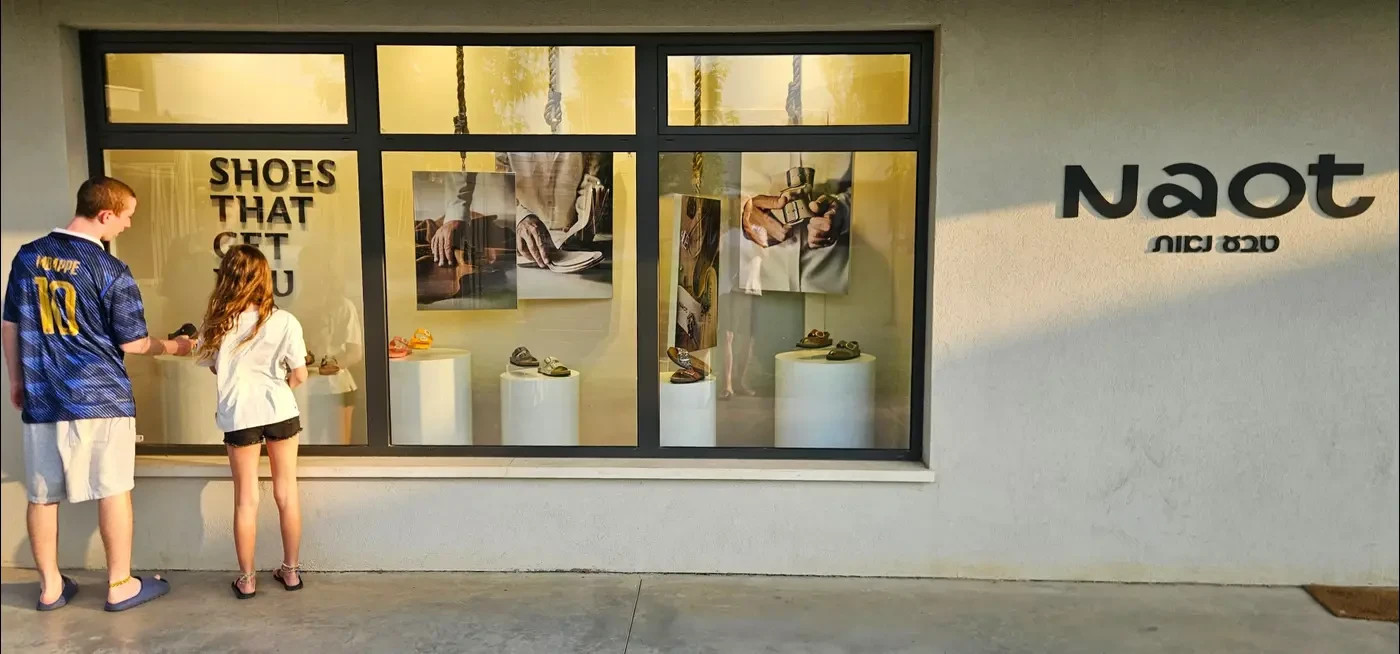
According to Medina, the investment in the new complex was significant – approximately NIS 14.5 million ("The return on investment is expected to take a decade," he says). Since then, new and returning businesses have entered gradually: A bakery (Jolan), a pizzeria (the famous updated Pizza Truck), an ice cream parlor (Buza), the veteran Naot footwear store, and more. Now a new station is also planned for the complex, which will include a hosting delicatessen with cheeses from the Schwartz farm, wine, and custom-made sandwiches.
If everything progresses according to plan, this is only the first chapter.
Sleeping in Dafna, waking up to a motorcycle, and finishing with fish and chips
I walk around the new complex with Medina. A broad lawn adorns the central plaza, where travelers sit from twilight when it becomes more pleasant, eating pizza or ice cream, or as usually happens, both. The construction of the shops is modern, square, and new – reminding me of the construction in the expansions of kibbutzim across our country – with square, black metal trimmings and beige-colored walls. I connect with it less, but it is certainly functional for visitors. There are plenty of seating areas, both on the patio of each ice cream parlor or eatery, as well as stone benches alongside the lawn. There is no shading in the center, but several new trees were planted that may shade the complex in coming years, and shade is definitely needed there during the harsh summer.

According to Medina, the vision of Dafna's residents is to create Dafna Tourism – no longer a single attraction visited for an hour, but an entire fabric of experiences. "The goal is clear," Medina says, "to ensure that anyone who comes for two or three days does not feel they must drive to a different place every day to find something to do."
This is also part of a broader attempt to cope with the new reality in the North. In Kiryat Shmona, for example, about 13,000 out of approximately 28,000 residents left – about 50 percent! At Dafna, they understand that tourism cannot solve all the problems on its own, but it can certainly be part of the return to life.
The grandmother who got a burger joint named after her
The foundation already exists: Travel Hotel Dafna, which is owned by the kibbutz in partnership with the Travel Hotels chain, reports an annual occupancy rate of about 90 percent. Around it, additional points of interest are being built, such as Klompus – a burger restaurant designed like an American diner bearing the name of Tzipora Klompus, the owners' grandmother. It started at nearby Gan Hatzafon and has now continued along Route 99 east to Dafnale. A classic burger (220 grams) costs NIS 62 without toppings, and there are also chicken, schnitzel, and several salads for vegetarians, or a vegan burger. Oh, and there are also Gyps, which is a mix of potato fries and sweet potato.

Right next to it is Buza (ice cream in Arabic), which is wonderful for dessert. The coexistence ice cream of Alaa Sweitat (Tarshiha) and Adam Ziv (Kibbutz Sasa), which started in Tarshiha, has already made a name for itself in the North and throughout the country, and today shows that Jews and Arabs can lick together across 11 national branches.
Across from Buza is the Jolan bakery – if you saw the line and the crowd there on a Saturday morning, you would think it was at least Matarello in its glory days at Ein Zivan. A variety of paper-thin layered croissants, with or without berries, sweet creams, and what not. Decadence and calories are right there.

Zen and the art of place maintenance
The kibbutz itself has traditionally relied on agriculture and industry – avocados, a dairy farm, field crops, fish farming, the Dafna Footwear boot factory that I still remember from my army boots, and a apartment rental market for students. Now, a branch that is taking center stage is being added to this mix: Tourism.
One of the surprises in Dafna is found inside Hasadna – a museum of collectible motorcycles. Behind the place stands Elad Koton, a kibbutz member who began collecting motorcycles about 30 years ago when he was 27. "Today the collection includes 58 motorcycles, and only five of them are non-operational," he says as we tour his workshop.
Among the motorcycles are two vehicles produced at Kibbutz Tzora by ICM, the Tilon model – a distinctly Israeli item inside a collection that tells a broad story about motorcycle culture. "There is also a Honda Super Cub 305 here that belonged, according to the story behind the collection, to Robert M. Pirsig, author of the book 'Zen and the Art of Motorcycle Maintenance,'" Elad says proudly, "and Elvis Presley also owned such a motorcycle before he switched to a Harley-Davidson."
Elad himself was not satisfied with collecting and rides a Ural motorcycle with a sidecar that has an old look, but is "only" from 2020. Now he allows visitors to peek into this world, not just through museum glass, but through vehicles that have a story, a smell of oil, and history on the road. Along the way, he also operates a cute coffee stand.
Tel: 052-3992090, free on Fridays and Saturdays.

The forest where they restore the land – and it restores man
Where Dafna's old campsite once stood, a completely different type of project is growing today. Bar Peled, a kibbutz member, began planting trees and bushes in the complex after October 7. He previously worked for a company involved in food forests, and his mother came from the healing field. Together they combined the two and created a food and healing forest.
One of the most interesting initiatives is located where an old parking lot once stood, upon which a vegetable garden was established using the "No Dig" method – a method in which soil and organic material are added without turning over or removing the existing soil. Today, groups come here for forest medicine activities, "forest bathing," and agriculture. A tour of the site costs NIS 40 per person.
"The idea is that man restores land, and the land restores man," says Bar. This is perhaps the sentence that best describes what is happening here. After a year and a half in which the North was forced to stop, there is an attempt in Dafna not only to restore buildings and businesses, but also to create a new reason to visit. Oh, and he also has a cool, shaded coffee cart there next to the fish farming facility along a branch of the Dan Stream.
Right nearby, the Fish Garden complex is an unfamiliar corner of magic. Alongside the store selling trout raised at the farm, a cute branch of the Dan Stream flows, and under shading plane trees, they opened a space where you can order one thing – fish and chips. The breeze is wonderful even during the day, the trees provide shade, and the branch of the Dan provides a cool wading spot. It is recommended.

Pizza, lawn, and a mat – just like before, only a little different
One of the places that has already become part of Dafna's new story is the Pizza Truck – perhaps one of Dafna's icons over the last decade and a half and, as noted, the first coffee cart in the North before they knew to call it that.
Pizza Truck first opened in 2012, when it was owned by the well-known Cookia cafe managed by Aviva and Yoel Orbach from the kibbutz, which has since moved to the coop path in Kfar Giladi. Chen Kanner, a member of Kibbutz Snir and now one of the partners in the pizzeria, was washing dishes at Cookia in 2010, and later managed the pizzeria between 2017 and 2019 until the complex closed for renovations. After returning from his big post-army trip during the COVID period, he joined Nati Yosef from Ma'aleh Adumim and Aviva and Yoel, and the four returned to operate the venue. "The original plan was to open as early as October 8, 2023, but ultimately the Pizza Truck opened in September 2025," says Chen.
Beyond the change in seating and the cheeses that now come from Jacobs Farm, everything there remained quite similar, even retaining the truck's red cab. However, alongside the traditional Margherita (NIS 54), they introduced several interesting pizzas such as Levinsky with Kalamata olives and feta (NIS 66) and Shos Mushrooms with button, portobello, and truffles (NIS 68). One particularly intriguing dish is pizza with eggplant cream (NIS 66).
"This is an August that is a bit different from what we knew before the war," says Chen. "There is a slight recovery, but heavy traffic is still not felt. My benchmark is the Banias parking lot – if it's full there, I know it will be full for us too."
The concept is quite simple: Buy pizza, take it to the lawn, sit on a mat, and let the children run around. No need for a white table, a waiter in a tie, or a menu. Just pizza, lawn, and Galilean air.
Open all week from 12 p.m. to 9 p.m., except Fridays.
The next stage: Another 15 percent of the complex and much more evening activity
In Dafna, they do not intend to stop with what has already opened. Plans include occupying another 15 percent of the complex, expanding evening activities, holding events, and adding charging stations for electric vehicles. In addition, the possibility of introducing Asian food to the complex is being examined to complete the variety of options.
"The intention is to build a tourism product here that begins at the hotel and continues through food, nature, agriculture, history, and activities for the entire family," says Doron.
That is perhaps the most interesting thing in Dafna: This is not an attempt to turn back the wheel. The kibbutz is not trying to recreate what existed before the war, but to build something new from what remains. After a year and a half in which the North waited, in Dafna they are no longer waiting. They are starting to plant.