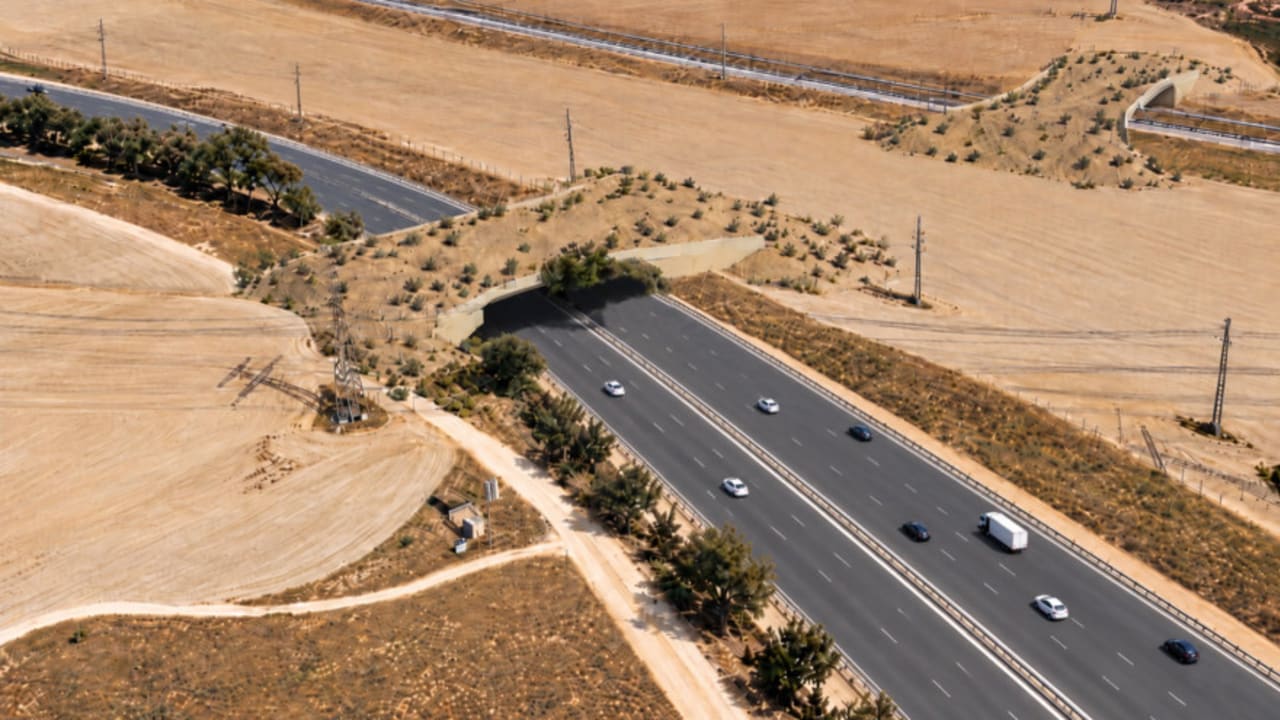
While jackals, foxes, badgers, and porcupines manage fairly well with highways - often using underpasses beneath the road such as the bridges spanning the Pura, Shikma, and Adorayim streams - gazelles rarely enter such structures. Consequently, in the northern Negev, Highway 6, Highway 40, and the railway track act as an impenetrable wall, severing gazelle populations in the area.
To resolve this issue, the Israel Nature and Parks Authority is promoting the construction of an ecological crossing over Highway 6: A broad, vegetation-covered bridge enabling wildlife to navigate across the artery safely. This week, the National Planning and Building Council approved continuing to advance the plan.
An 80-meter bridge
The crossing will be constructed near the Ma'ahaz Interchange and the Pura Nature Reserve, spanning approximately 50 meters in width and 80 meters in length. It will connect directly to another previously approved ecological crossing over the planned local railway track, creating a seamless continuous path for wildlife to traverse both major transport corridors.
The bridge forms a critical component of a national ecological corridor designed to link the open landscapes of the southern Judean Mountains - through the Lachish region and the Shfela hills - all the way to Shikma stream and the Ruhama Badlands. The structure was designed by landscape architect Shai Harnoy.
The location was selected through rigorous spatial analysis. According to the Israel Nature and Parks Authority, detailed predictive models of gazelle habitats and preferred movement routes were built prior to the decision. Out of three potential sites evaluated, the chosen location proved to be the most effective.
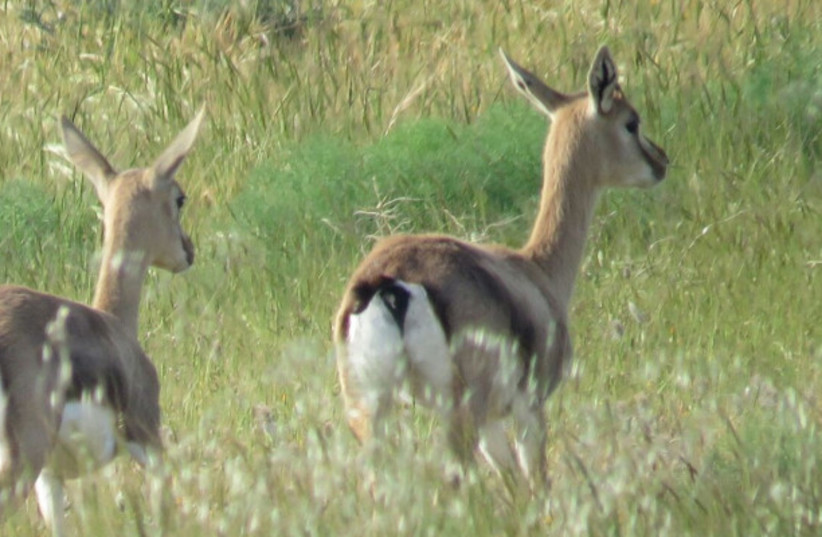
Dr. Yariv Malihi, Central District Ecologist at the Nature and Parks Authority, explains that the Israeli gazelle is an endangered species and that isolation between populations harms it. According to him, roads and the railway track currently disconnect the gazelles in eastern Lachish from those in the Shikma stream area. "The new crossing is intended to restore connectivity between populations and allow safe movement for gazelles and other animals," he says. Connecting the populations is important because it increases genetic diversity, thereby improving their chances of survival.
'Not just the danger of being run over'
Mira Avneri, Central District Planner at the Nature and Parks Authority, says that overpasses are already operational in other locations across the country, and the Authority monitors them. "For gazelles, a highway is not just a risk of being run over, but also a barrier that separates populations and limits their ability to move and reproduce," she says. "Approval to continue advancing the plan proves that national infrastructure can and must be planned while considering the needs of nature."