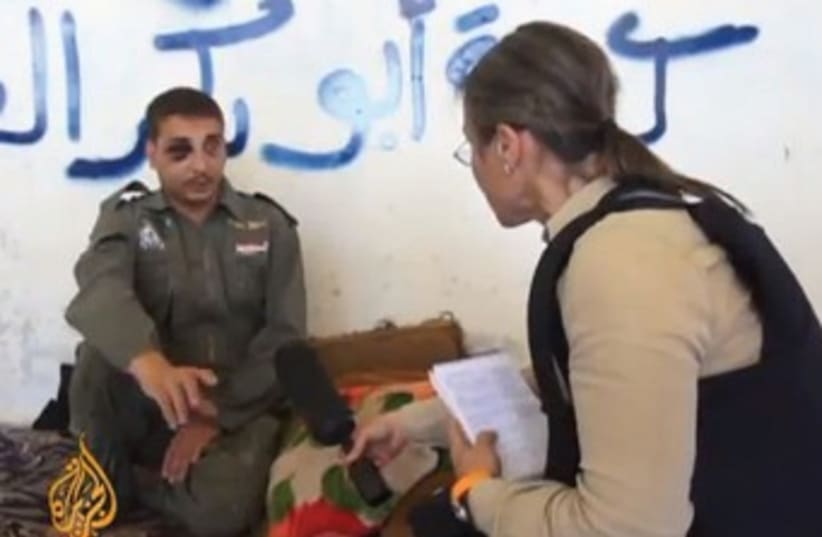
The pilot does not immediately strike us as a sympathetic character, but his treatment by Al Jazeera is indicative of the moral and ethical blinders that the media has, for too long, tolerated.
By SETH J. FRANTZMANAnita McNaught interview with Syrian pilot 370(photo credit: Courtesy/Youtube)
On October 17, Al Jazeera posted a shocking video of an interview with what was described as a downed Syrian pilot on its website. It showed the pilot sitting against a dirty, graffiti-filled wall, on a mattress, being questioned by a reporter named Anita McNaught.The segment begins with the reporter, with her British accent, taking in the aftermath of a bombing, commenting that luckily, few people had died. “But this time,” she says, “they [the rebels] claim they used their AKs to shoot down a plane... [and captured] its pilot alive. He’d tried to escape and fought with his captors... we had no way to establish how he’d been treated or what pressure he was under.”The interview itself begins with the reporter asking the pilot why he’s bombing civilians. The pilot, whose right eye is swollen shut, as if he has been punched in the face, replies; “They told us that we were bombing armed terrorists.”“Why did you believe this?” inquires McNaught, who then asks who he thought he was fighting.“Afghans, Libyans and Chechens,” he replies.McNaught then interjects, “the phrase ‘I was only following orders’ came up more than once,” and launches into a lecture on the subject.“I told the pilot somewhere between 20,000-30,000 of his fellow Syrians were dead from fighting, 250,000 Syrians were refugees and millions displaced.... Most [rebels] think the pilot’s innocence is feigned, a ploy to escape responsibility for his actions. That judgment lies with the people of Al-Bab.”This interview is important because while the pilot, named “Captain Ibrahim” in the video, does not immediately strike us as a sympathetic character, his treatment by Al Jazeera is indicative of the moral and ethical blinders that the media has, for too long, tolerated.According to the Geneva Convention, Section II, Article 13, “prisoners of war must at all times be protected, particularly against acts of violence and intimidation and against insults and public curiosity.”In March 2003, during the American-led operation to overthrow Saddam Hussein, several American soldiers were captured by the Iraqis. The Iraqi government sent a reporter to interview the American POWs. He asked the men if their orders were to kill Iraqis.One American replied, “no, I fix broke stuff.”The Iraqi government wanted the footage for its state-run television, however the video was also distributed to news outlets. Al-Jazeera aired the video, as did Sky News. Even America’s CBS broadcast a portion of it. The Pentagon condemned Iraq for possibly violating the Geneva convention.However in May 2008 PBS published an interesting article online discussing whether the Geneva convention, whose sections on POW treatment have their origins in 1899, should be updated to take into account new media. PBS also made an important notation: “international laws governing armed conflicts govern only the conduct of the parties to the conflict – not media outlets.”THE MEDIA has often viewed itself as above the laws of war – indeed, above most laws. This is partly due to the tradition of freedom of the press (i.e. prior restraint and other hurdles should not impede journalists), and also because of the nature of the journalistic profession is to “get the story.”In October 2011, Lawrence Pintak wrote an article for The Columbia Journalism Review entitled “POWs, dead dictators and journalistic ethics” in which he defends journalism’s shabby treatment of POWs and others. He discusses an incident he took part in during the Iran-Iraq war in September 1980.“The young Iranian prisoner was no more than 14, still caked with a thick layer of dust from the battlefield,” he wrote, going on to relate how he had talked to the POWs in the presence of Iraqi “minders.” He asked the boys through a translator about their experience fighting for Iran.“Those encounters provided unrivaled insight into the mindset that was fueling the carnage that would ultimately claim more than 500,000 lives. It was also illegal.The Geneva Convention prohibits reporters from interviewing POWs. But when I aired the piece on The CBS Evening News with Walter Cronkite, no one objected.”Pintak uses this explanation as a segue into a defense of Egyptian reporter Shahira Amin’s interview with Gilad Schalit in 2011.“But how many reporters can honestly say that, given the opportunity, they would have turned down the chance to be the first to speak with Schalit? Would Israel TV have said no?” Actually, Mr. Pintak, Israeli television stations (there is no such thing as Israel TV) did not interview Schalit, and provided him and his family with privacy.Pintak notes that “it might be useful to separate the ethics of doing the interview from the ethics of how the interview was conducted.” He claims that the West has a hypocritical view of journalistic ethics; that while people are outraged at images of dead Americans on foreign channels, the West played images of a dead Muammar Gaddafi.There is a difference, though, between a journalist interviewing a half dead Gaddafi and airing video that has been obtained from outside sources.IN CASES where journalists are provided access to POWs, as Anita McNaught was, it is unclear why the Geneva Convention is only seen to apply to the government that made the POWs available. McNaught, who was born in London in 1965 and has worked in journalism for many years, should have understood that the image of the captured pilot was being used by the rebel fighters for propaganda purposes and that this was illegal under the Geneva Convention.In order for the video of the downed pilot to be produced in this case it required the collaboration of the Al Jazeera journalist. In the case of the video of the American POWs in Iraq, all Al Jazeera did was air a video it had obtained.But when the journalist actively participates in the unethical activity, why is there so little discussion of the immorality of this behavior? We have to consider exactly how ethe media obtains an interview with a POW in order to understand the media’s complicity in war crimes. A journalist is provided access to the POW by the forces that hold him; the journalist has “minders” that often tell him or her where to set up the camera, often making sure the weapons or instruments used to torture the POW are out of sight.The entire scene is choreographed by the group – the journalist is no longer a free actor but is doing what they are told.Should a journalist interview, for example, a mafia boss, their freedom would also presumably be circumscribed – but the content of the story is ultimately up to the journalist. The mafia boss doesn’t get to edit it.This is an important issue, and one that is not often discussed. Countries with freedom of the press need not place a prior restraint on whether journalists who interview POWs do so in contravention of international law.Rather, media outlets should enact their own guidelines to prevent such videos from airing.In addition, international law should consider updating the Geneva Convention so that the onus of “public curiosity” also applies to those who manufacture and distribute material that aids a government or non-state actors in the commission of crimes against POWs.
Related TagsAl Jazeera
if(catID != 151){
var cont = `Take Israel home with the new Jerusalem Post Store