The modern pilgrim to the Middle East carves out a pilgrimage trail – in order to present the story of Palestinians to the western world.
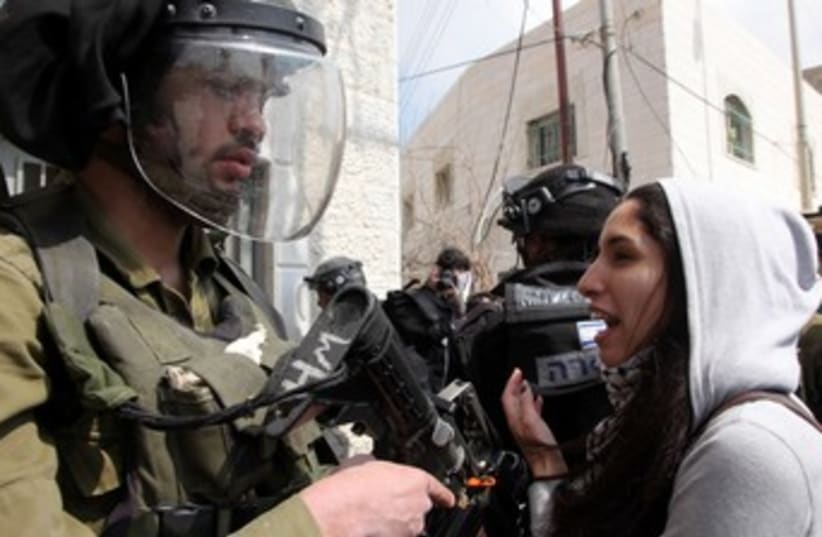
By SETH J. FRANTZMANPalestinian protest at Kalandiya checkpoint 370(photo credit: Marc Israel Sellem)
The existence of “the conflict” in the Middle East has given birth to a 21st-century literary artifact that can best be described as the neo-pilgrimage account of the Holy Land. The publication of “pilgrimage itineraries” has a prestigious pedigree in Western literary history. From the 5th century on, those who visited the East were able to gain fame, or monetary gain, through putting their experiences down in print. By the 19th century these accounts generally tried to translate to a believing public the truth and earthly reality of the holy sites and the life of Jesus. Some non-traditional accounts, such as Mark Twain’s Innocents Abroad poked fun at the pilgrims’ devotion.The accounts generally took the form of travelogues, weaving in personal experiences with observations on flora and fauna. Studies of these accounts have been able to chart the relative importance of various holy sites by seeing which pilgrims visited which places. As new sites were excavated and discovered, such as the Garden Tomb in Jerusalem, or made safe for travel, such as the baptismal site on the Jordan, accounts began to mention them more often.The modern pilgrim to the Middle East also carves out a pilgrimage trail – in order to present the story of Palestinians to the western world. In general those who leave these accounts are either full-time pro-Palestinian activists, journalists or workers for one of the many thousands of NGOs that feast on portrayals of Palestinian suffering. The writers are often young and college educated. The itinerary is relatively predictable and an analysis of the literary devices employed reveals several recurring themes.Self-discoveryIn Paula Olson’s Fast Times in Palestine (2011), the author is described as “a small town girl from eastern Oklahoma...[who] felt consumed by dread and confusion. This irresistible memoir chronicles her journey from aimless ex-bartender to Ramallah-based journalist and foreign press coordinator for a Palestinian presidential candidate.”Witness in Palestine (2007) describes its author as “Anna Baltzer, a young Jewish American, [who] went to the West Bank to discover the realities of daily life for Palestinians under the occupation. What she found would change her outlook forever.”Sarah Schulman’s Israel/Palestine (2012) is said to be a “chronicle of political awakening and queer solidarity, the activist and novelist Sarah Schulman describes her dawning consciousness of the Palestinian liberation struggle.”A critical common factor here is the claim that the pilgrim is initially unaware, unbiased. The reason for this is obvious; the knowledge that an author is a long-time anti-Israel activist who went to the West Bank for the specific purpose of writing a book advancing their preconceived views would put off many readers.The checkpointThe checkpoint is a common “coming of age” event to which many pages are devoted in pilgrims’ accounts. One writer notes, “I did duty at one of the agricultural gates this morning. The gate only opens for one hour in the morning, one hour at lunch time and one hour in the evening. The humiliation these people have to go through every day of their lives is unbearable.”Olsen asks: “But who could watch so many proud young women and dignified old men humiliated at checkpoints?” The checkpoint was ever-present, “the sun set over a sea we couldn’t walk to and touch without crossing walls and checkpoints.”Schulman reminds us of the “dusty roads through the West Bank, where Palestinians are cut off from water and subjected to endless restrictions.”She writes of the trepidation of experiencing the Kalandia checkpoint north of Jerusalem: “What the people there undergo every single day just to get to work...this was the most harrowing moment of my entire trip...the checkpoint is not about security. It is only about humiliation.”Baltzer notes that “without experiencing it first hand, it’s hard to imagine what it’s like to wait at a checkpoint...attempting to think rationally and practically in the context of such inhumanity would probably drive some people crazy.”Most of those who go to the checkpoint/ holy site experience catharsis.“I wonder how I would react in their shoes, if I were a Palestinian would I resist?” asks Baltzer. Dignity is also a common theme, as Baltzer writes, “the process was painful to watch; dignified but exhausted people trying not to lose their tempers or pride.”Palestinians invariably are described as “dignified and proud,” today’s version of the “noble savages.”The Palestinian who is cut off from his fields: JayyousIn the pilgrims’ accounts, Palestinians (who are all invariably farmers who live off of agriculture) are portrayed as cut off from their lands. A woman who lived in Jayyous recalls, “Palestinian farmers have to apply for a special permit to work in their own lands (which are now separated from the villages)...In among the olive trees beyond ‘The Wall’ there are six Palestinian wells. These wells are (were) used to irrigate the trees but now settlers have damaged the wells – sometimes they just fill them with garbage.”Olsen, who also lived in Jayyous, describes her experience: “We harvested each day until we couldn’t see anymore...in those moments, leaning against an ever-growing pile of ripe olives, breathing in the deep, rich subterranean scent of a hard day’s work, I felt completely content and at peace.”Sarree Makdisi, author of Palestine Inside Out (2010) also describes an agrarian society: The Palestinian’s life consists of “tending one’s fields, visiting a relative, going to the hospital: for ordinary Palestinians, such everyday activities require negotiating permits and passes, curfews and closures.”Baltzer mentions that “the women told us stories of farmers denied access to their land at checkpoints or allowed through but denied permission to return for up to a week, by which time the freshly picked crops had gone bad.”Readers might ponder how it is that every Palestinian has lands on the other side of the fence. What were Palestinians farming and subsisting on before 1967 if everything they farm today is supposedly inside pre-1967 Israel or right along the border?The refugee campSchulman describes the Jewish communities in the West Bank as “gated communities of white, religious Jews. The houses were homogeneous and substantial...the Stepford wives of Israeli suburban life,” contrasting them with the existence of the Palestinians: “The streets smelled like open sewers. People brought water from trucks. The villages were poor, neglected, crumbling, filled with men of all ages with nothing to do and the women serving them.”Olsen writes of the “standard fare for a Palestinian refugee camp, narrow streets, concrete buildings, cramped alleys, and occasional touches of bougainvillea or decorative tiles to lend a whiff of dignity.”Schulman’s odyssey takes her to meet cave-dwellers and a village of 70 people who live in “hovels made out of garbage and dirt.”There seems to be a prurient interest on the part of many of these travelers to focus the lens on the poorest people in the most vulnerable circumstances, and present them as if they represented the vast majority of Palestinians.The young Israeli soldierAnother motif that runs through the accounts is the young Israeli soldiers.They are subjects of either deep hatred or dismissed as forlorn youth forced to do an unenviable job. Olsen recalls, “I can’t imagine what I would have felt or what I might have been capable of, if the soldier had been denying my mother life-saving medical treatment instead of just messing up her vacation...but [he] was, after all, just a teenager... here was another kid caught in the maw of it, standing at a checkpoint instead of off at college.”Schulman writes, “I saw three Israeli soldiers behind a bulletproof window. They looked like kids I had known. The guys could have been my cousin from Westchester.”IF WE analyzed these accounts based on Henri Lefebvre’s notion of “production of space” we would find that the world of the Palestinian and the landscape of the West Bank has been pared down to consist of a very clear pilgrimage itinerary, a very narrow view.From the checkpoint to the refugee camp, on to Ramallah, then working in the olive fields and tea or coffee with a few fellow activists; this is the essence of the leitmotif placed before us.In the view of the neo-pilgrim, the Palestinians, for all their diversity, are boiled down into two archetypes; on the one hand are all the “salt of the earth” types, “proud and dignified” men who till the earth from morning to night, or sit with a nargillah between their lips. On the other hand, the leaders, the several cultured activists or political people who lead the toiling agriculturalists. There are no computer technicians, no truck drivers, no policemen, no judges, no middle class.The chroniclers seek to introduce a Western audience to this 'native noble-savage' people that they have “discovered” as part of a fame-seeking self-discovery project. The pornographic cornucopia of suffering that suffuses these accounts may indeed reflect momentary realities for the people described.However, just as some of the pilgrims of the 19th century presented Palestine as a dead landscape full of grottos and biblical mystery, so today’s pilgrims provide a one-dimensional view of suffering and poverty that takes away the humanity of the vast majority of people in the West Bank.Fetishizing humiliation may encourage some people to oppose Israel’s policies, but in general these books are only read by the already converted, so who profits from the humiliation fetish? The author and the reader who experiences catharsis may benefit, but certainly the Palestinians do not.
Related Tagspilgrim
if(catID != 151){
var cont = `Take Israel home with the new Jerusalem Post Store