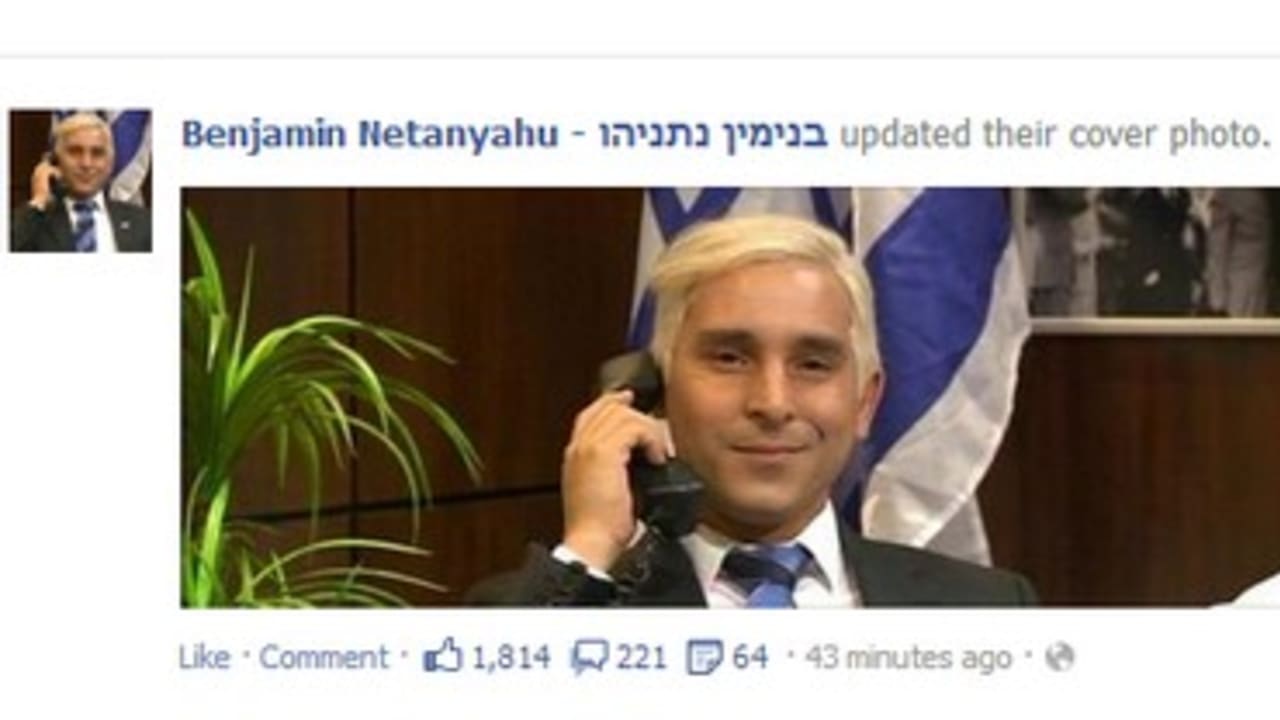
Does US President Barack Obama really support Israel? What are Iran’s real nuclear aspirations? Is smoking really bad for you? Is Coca- Cola truly the “real thing?” Technological and cultural advancements are changing the availability of information, knowledge and ideas. So is our world becoming more revealed, genuine and true? Intuitively, the answer should be – yes, for surely we must know more than we knew in the past about... well, everything.Advances in science and technology, from medicine to space exploration, enable us to better understand ourselves, our planet and the universe.Technology and its cultural implications are making our lives more documented and exposed. Almost everything is penetrable, accessible and visible.From smartphones to banks, cameras are everywhere. Life-bloggers have been recording personal daily activities for years, and soon people will be wearing augmented reality glasses with cool features such as facial recognition.Dramatic development in forensics enables authorities to solve crimes more scientifically than ever before. Fingerprints can be matched with worldwide databases, and DNA samples offer unequivocal identity validation.Our attraction to the up-close, personal and real, have made the “reality show” a popular genre. We like following real people in real-life situations.Our governmental cultures are also becoming transparent, open and communicative, from direct interaction with politicians, to public access to official records.But the best example is the Internet, where the world is literally at our fingertips.Social media has revolutionized the way we interact and share information. It has even become complicated to lie. You can’t tell your boss you were home sick if someone tagged you at the beach.So it seems that the modern world has brought openness, candidness and realism. Our lives are more and more exposed to the true state of things, right? Well, no. Not at all! During the weeks of coalition building, Yesh Atid’s Yair Lapid and Ofer Shelach posted updates with this recurring theme: “Don’t believe what is being published. It’s all disinformation and spins.” The two ex-media professionals were telling us the truth – there is really no such thing as the truth.Their colleague, Rabbi Shai Piron, insulted by false publications intended to smear his credibility, posted: “Have we gone mad? Is it normal that I should now constantly deal with fear and terror? Is this the language of a fair and moral society?” No, rabbi, it is not. Unfortunately, truth is not a moral beacon in politics, local or global. A biased United Nations proves that what matters are agendas and narratives, not facts.The postmodern French philosopher Michel Foucault has taught us that truth is a subjective concept, and depends on social discourse and cultural circumstances. It is not something out there waiting to be discovered, but more for us to collectively adopt and create.Another Frenchman, the social theorist Jean Baudrillard, coined the term “hyper-reality,” claiming that there is no way of knowing what “real” really is.Modern mankind is immersed in a world of “simulacra,” where mass media poses a simulated reality of signs and images.Facebook is a classic example of hyper-reality. We sometimes seem to leave reality behind for a better, virtual, reality. Our friends’ lives are not really as glamorous as they may seem online.Although we upload increasingly more pictures and videos, this does not contribute to a realistic portrayal of the world, for at the same time more tools are implemented to distort and manipulate them.Computer-generated imagery (CGI) revolutionized film-making to a point where it is almost impossible to tell the difference between live-action and animation.Watching Arnold Schwarzenegger fly a Harrier jet in the 1994 film True Lies, I was amazed how realistic it seemed.Who would believe that it was actually filmed in a studio, with a model plane in front of a green-screen? Baudrillard would probably say the same holds true for much of our modern lives.Virtual-world and alternate-reality gaming, such as “Second Life,” may also be examples of hyper-reality. For some young players, the lines between the real and simulated world are blurred.There are recent examples. Participants in the Tel Aviv Marathon may think of it as a sports event, but in fact it is a promotional campaign for Gillette, and every “personal” photo posted online was actually a deodorant advertisement.This Passover, Coca-Cola is operating a “recycling factory,” to “promote their overall environmental responsibility strategy.” Hyper-reality at its best.The deceptively named “reality shows” are far from portraying reality. They are edited, manipulated and sometimes even staged, taking advantage of our human nature and current trends.Considered foolproof, forensic science may be exploited to frame innocent people. Computer data manipulation, fabricated DNA samples, fake fingerprints and even Facebook posts may all be used to falsely place an individual at a crime scene. The flip side may be criminals creating a scientifically credible alibi to withstand future allegations.The Internet is an ocean of knowledge, but also filled with distorted information and outright nonsense. Many users, especially young people, attach too much credibility to things they see online, without having the tools to evaluate their value.When we google a term, the results are not “reality,” but the product of a search algorithm. “Search engine optimization” (SME) or the broader “online reputation management” (ORM) are manipulative actions used to influence what we see on page 1.What can we do to mitigate the effects of hyper-realism? The most important thing is awareness. Internalize that all sources of information are biased, and take everything you see, not with a grain, but with a heaping spoon of salt.Teach your children techniques for how to ascertain what is useful and what is junk.Don’t believe anything, even if you see it with your own eyes, unless you validate and cross-check the source.Don’t make decisions based on anonymous sources, especially on important issues, such as your health.Be aware that many “likes” and customer reviews are contracted fakes.Assume that everything you do or say is recorded and may be accessible by anyone, anytime.To answer the question about President Obama, I will follow Michel Foucault teachings, and say that it is Obama’s words, and more than that – his deeds, that attest to his unwavering support for Israel. All the rest is speculation, deception and spins.The writer is a former Israel Air Force pilot and founder of Cross-Cultural Strategies Ltd.reuven@CCSt.co.il