RSS | Advertise With Us | Blogs | Judaica Gifts |  6 Kislev 5770, Monday, November 23, 2009 9:54 IST |
WebJPost.com 
Subscribe! Judaica Gifts
RSS Feeds E-mail Edition
HomeHeadlinesIranian ThreatJewish WorldOpinionBusinessReal EstateLocal IsraelBlogsArts & Culture Français Classifieds
IsraelMiddle EastInternationalHealth & Sci-TechFeaturesTravelCafe OlehMagazineSportsIsrael GuideSubscribe
Specials
Eldan Rent a Car
Israel's leading car rental company offers a 20% discount on online reservations
Israeli Basketball
Watch Live Israeli Premier Basketball Games
Jerusalem Post Lite
Light Edition of the Jerusalem Post for English improvement
Desert lodging & activity
Tents, camping & cabins, various activities and meals in the Negev
The Best Jewish Charity
Learn how Efrat saved 30,000 lives of Jewish children
Tamir Rent a car
Car rental in Israel, special prices
ג'רוזלם פוסט לייט
עיתון חדשות באנגלית קלה התורם לשיפור השפה האנגלית
Tour guides in Israel
Choose you’re your tour guide in Israel
Israel guide
Your guide to Israel
Green Israel
Protecting Israel's environment
ג'רוזלם פוסט לייט
עיתון חדשות באנגלית קלה התורם לשיפור השפה האנגלית


Middle East & Israel Breaking News » Opinion » Editorials » Article

Pressure Russia

PrintSubscribe
Toolbar
+ Recommend:
facebook twitter del.icio.us reddit fark
What's this?

Decrease text size Decrease text size
Increase text size Increase text size

At the same moment when even Arab states are trying to reassure Israel that Syria has no plans to attack, Damascus is taking delivery of advanced Russian SA-22 E anti-aircraft missiles and artillery. According to Arab press reports, this arms deal, which cost some $900 million, is being financed by Iran.

Iranian President Mahmoud...

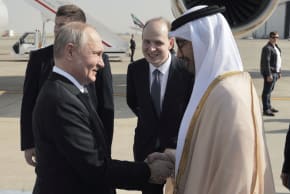
Iranian President Mahmoud Ahmadinejad shakes hands with Russian Security Council Secretary Igor Ivanov.

Photo: AP , AP

This news came on the heals of reports last month that Russia would sell 250 advanced long-range Sukhoi-30 fighter jets to Teheran. Russia has already supplied Iran with sophisticated air defense systems.

Why would Russia, a country that expects to be counted among the world's leading industrialized nations, be selling advanced weaponry to the most belligerent outlaw states? The claim that such sales are of defense weapons and are therefore harmless is risible and insulting. It is not possible, of course, to make such a claim regarding fighter jets, which obviously have advanced offensive capabilities. But air defenses are also offensive tools in the hands of belligerent nations, because they protect missile arsenals or nuclear facilities from preemptive or counterattack, thereby giving rogues states greater confidence that they can either attack directly or support terrorism with impunity.

Let's say, however, that Russia were selling purely defensive systems to Iran and Syria. This too would be unacceptable, because the sale of any weaponry to countries that are openly supporting terrorism and defying the international community directly conflicts with efforts to punish such behavior.

It is a failure of the international system that full arms embargoes have not been imposed on Iran and Syria. Both nations are already in violation of the UN embargo against supplying Hizbullah with weaponry, imposed after the Second Lebanon War. Syria, in particular, is responsible for a wave of prominent assassinations in Lebanon that is also under intense UN investigation.

Russia is doubly responsible for this international failure: first, by using its veto threat to block effective sanctions against Iran and Syria, and second with its bilateral arms deals that would violate the minimal sanctions that should long ago have been imposed to punish these nations' international aggression. There is no sign that Russian behavior is improving in this sphere. The idea that Russia is now competing with the US in pumping arms into the region is not an excuse, but an indictment.

While we would argue that it is a mistake to be selling additional advanced weaponry to Saudi Arabia without conditioning such sales on a host of changes - including the end of Saudi-based financing, by the billions, of schools indoctrinating jihad against the West; of anti-Israel boycotts and anti-Semitism; of support for Sunni militias in Iraq; and of support for Hamas in Gaza - selling weapons to Syria and Iran is obviously much worse.

International peace and security demands that the radical Islamist alliance of Iran, Syria, Hizbullah, Hamas and al-Qaida be isolated and defeated. In this global battle, Russia has been weighing in on the wrong side.

Rather than being held hostage by Russia and China in the UN Security Council, the US and Europe need to use the authority of already-passed resolutions to impose much tougher sanctions on Teheran and Damascus. In addition, Russia needs to know that it cannot remain a member in good standing of the G-8 - the international community's most exclusive club - while it is selling advanced weaponry to and running diplomatic interference for some of the world's most dangerous rogue states.

While President George W. Bush has often been accused of going it alone diplomatically, this certainly has not been the pattern with Russia. If anything, Bush is to be criticized for putting too much confidence in his "friendship" with President Vladimir Putin. This sort of soft touch has evidently reached its limits, as Putin has taken advantage of US reluctance to trim back its relations with Russia in any way, even though the US could threaten to withhold billions of dollars worth of space cooperation and other bilateral benefits to Russia.

Putin does not seem to respond to statements without consequences, such as American opposition to its arms sales. Nor is "friendship" a meaningful category in shaping his policies toward the region. American attempts to bolster its allies will be for naught if those allies see that the other side is continuing to escape sanctions and to grow in strength and influence.

Western willingness to impose consequences on Russia for its open support of rogue regimes will be a key litmus test for all nations that are making judgments regarding which side is serious enough to win. It is not the US that should fear jeopardizing its "friendship" with Russia, but Russia that should be concerned about losing the benefits of its current membership in the West.

RATE THIS ARTICLE
PrintSubscribe
Toolbar
+ Recommend:
facebook twitter del.icio.us reddit fark
What's this?
Post comment | Terms | Report Abuse
Most Original
eTeacher
Nefesh B'eNefesh
Kadish
JPost.com
KKL Picture of the week
Got a Question?
Have a question about something in this story? Ask it here and get answers from other users like you.


© 1995 - 2009 The Jerusalem Post. All rights reserved.    About Us | Media Kit | Exclusive Content | Advertise with Us | Subscribe | Contact Us | RSS
The online edition of The Jerusalem Post – JPost.com – provides first class news and analysis about Israel, the Middle East and the Jewish world. Whether news about Iran, Gaza, Syria, Fatah, Hamas or Hezbollah, JPost.com covers the burning issues of the Middle East and the Israeli-Arab conflict.