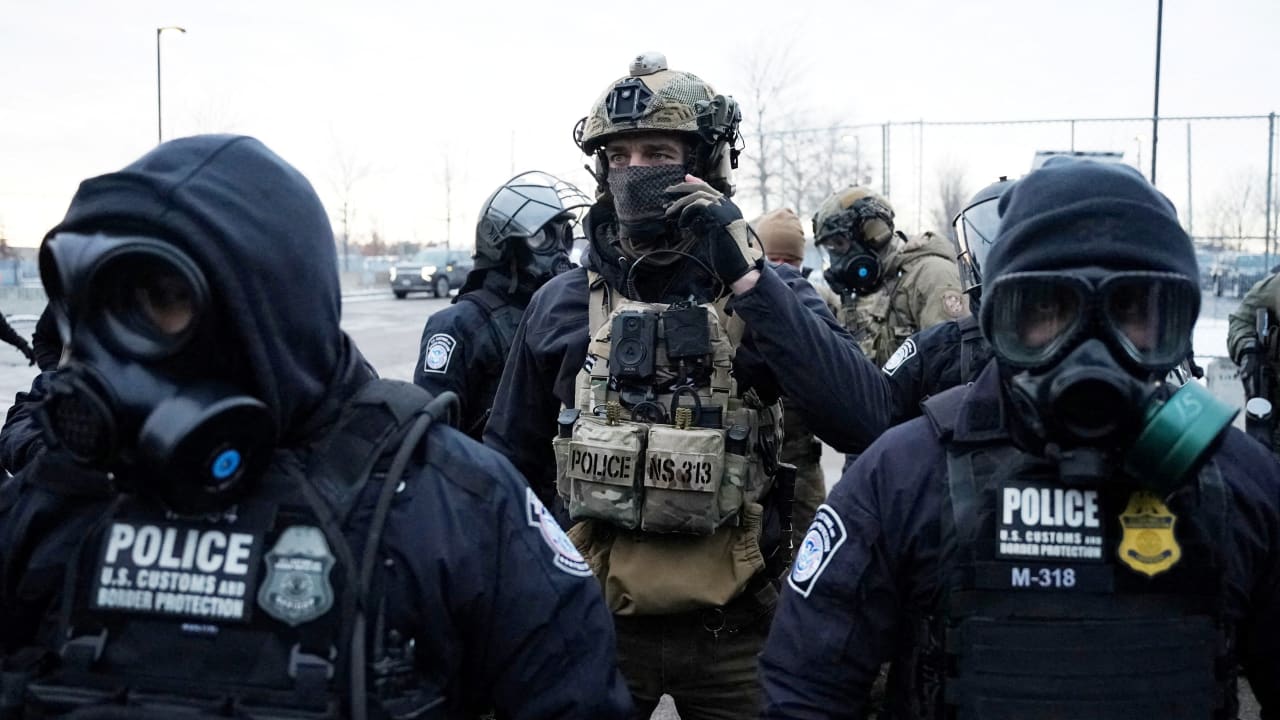
The Trump administration's operation against illegal immigration in Minneapolis will begin its "conclusion phase," border czar Tom Homan said at a press conference on Thursday, NBC News reported.
"I have proposed, and President Trump has concurred, that this surge operation conclude," Homan said.
Homan credited coordination between immigration officials and Minnesota's county jails as one reason for the operation's success.
The operation will begin to wind down this week, and activity will continue to decline into next week, Homan explained, adding that 700 agents will be sent home and that he himself will remain there "a little longer" to ensure the operation ends successfully.
The announcement comes weeks after two US citizens were shot and killed by immigration agents in separate incidents, both resulting in nationwide protests.
The context of the operation and its conclusion
Operation Metro Surge, the official name for the operation, began in November 2025, when over 3,000 immigration agents were deployed to Minneapolis in an effort to quell illegal immigration in the city. According to the Department of Homeland Security (DHS), more than 4,000 suspects were arrested during the operation, including more than 200 for impeding law enforcement.

Prior to Thursday's announcement, the operation had already begun a drawdown after the death of Alex Pretti, one of the two US citizens killed in recent weeks during the operation. Customs and Border Protection (CBP) officer Greg Bavino was removed from his role as commander at large of the operation after Pretti's death, with Homan then assuming the role.
"I don’t want to see any more bloodshed," Homan said. "I pray every night for the safety of law enforcement personnel and the safety of those in the community, whether you’re here legally or illegally. I don’t want to say anybody harmed."
Acknowledging the issues faced during the operation, Homan noted, "As I said in my first press conference a couple of weeks ago, President Trump didn’t send me here because operations were being run and conducted perfectly. I came here to identify issues and implement solutions to improve our mission execution."
ICE blocked detainees' access to lawyers in Minnesota, judge finds
A federal judge on Thursday ordered US Immigration and Customs Enforcement (ICE) to ensure that detainees in Minnesota have access to their attorneys, after finding that the agency had blocked thousands of people from seeing their lawyers during a recent enforcement surge.
US District Judge Nancy Brasel, who was appointed by Trump in his first term, said ICE’s practices during the recent Operation Metro Surge, including a policy of quickly moving detainees out of Minnesota and depriving them of phone calls, “all but extinguish a detainee’s access to counsel.”
Brasel issued the initial ruling in a class action lawsuit filed on January 27 on behalf of detainees, and her order will remain in place for 14 days while the proceedings play out.
The court order requires the government to stop rapidly transferring detainees out of the state and to allow attorney-client visits and private phone calls between detainees and their lawyers.
A US Department of Homeland Security spokesperson said detainees have access to phones to contact their families and lawyers and denied that there is any "overcrowding" at the Minneapolis federal building where detainees are processed.
Democracy Forward, a nonprofit that filed the lawsuit on behalf of detainees, said that the right to a lawyer is not "optional" in the US.
"DHS has been detaining people in a building never meant for long-term custody, shackling them, secretly transferring them out of state, and blocking access to counsel and oversight in a deliberate effort to evade accountability," Democracy Forward President Skye Perryman said in a statement.
ICE did not dispute that detainees have a constitutional right to counsel and said it does not have a policy of preventing them from seeing their lawyers, according to the ruling. But in practice, it provided conditions that isolated thousands of people from their attorneys, Brasel said.
The plaintiffs, who are noncitizen detainees, had provided substantial and specific evidence about their detention conditions, which contradicted ICE’s “threadbare” explanations of its policies and its protestations that it did not have enough resources to provide detainees with access to their lawyers, the judge found.
“Defendants allocated substantial resources to sending thousands of agents to Minnesota, detaining thousands of people, and housing them in their facilities,” Brasel said in her ruling. “Defendants cannot suddenly lack resources when it comes to protecting detainees’ constitutional rights.”
Most detainees are initially held at the Bishop Henry Whipple Federal Building in Minneapolis, but many are immediately transferred out of state, without notice, with no way for attorneys to contact them, according to the ruling.
Detainees are sometimes moved so quickly and frequently that ICE loses track of their whereabouts, the judge found.
Most detainees are provided some phone access, but that falls short of providing adequate legal representation, Brasel's ruling said.
ICE does not always provide the name or phone number of a lawyer when detainees ask, and phone calls often take place in a public area where ICE personnel and other detainees can listen in, according to the ruling.
One detainee in the lawsuit, a 20-year-old asylum seeker with a government-issued work permit, was sent to a detention center where ICE provided two flip phones to be shared among 72 detainees in a single holding cell, according to the court ruling. The detainees each had no more than two minutes for a call, it said.
The 20-year-old detainee was released after 18 days in detention, despite a court order requiring his release after five days. In the meantime, he was transferred first to Texas and then to New Mexico before being returned to Minnesota; ICE officers never told him why he was detained or why he was released, according to the ruling.
DOJ moves to drop charges against men arrested after Minneapolis ICE shooting
The DOJ has moved to drop charges against two men charged with assaulting Immigration and Customs Enforcement officers in Minneapolis in January after an officer shot a Venezuelan immigrant, a court document showed on Thursday.
The top federal prosecutor in Minnesota, Daniel Rosen, asked a judge to dismiss the charges, writing that "newly discovered evidence in this matter is materially inconsistent with the allegations." Rosen sought dismissal with prejudice, meaning the charges cannot be reintroduced.
The shooting that wounded the Venezuelan man, Julio Cesar Sosa-Celis, came during Operation Metro Surge.
The DHS, which oversees Trump's immigration crackdown, said in January that officers were conducting a targeted traffic stop on Sosa-Celis when he sped away, crashed his car, and fled on foot.
DHS said at the time that Sosa-Celis and two other men hit an ICE officer who pursued him with a snow shovel and broom handle, prompting the shooting.
But court documents unsealed later told a different story.
An FBI affidavit said the ICE officers had scanned a license plate registered to a different person suspected of an immigration violation, leading them to chase the wrong person.
The affidavit said another man was driving the car and was the sole occupant, not Sosa-Celis. The car's actual driver - another Venezuelan immigrant - crashed and fled to an apartment building where Sosa-Celis was present, it said.
At the building, an ICE officer trying to detain the driver was struck by him and Sosa-Celis with a broom, while a third man used a shovel, before the officer fired.
While DHS said initially that the officer "fired a defensive shot to defend his life," the FBI affidavit said the alleged attackers dropped the broom and shovel when they saw the officer draw his gun and were fleeing as he fired.
Rights advocates say Trump's actions have made the environment unsafe for citizens and immigrants and violate due process protections.
Reuters contributed to this report.