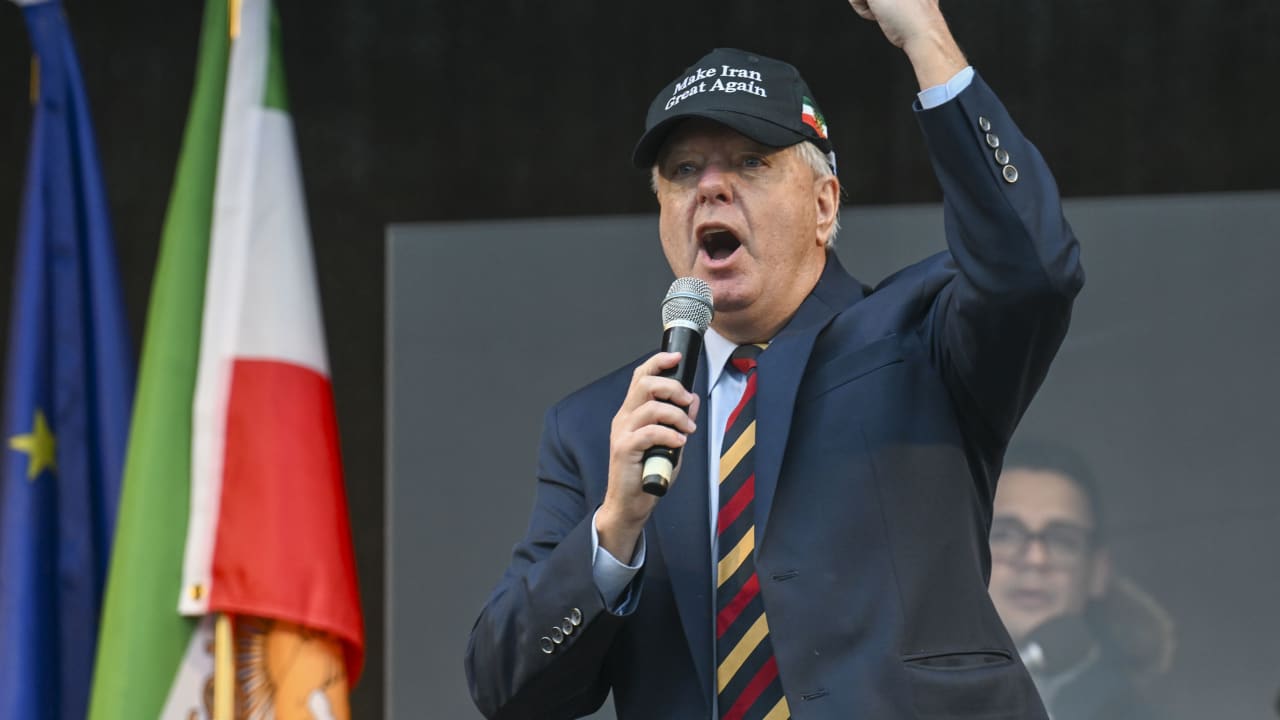
Republican US Senator Lindsey Graham expressed frustration with Gulf leaders during an interview with Christiane Amanpour at the Munich Security Conference on Friday, saying, "I'm tired of this c***."
Graham was interviewed alongside Iranian Crown Prince Reza Pahlavi and European Parliament President Roberta Metsola.
Graham claimed that the Iranian regime is currently at its weakest point and that the time has come for US military intervention promised in US President Donald Trump's January statement that "help is on the way."
He also likened Iranian Supreme Leader Ali Khameini to Adolf Hitler, saying:
"Hitler wrote a book [saying that] he wanted to kill all the Jews. Nobody believed him. I believe the Ayatollah and his regime - not the Iranian people - are religious fanatics, religious Nazis. Hitler wanted a master race; they want a master religion."
He then compared Trump's "help is on the way" post to Ronald Reagan's address at the Berlin Wall in 1987, in which he famously said, "Mr. Gorbachev, tear down this wall!"
He clarified that both he and Trump would prefer a diplomatic solution, but the Iranian regime - which he referred to as "the mothership of terrorism" - must fall one way or another.
Asked about the possibility of someone worse than Khameini taking over Iran in the power vacuum which could result from the US dismantling the regime, Graham assured Amanpour that the likelihood of that outcome was "pretty low."
"The risk associated with a regime change is real," he admitted, "but we have troops in the region... we're still the United States... We have incredible capability. I know we would win a conflict."
If Iran's regime remains standing, Graham argued, it would be a disaster for the region, with all Iranian dissidents being killed off, and Hezbollah, Hamas, and the Houthis growing stronger over time.
He added that he is planning to visit Israel, Saudi Arabia, and the UAE this coming week, with the following message: "If we can [take down the Iranian regime] through diplomacy, fine. But we've had it with this regime. Think big...Don't let this moment pass."

Graham then addressed the rift between Saudi and Emirati leaders, Saudi Crown Prince Mohammed bin Salman and Emirati President Mohamed bin Zayed al-Nahyan.
"Knock it off, Saudi Arabia, I'm tired of this c***. MBZ is not a Zionist, and you're emboldening Iran by having this conflict. I know they've got differences in Yemen and Sudan, but we've got to think big picture."
Why are UAE and Saudi Arabia at odds?
The two Gulf powers have both been highly involved in the power struggle in nearby Yemen, each backing opposing factions.
The dispute broke into the open last year when UAE-backed separatist fighters pushed Saudi-backed forces aligned with the internationally-recognized Yemeni government out of key provinces.
In late December, Saudi Arabia struck what it said was an Emirati shipment of weapons and equipment destined for the STC, Yemen's main separatist group, at the port of Mukalla, before backing an offensive that saw the STC collapse and the UAE withdraw after nearly a decade as the main force on the ground in Yemen.
Disagreements between Riyadh and Abu Dhabi span the region and range across topics from geopolitics to oil output. The two countries are also engaged in fierce economic competition, including over who can attract more foreign capital and visitors and take the biggest share of the global AI boom.
Reuters contributed to this report.