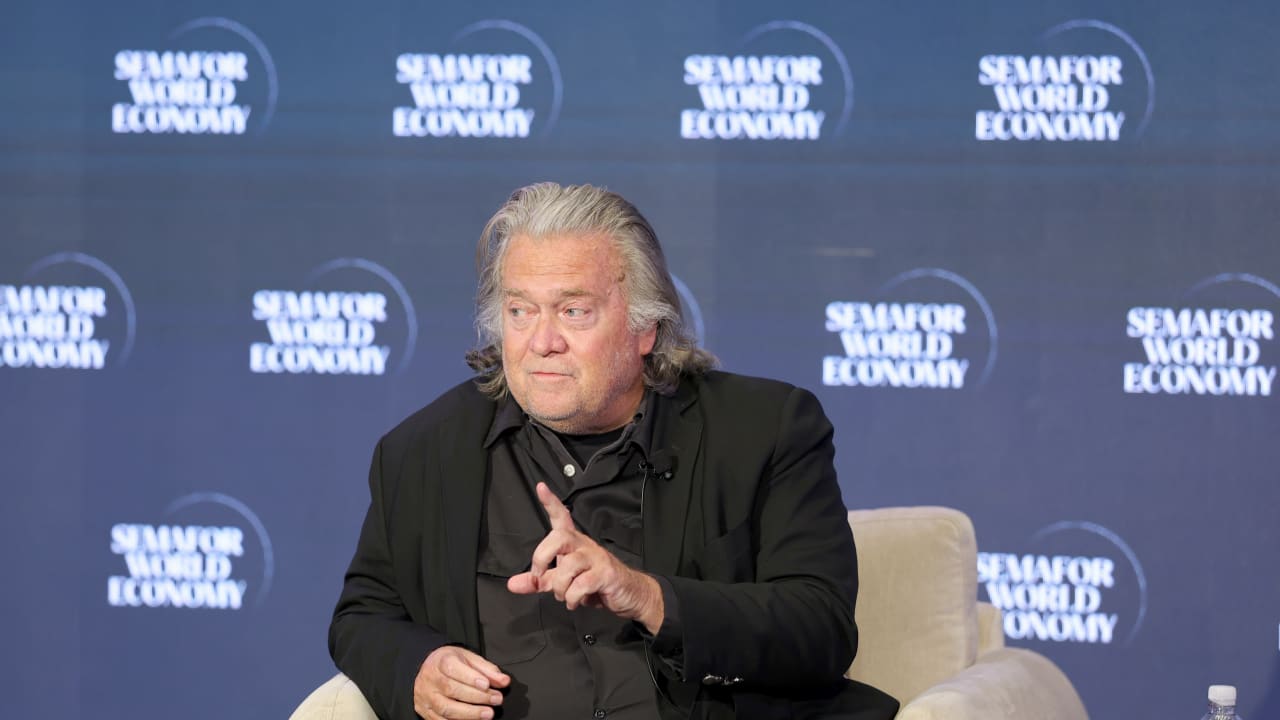
Far-right podcast host Steve Bannon has partnered with far-left politicians Rep. Alexandria Ocasio-Cortez (NY) and Bernie Sanders (VT) to warn against the dangers of artificial intelligence and the data centers that power it, the Wall Street Journal said Thursday.
Bannon, who once served as US President Donald Trump's chief strategist, has publicly backed Sanders and Ocasio-Cortez's proposal to ban the construction of new data centers and has rallied support against the Trump administration's recent industry-friendly AI strategy, which bans states from passing their own regulations, according to the report.
Trump has pushed hard for new data centers, writing that “[t]he only reason that communities throughout the USA should not want Data Centers is if they want to end up being backwards and poor,” in a post on social media on Monday.
Bannon has aligned himself with Democratic progressives on the issue, setting aside disagreements over issues such as immigration, believing that it is the "defining issue" of the future, the WSJ wrote.
“If we don’t get this right, none of that other stuff is going to matter,” Bannon said in an interview. “I have not seen any issue in modern American life that, at the populist level, unites disparate elements of our country more than this.”

“Politics is always a situation where you make strange coalitions and different coalitions every day,” Bannon said.
Sanders addresses unlikely alliance with Bannon
Sanders commented on the unlikely alliance with Bannon in an interview.
“Politics is always a situation where you make strange coalitions and different coalitions every day. But on this issue, I think many of the right-wing people have the same concerns that I have.”
These concerns uniting the rival camps are power and water consumption, job loss, distrust of big tech, and surveillance.
The issue has been building for more than a year and is emerging as a contentious political debate ahead of this year’s midterm elections.
Campaign ads criticizing data centers have appeared in more than 70 US House and Senate races since 2025, according to a Wall Street Journal review of AdImpact transcripts. The backlash has pushed congressional and gubernatorial candidates to revisit their previous support for the industry.
Most recently, Texas Gov. Greg Abbott (R) and Pennsylvania Gov. Josh Shapiro (D), a potential 2028 Democratic presidential candidate, have moved to pause or restrict some data center projects after previously touting the sector’s economic benefits.
Despite growing opposition, attempts to enact major legislation targeting data centers have gained little traction in Congress. A bill introduced by Sanders seeking a federal moratorium on new data center construction has attracted no Senate co-sponsors, while the House version, sponsored by Ocasio-Cortez, has support from 14 Democratic lawmakers.
Other proposals backed by lawmakers from both parties, including measures addressing data center energy consumption, artificial intelligence regulation, and chip export controls, have made progress in Congress but have not yet become law.
Industry advocates, Trump allies push back on restrictions
The regulation efforts have also faced opposition from technology companies and some Trump allies, who argue that additional restrictions could undermine US competitiveness.
The political divide over data center regulation has drawn criticism from both supporters and opponents of new limits. Montana Sen. Tim Sheehy (R) argued that restrictions on major industries had repeatedly hurt American workers.
“First they killed our timber mills, then our mines, then our factories - now data centers. Every good-paying, middle-class employment powerhouse has been systematically murdered by globalist and communist lobbying in America,” Sheehy wrote on X/Twitter.
Industry advocates have also pushed back against calls for broader restrictions. Venture capitalist Joe Lonsdale, a co-founder of Palantir and Trump donor, said the administration and technology sector needed to confront what he called “crazy populists.” He referred to the opposition as the “BBC,” an acronym for Bernie, Bannon, and the Chinese Communist Party.
“All those people want to ban data centers, and they want America to lose,” Lonsdale said on Fox Business. “We have to make sure the BBC radicals lose.”