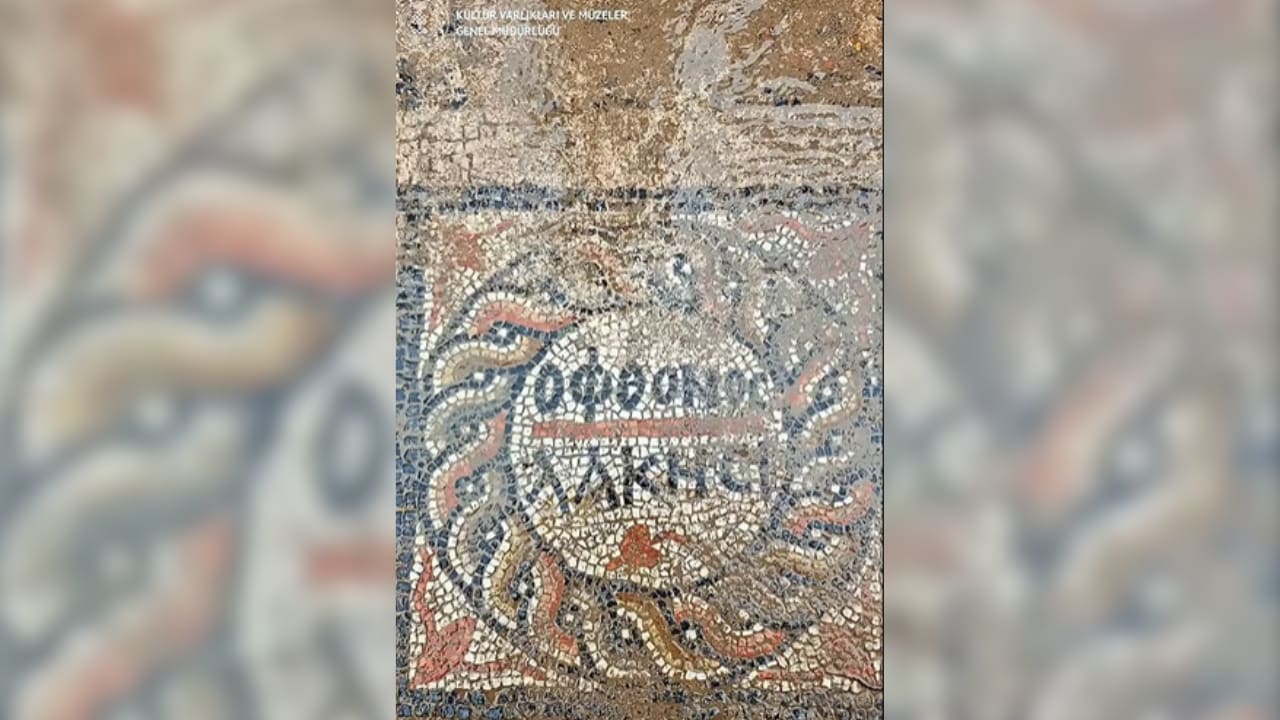
A 1,500-year-old mosaic bearing two ancient Greek inscriptions was discovered during excavations in the ancient port city of Syedra in southern Turkey, the Turkish General Directorate of Cultural Heritage and Museums announced in a mid-March social media post.
The first inscription, found at the top of the mosaic, roughly translates to “may the jealous burst with envy,” a phrase similar in meaning to “haters gonna hate.”
“It has a figurative meaning: the first word refers to ‘the jealous,’ while the second conveys ‘bursting’ or ‘splitting’,” Ergurer explained to Andalou Agency (AA). “Finding such a phrase at the entrance of a 1,500-year-old building was a great surprise for us.”
The second inscription is featured in the center of the mosaic translates to “use with luck” or “farewell with good wishes,” according to Ergurer.
In addition to the two inscriptions, the mosaic consists of geometric patterns and several floral motifs.
Restoring mosaic to former glory
Ergurer shared with AA that the well preserved mosaic was found in one of Syedra’s largest, and believed to have been important, buildings.
“The building contains numerous rooms and a central courtyard. It was in use from the 2nd to the 7th centuries CE,” Ergurer was quoted by AA as saying, further noting that during that period, rooms were added, floors built, and some areas closed off.
“In later periods,” he added, “the entrance and the mosaic section were covered, which helped preserve the mosaic in such excellent condition until today.”
According to AA, both the building and the mosaic have been placed under protection as restoration efforts continue.