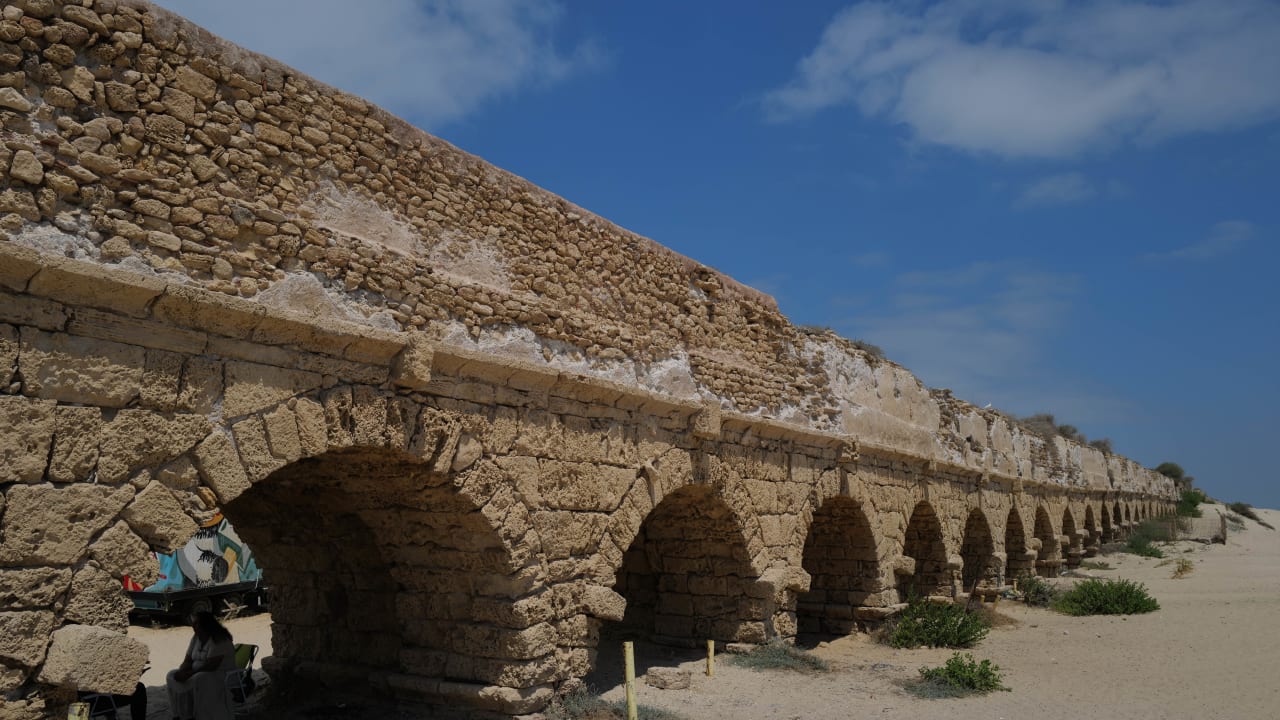
The Carmel Beach Regional Council, the Caesarea Development Company (CDC), and the Israel Antiquities Authority (IAA) signed a joint agreement this past week to preserve the famed Roman-era aqueduct in Caesarea, the IAA has announced.
“The Caesarea Aqueduct, one of the most spectacular engineering works left by the Roman period in the Land of Israel, has in recent years suffered from the ravages of time, natural erosion and weathering, even leading to collapses in some sections,” read the IAA statement.
According to the agreement, a total of NIS 15 million will be invested into the project by the Edmond de Rothschild Foundation, the IAA, and the Carmel Beach Regional Council. The CDC will invest an additional NIS 24 million toward “upgrading the aqueduct’s environs and the famed picturesque beach with the arches.”
Originally constructed by King Herod approximately 2,000 years ago, around 20 BCE, the aqueduct is built on top of arches, consisting of a canal that brought drinking water from springs in the south of the Carmel region to the city of Caesarea.
In 130 CE, the Roman Emperor Hadrian ordered extensive repairs and the construction of additions to the aqueduct after visiting the city. One of the arches repaired by Hadrian collapsed in 2023.

Antiquities restoration, building tourism infrastructure
Preservation efforts have already begun, the IAA noted, adding that the project is expected to take about 40 months.
“The work will include planning, conservation, the constructive stabilization of each of the aqueduct’s 85 arches, engineering treatment of the upper aqueduct (the water channel itself), and of course, arranging a safe pedestrian crossing under the arches,” the IAA said.
The authority added that it would be responsible for treating the damage caused to the aqueduct over the years, as well as “the restoration and scientific supervision, in accordance with its strict standards for preserving heritage assets for future generations.”
While the IAA works on the aqueduct’s restoration, the CDC will work on “upgrading the visitor experience at the Arches Beach and around the aqueduct’s environs” by managing finances and overseeing the “execution of the development and tourism upgrade work in the aqueduct and beach area,” including “infrastructure construction, landscape maintenance around the aqueduct, walking trails, parking arrangements, building visitor bathrooms, all while continuously ensuring a unique combination of nature, heritage, and recreation.”