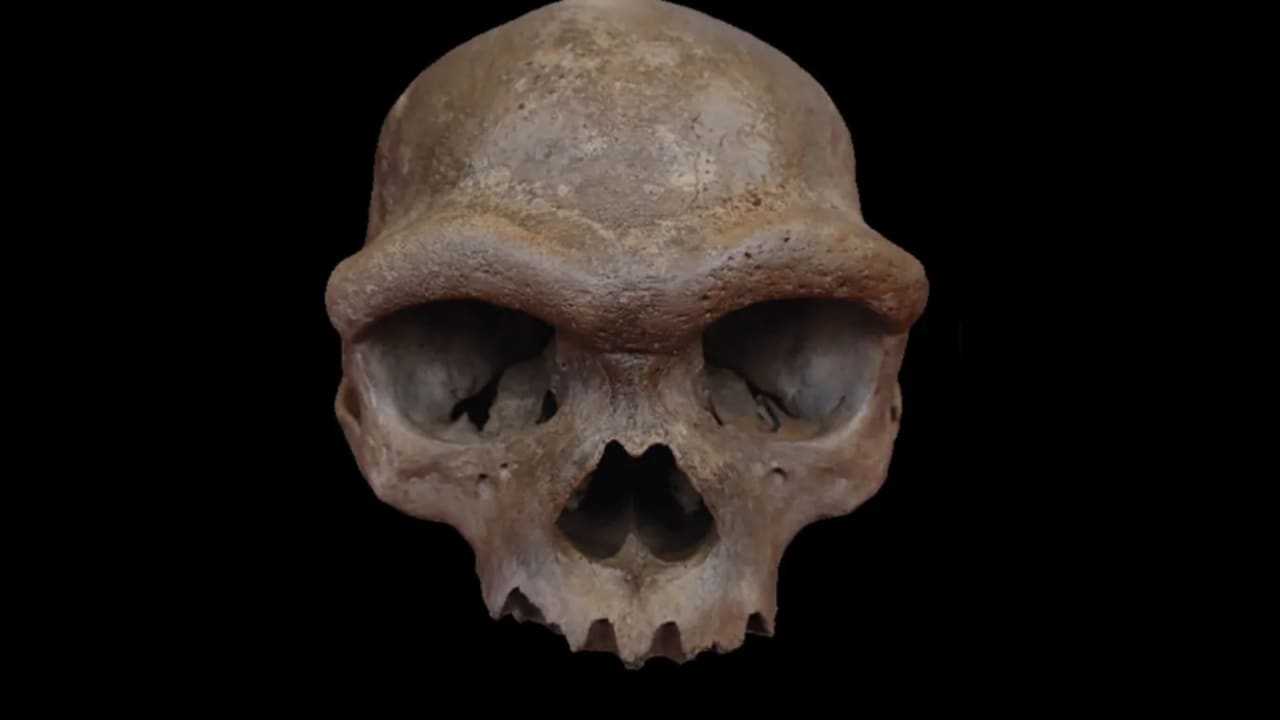
Two studies published on Wednesday in the journals Science and Cell presented molecular evidence confirming that the 146,000-year-old Harbin skull, discovered near Harbin in northeast China, represents a definitive Denisovan fossil, according to Ars Technica.
Researchers from the Institute of Vertebrate Paleontology and Paleoanthropology (IVPP) in Beijing identified 20,455 peptides from the Harbin cranium, yielding the highest-quality ancient hominin proteome data to date, including matches to specific proteins from Denisovan bones and teeth, according to Science News. In samples from the Harbin skull's temporal bone, the researchers found fragments of 95 proteins, representing an 11-fold increase in peptide coverage over previous contemporaneous fossil analyses.
"This is the first time we have connected a [fossil] cranium to Denisovans," said Qiaomei Fu, an evolutionary geneticist at the Institute of Vertebrate Paleontology and Paleoanthropology in Beijing, according to Science News.
The Harbin skull, nicknamed Dragon Man, is nearly complete and roughly 146,000 years old. It was unearthed in Harbin, China, during the Japanese occupation of the area, possibly during bridge construction. Until 2021, only one person had known what the Harbin skull looked like since its discovery in the 1930s, as the laborer who found it kept it hidden for most of the rest of his life.
The skull features a long, low braincase and a massive brow ridge, along with a broad nose and big eyes. Its cranium is longer and less dome-like than that of modern humans. Some traits of the Harbin skull, like the large molars and the long, low cranium, resemble those of earlier hominin species such as Homo erectus or Homo heidelbergensis, while other traits, like a relatively flat face set beneath the cranium, look more like modern humans.
Researchers recovered some information on proteins from an inner ear bone of the Harbin skull, and the skull still contains enough of its original proteins to tell a different story, according to Live Science. By comparing the proteome to those of contemporary humans, Neanderthals, Denisovans, and nonhuman primates, the researchers found a clear connection between the Harbin cranium and early Denisovans, matching Denisovans on three of these proteins.
Mitochondrial DNA (mtDNA) recovered from the Harbin skull showed that Dragon Man was related to an early Denisovan group that lived in Siberia from around 217,000 to 106,000 years ago. The new genetic evidence suggests that Denisovans with a shared maternal ancestry ranged from Central to East Asia, indicating a wide distribution from Siberia to northeast China during the late Middle Pleistocene.
Chris Stringer, a paleoanthropologist at the Natural History Museum in London, stated the new studies make it likely that the Harbin cranium is the most complete fossil of a Denisovan found so far. "This is particularly important because DNA does not preserve well in most fossils," he said, according to Live Science.
With the identification of the Harbin skull as Denisovan and the identification of a jawbone found off the coast of Taiwan as Denisovan in a study published in the journal Science in April, paleoanthropologists now have definitive examples that other unknown skulls.
Until now, the Denisovan group of early humans was known mostly from their DNA and a tiny handful of fossils, which are mostly small fragments that don't reveal much about how they lived or what they looked like, according to Live Science. Denisovans are the only human species identified not by the shape of their bones and skulls, but by DNA extracted from tiny bone fragments found in the Denisova Caves in Russia.wqw"
The molecular identification of the Harbin cranium confirms that Denisovans were a successful group, surviving for tens of thousands of years in diverse environments in Asia. The researchers wrote in the Cell study that this finding means that Denisovans inhabited a large geographical range in Asia, according to Live Science.
The origins of Denisovans and Neanderthals, and who their ancestors were, remains a mystery. With the extremely well-preserved Harbin skull identified as a Denisovan, scientists are finally able to look their "ghost" cousins in the face, as Ars Technica noted.
The discovery overturns the previous understanding that Homo longi is a new human species native to Asia; it is now believed to be a Denisovan, according to EL PAÍS English Edition. In 2021, a team of five Chinese researchers suggested that the unusual skull belonged to a previously unknown species, which they officially named Homo longi, or "Dragon Man," inspired by the Long Jiang Dragon River region where it was found, as reported by Live Science. However, the new studies provide molecular evidence that the Harbin skull is actually a Denisovan related to its Siberian counterparts.
"These studies are important for identifying what Denisovans actually looked like," researchers wrote in the Science study, according to Live Science. "Denisovans are the new star of human evolution," summarizes Antonio Rosas, a paleoanthropologist at the Spanish National Research Council, reflecting their growing importance in the field.
Produced with the assistance of a news-analysis system.