A group of rock-cut tombs dating back to the Old Kingdom were discovered by a team of archaeologists during recent excavations on the west bank of the Nile River, Egypt's Tourism and Antiquities Ministry announced on social media earlier this week.
The tombs, discovered at the Qubbet el-Hawa site, were complete with shafts and burial chambers. The site itself was first excavated in the 1800s and was inscribed on the UNESCO World Heritage List in 1979.
It is known to researchers to contain a collection of tombs spanning different historical periods, from the Fourth Dynasty of Egypt and all the way to the Greco-Roman era. As of 2022, Egypt’s Tourism and Antiquities Ministry had documented 100 tombs discovered at the site.
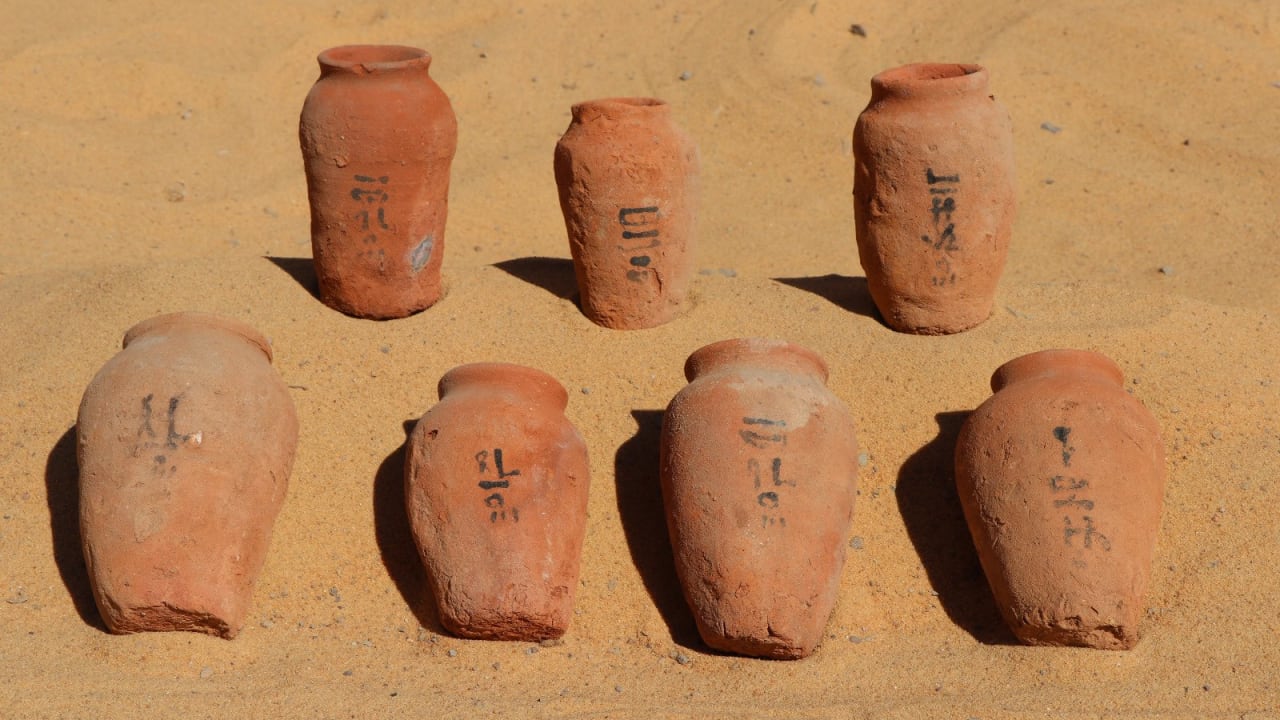
Inside the tombs, archaeologists succeeded in uncovering approximately 160 pottery vessels, most in good condition and bearing Hieratic script, a cursive writing system that had developed from heiroglyphics.
Preliminary studies suggest the vessels were used for storing liquids and grains, according to Mohamed Abdel-Badie, Head of the Egyptian Antiquities Sector at the Supreme Council of Antiquities (SCA).

He added that bronze mirrors, alabaster vessels, strings of colorful beads, and assorted amulets dating back to the Middle Kingdom had been excavated in the tomb’s outer courtyard.
“The Egyptian mission continues to work on-site to uncover more tombs and artifacts,” he noted.
Importance of discovering ancient Egyptian relics
Egyptian Tourism and Antiquities Minister Sherif Fathy praised the archaeologists working tirelessly to make the discoveries, noting how they have made an impact on the “archaeological landscap,e and contributed to boosting the appeal of the cultural tourism offering for lovers of ancient Egyptian civilization around the world.”
Fathy added that his ministry will continue to support archaeological digs in order to reveal “more secrets of ancient Egypt,” and strengthen Egypt’s position on the international tourism map.
Dr. Hisham El-Leithy, Acting Secretary-General of the SCA stressed the importance of this discovery in adding to and deepening our understanding of the Qubbet el-Hawa site.
“It is clear that the discovered tombs date back to the Old Kingdom and were reused during the First Intermediate Period and the Middle Kingdom,” Leithy added, “highlighting the site's significance across different eras.”