
A shelter containing rock art spanning nearly 10,000 years was discovered by a team of archaeologists in the southern Sinai, the Egyptian Tourism and Antiquities Ministry announced last week.
The find was discovered on the Umm Arak Plateau as part of an ongoing mission to survey and document rock inscriptions in the area, the ministry stated.
According to Mohamed Abdel Badie, Head of the Egyptian Antiquities Sector, the archaeologists had been guided to the location by Sheikh Rabie Barakat, a resident of the nearby Serabit el-Khadim locality.
Archaeologists managed to fully document the site, including the sandstone shelter, which extends for more than 100 meters in length. It is between two and three meters deep, and between a meter and a meter and a half tall.
Rock art drawn in red pigment depicting various animals and symbols was discovered on the ceiling of the shelter, as well as an additional group of grey-colored drawings, documented for the first time.
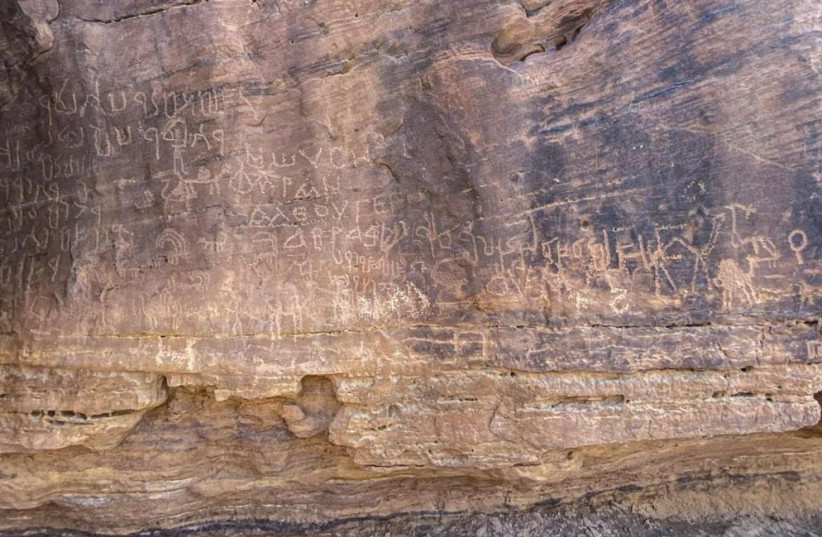
In addition, a series of engravings were found in the shelter, including a sunken relief showing a figure using a bow to hunt an ibex, accompanied by several hunting dogs.
Scenes of armed, war-like figures riding camels and horses were also discovered. Some of these scenes were accompanied by Nabataean inscriptions.
The engravings and drawings are divided into several chronological groups, researchers learned in their initial study of the space, the oldest of which are done in red and dated to between 10,000 and 5,500 BCE.
Shelter has been in use for thousands of years
Dr. Hisham Hussein, Head of the Central Administration for Lower Egypt Antiquities, explained that a large quantity of animal droppings had been found in the shelter, indicating that it had later been used as a refuge against rain and cold for humans and livestock.
“There were also stone partitions forming independent living units, with remnants of fire layers in their center,” Hussein added, which confirmed repeated human use of the site.
Flint tools and pottery fragments also discovered within the shelter, believed to date to the Middle Kingdom and around the third century CE in the Roman period, reinforce Hussein’s statement.
Egyptian Supreme Council of Antiquities Secretary-General Hisham el Leithy noted that the site is one of the most important rock art locations discovered recently.
He further noted that the “chronological and technical diversity” of the carvings makes the space an “open-air natural museum, documenting the development of human symbolic and artistic expression from prehistoric times to the Islamic periods, giving the site exceptional scientific importance.”
The discovery is a “major addition to Egypt's archaeological map, reflecting the unique cultural and human richness of Sinai,” Egyptian Tourism and Antiquities Minister Sherif Fathy said, adding that the find “provides new evidence of successive civilizations in this vital part of Egypt's land over thousands of years.”