
Iran has given sweeping assurances to the UN nuclear watchdog that it will finally assist a long-stalled investigation into uranium particles found at undeclared sites and even re-install removed monitoring equipment, the watchdog said on Saturday.
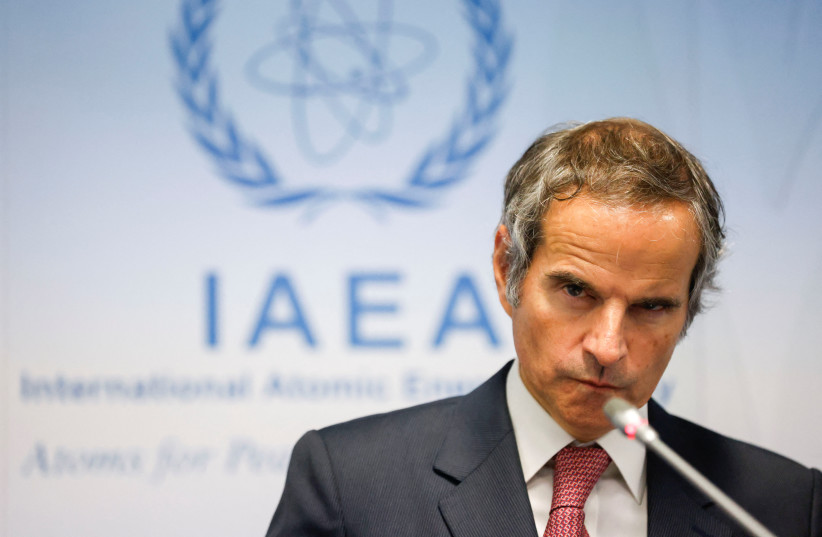
The International Atomic Energy Agency and Iran issued a joint statement on IAEA chief Rafael Grossi's return from a trip to Tehran just two days before a quarterly meeting of the agency's 35-nation Board of Governors.
The statement
The statement went into little detail and did not guarantee that Iran would actually follow through, but the possibility of a marked improvement in relations between the two is likely to stave off a Western push for a third consecutive International Atomic Energy Agency resolution, and possibly even UN Security Council action, ordering Iran to cooperate, diplomats said.
Iran has, however, made several similar promises before that have yielded little or nothing when it had to actually produce explanations regarding suspicions of prior military dimensions of its nuclear program.
The statement went into little detail and did not guarantee that Iran would actually follow through, but the possibility of a marked improvement in relations between the two is likely to stave off a Western push for a third consecutive resolution, and possibly even UN Security Council action, ordering Iran to cooperate, diplomats said. Iran has, however, made several similar promises before that have yielded little or nothing when it had to actually produce explanations regarding suspicions of prior military dimensions of its nuclear program.
The possibility that Iran might have mellowed in its attitude toward the IAEA, included a rare meeting between Grossi and Iran President Ebrahim Raisi, comes amid reports that it has uranium enrichment has reached 84%, a level that is very close to 90% weapons-grade enrichment.
It’s a level that is only necessary if one is producing nuclear weapons. The report of its 84% enrichment and its execution of protesters, has swayed European countries and the United States to take firmer diplomatic action against Iran’s nuclear weapons program.
Israel has used this shift in attitude to tighten its alliance with Europe and the United States against Iran, as it seeks a common united front. Israel has insisted in particular that only a credible military threat can thwart Iran’s nuclear program.
National Security Adviser Tzahi Hanegbi and Strategic Affairs Minister Ron Dermer are expected to visit Washington this week to discuss Iran.
Israel on Friday hosted the top US military officer, Army General Mark Milley, on Friday for discussions that it said included the need for cooperation on denying Iran nuclear weaponry.
Milley made the previously unannounced visit ahead of a trip to Israel by US Defense Secretary Lloyd Austin that will also include neighboring Egypt and Jordan.
"Ongoing cooperation is required in order to prevent Iran from gaining a nuclear weapon," Israeli Defense Minister Yoav Gallant's office quoted him as telling Milley, chairman of the US Joint Chiefs of Staff.
Milley made no public remarks in Israel. His spokesperson said Milley discussed regional security issues and "coordination to defend against threats posed by Iran" in his talks with Chief of the Israeli General Staff Lieutenant General Herzi Halevi.
On Saturday, Iran gave a nod in the direction of the international community and seemed suddenly ready to cooperate with the IAEA.
"Iran expressed its readiness to ... provide further information and access to address the outstanding safeguards issues," the joint Iranian statement with the IAEA said. A confidential IAEA report to member states seen by Reuters said Grossi "looks forward to ... prompt and full implementation of the Joint Statement."
"Iran expressed its readiness to ... provide further information and access to address the outstanding safeguards issues."
Iranian statement with the IAEA
Iran is supposed to provide access to information, locations and people, Grossi told a news conference at Vienna airport soon after landing, suggesting a vast improvement after years of Iranian stonewalling.
Iran would also allow the re-installation of extra monitoring equipment that had been put in place under the 2015 nuclear deal, but then removed last year as the deal unraveled in the wake of the US withdrawal from the deal in 2018 under then-President Donald Trump after the Mossad exposed that Iran had been concealing aspects of its nuclear program from the IAEA. US President Joe Biden’s efforts to revive the deal have faltered and the Biden administration has said it’s not possible at this time to resume negotiations.
Follow-up talks in Iran between IAEA and Iranian officials aimed at hammering out the monitoring details would happen "very, very soon," Grossi said.
Asked if all that monitoring equipment would be re-installed, Grossi replied "Yes." When asked where it would be re-installed, however, he said only that it would be at a number of locations.
Yonah Jeremy Bob contributed to this report.