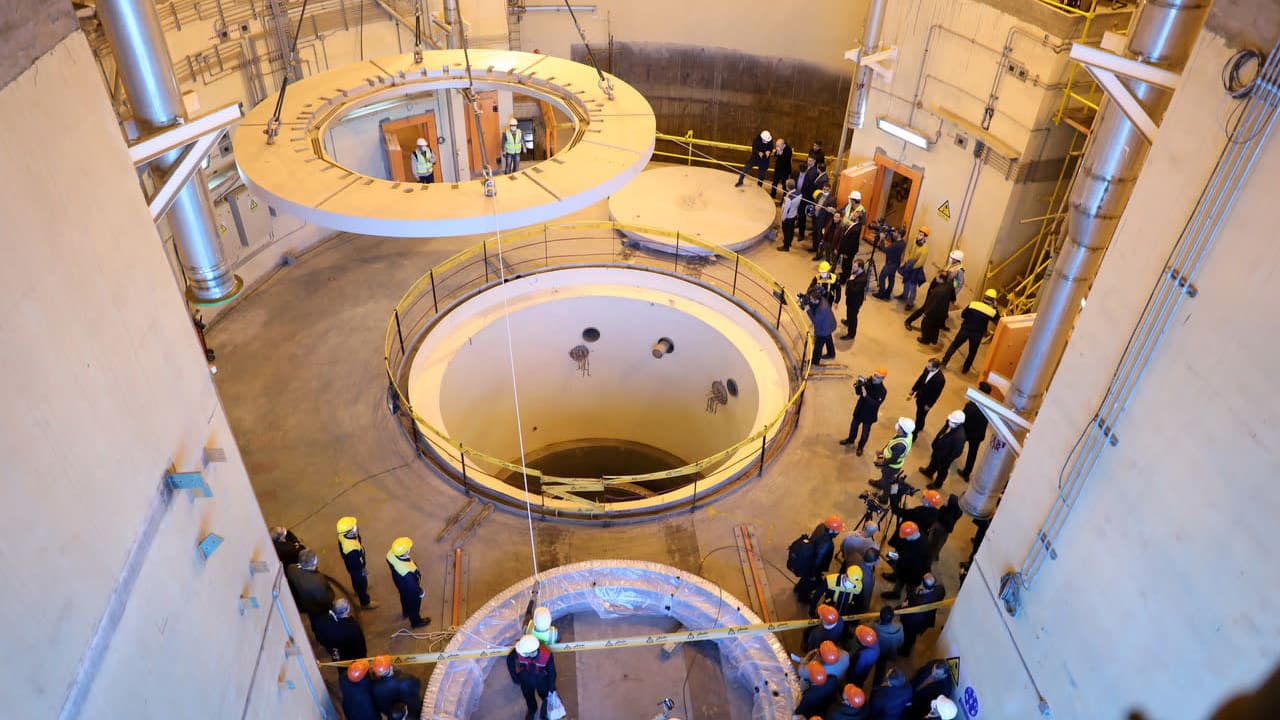
"Of course, the security and intelligence officials must give the final reports, but apparently it is the crime of the Zionists, and if the Zionists act against our nation, we will answer it," Iranian president Hassan Rouhani said in a televised cabinet meeting.
"Our response to their malice is replacing the damaged centrifuges with more advanced ones and ramping up the enrichment to 60% at the Natanz facility."
Iranian authorities have described the incident as an act of “nuclear terrorism”.
Rouhani, echoing Iran's stance for decades, said Tehran had no intention to obtain or develop nuclear weapons.
"They (Israel) want our hands to be empty in the negotiations, but we will be in the negotiations with a stronger hand," Rouhani said.
Fissile material must reach 90% purity to be used for a nuclear weapon. Under the 2015 nuclear deal, Iran was meant to enrich uranium to under 5%, until it expired in 2030.
Before 2015 and since Iran began violating the nuclear deal in 2019, Iran enriched its stock to about 20%.
Even the jump to 20% set off alarms globally as taking a major additional step toward a nuclear weapon – especially since there is no viable civilian use for 20% enriched uranium.
But to date, Iran has not enriched uranium up to 60%, often referred to as the next level for jumping toward a nuclear weapon.
US President Joe Biden has called for Iran to return to compliance with the Joint Comprehensive Plan of Action, as the world powers’ 2015 nuclear agreement with Iran is called, in exchange for the US lifting sanctions placed on Iran in recent years and an American return to the JCPOA.
A State Department spokesperson said talks would continue, following Iran's declaration, and that the negotiations had thus far been constructive.
"We take seriously Iran’s provocative announcement of its intention to begin enriching uranium to 60%, which the P5+1 should be unified in rejecting," the spokesperson said, referring to the parties to the JCPOA.
"This step both calls into question Iran’s seriousness with regard to the nuclear talks and underscores the imperative of returning to mutual compliance with the JCPOA."
However, the US National Security Advisor Jake Sullivan “reaffirmed the Biden-Harris administration’s unwavering commitment to Israel’s security and to ensuring Iran will never obtain a nuclear weapon,” in a virtual meeting with his Israeli counterpart Meir Ben-Shabbat on Tuesday. This was their second strategic consultation, and they said they would continue an open dialogue in the months ahead. Sullivan invited Ben-Shabbat to visit Washington later this month.
Russia's Ambassador in Vienna Mikhail Ulyanov, who is involved in the nuclear talks, tweeted that on Thursday, "no doubt that in addition to previous issues the Commission will address the latest steps of Iran in the nuclear field, including 60% enrichment."
The European parties to the Iran deal – the UK, France and Germany – have spoken out against Iran’s recent increase of enrichment to 20% and its development of uranium metal, pointing out that they have no credible civilian use, but not immediately.
An Israeli official said that enrichment to 60% is “breaking a threshold where it's very clear what they're doing and obviously this is well on the way for a weapons-grade material.”
The official explained that this highlights the core problem with the JCPOA, that it allows Iran to maintain “the infrastructure in place that allows it to do this. It's only a matter of a political decision.”
Sources told The Jerusalem Post that Iran's threat may be more of a boast as they may not really yet have achieved the capability of enriching uranium at the 60% level. Even if they might have had the capability a few days ago, Sunday's wiping out of the Natanz power grid might also make the statement more of a future than a present threat.
Still, even a public commitment to enrich at that level would be unprecedented for Iran and could show its seriousness to move closer to the nuclear threshold.
Alex Winston contributed to this report.