
The use of artificial intelligence for “vibe coding” will replace the role of UX/UI front-end engineers with designers and product managers within a year or two, according to Keren Fanan, co-founder and CEO of Israeli AI platform MyOp.
Fanan spoke to The Jerusalem Post on Sunday after organizing the first vibe-coding hackathon for students at the Bezalel Academy of Arts and Design in Jerusalem, which aimed to prove that anyone can create platform features without a developer’s background.
“Vibe coding” refers to using AI to write code without a prior technical background.
“The idea came from Pic-Time, a very successful platform that photographers use to manage their entire business,” Fanan said. “They use our platform, MyOp, as their internal vibe coding tool.”
Hanan Lehr, the chief UX officer at Pic-Time, told the Post: “It’s part of a concept we’ve been implementing at Pic-Time for about 10 months. We’ve changed the roles of our designers and product managers. We’ve changed the title from ‘designer’ to ‘builder.’”
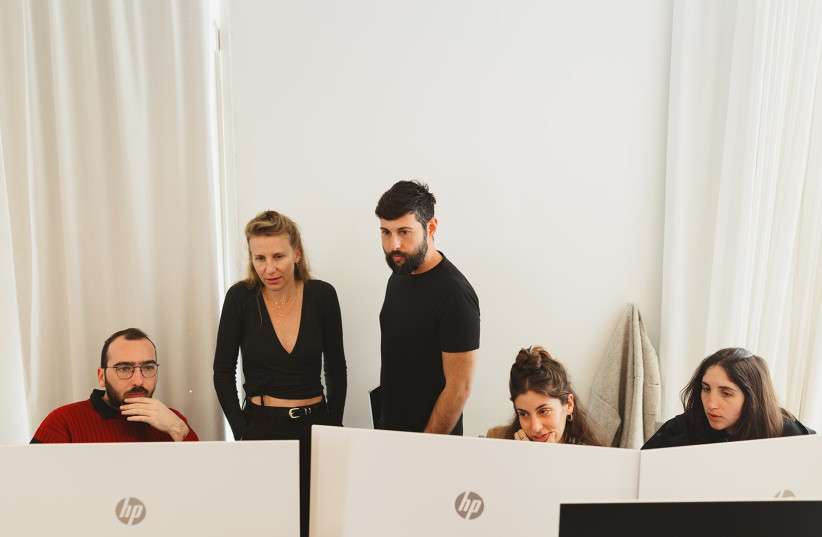
“AI, together with MyOp, allows us to take our designs and turn them into real, functional products without needing a front-end developer,” he said. “The hackathon was an experiment to get new ideas and talent.”
Fanan said: “Every group, including the winners, brought a complex component into fully functioning code during the hackathon, ready to be used by the Pic-Time dev[elopment] team. People got the concept of vibe coding so quickly, even those with no background in writing code.”
According to Lehr, adopting the MyOp platform was “surprisingly easy.” The new workflow system had allowed him to do work that used to take weeks in a matter of hours, he said.
“Technically, though, it was simple,” Lehr said. “I spoke with the AI and gave it 120 prompts in one day. It was like talking to a human developer, telling it what I wanted, and it did it immediately.”
Fanan said the platform works as a link between AI-generated code and larger, more mature stacks.
“It’s not just about vibe-coding a new app from scratch,” she said. “For example, Pic-Time has been around for 10 years with millions of users and a very complex stack. We are putting AI-written code from people outside the organization into it.”
“Within a year or two, I believe development teams won’t just be engineers,” she added. “Engineers will handle the ‘backbone,’ back-end logic, databases, and state management, but the entire user-facing part will be developed by nontechnical people, specifically designers or product managers using vibe-coding tools.”
Creating AI infrastructure
MyOp is not working to create an AI model to compete with OpenAI, Google, or Anthropic, Fanan said, but to be able to develop infrastructure capable of taking AI-created output and adding it to other appliances.
“We wrap the builder’s code as a standalone component that communicates with the inner logic through a secure, unique contract,” she said. “This creates a bridge between the new world of AI coding and ‘legacy’ systems.”
According to Lehr, “Our output is much bigger.”
In addition, Pic-Time managed to “remove the ‘developer in the middle,’” he said. “In the traditional method, you give instructions to a developer, they build it, and then the client sees it. Now, we build it and show it to the client immediately.”
Regarding how MyOp users handle bug-fixing, Fanan said: “Our rule at MyOp is: You should only build what you can validate. If I’m a PM, I can validate the visual experience: the buttons, the drop-downs, the flow. If it requires complex back-end logic that I can’t verify without reading code, that task isn’t for me.”
“When a visual or UX bug is discovered, the designer returns the AI to the prompt, requests a fix, and redeploys,” she said. “If it’s an authentication or API bug, it goes to the engineer. We’re actually seeing the script flip: Developers are now opening bugs for UX professionals to fix in the UI.”
Vibe-coding hackathon
AI-based vibe-coding helps improve work capacity, Hillel Dror, one of the students who participated in the hackathon, told the Post.
“The most significant change in my workflow is the sheer number of iterations I can now complete in an hour,” he said. “Ultimately, more iterations naturally lead to a much better design.”
“It definitely has a positive impact on my profession,” he added. “It opens up capabilities that simply didn’t exist for me before. I see this as a major trend that is turning designers into people who design actual, working products; it’s an ‘all-inclusive’ process now.”
This was not the case with every participant. According to Mia Gaon, who also spoke with the Post, Figma (a design tool for UX/UI development) still allows for a more controlled final product.
“I can take a design to much further lengths there, mold it into anything I can come up with, and have it look different than the norm, without compromise,” she said.
“With vibe-coding, you’re working within what the AI interprets and what the underlying code naturally wants to do,” she added. “There’s a ceiling on how opinionated you can get visually, at least for now.”
Both of them said language is the main barrier to the application of AI-based coding solutions.
“The most frustrating part was definitely the language barrier,” Dror said. “I could only communicate my design intent verbally through prompts. Because these AI models aren’t visual, object-oriented HTML editors, making isolated tweaks was incredibly hard.”
Gaon said, “The hardest constraint to shake off is the defaults. These models are trained on existing interactions, components, and interfaces, and the reality is that there are far more ‘sufficient’ designs in the world than there are truly interesting, innovative, or expressive ones. So, the AI tends to naturally pull toward the familiar.”
Even with these limitations, the final results showed ideas that had not been considered during the 10-month period since MyOp was implemented in the Pic-Time platform, Lehr said.
“The creativity and enthusiasm were huge,” he said. “We worked from 9 a.m. to 10 p.m., and the ideas kept coming. Because these are design students, we didn’t just get prototypes; at the end of the day, we had functioning features.”
“We saw so many ideas, big and small, that made us wonder, ‘How did we not think of this ourselves over all these years?’ We got a massive concentration of innovation in just one day,” Lehr said.