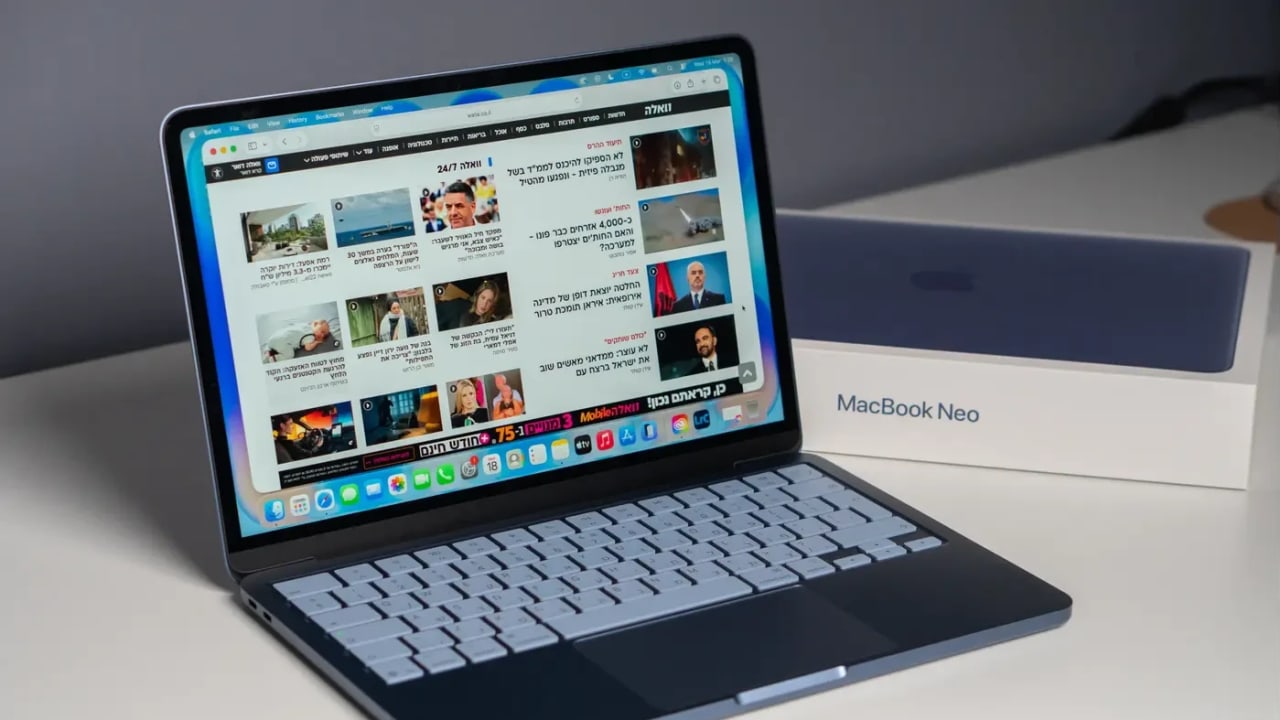
For years, one thing was fairly clear in the computer world: If you bought a laptop around NIS 2,000, you got a cheap product in every possible sense. It wasn’t just about price, but about the feel. A plastic case, a mediocre screen at best, and performance that quickly made you wonder if you had made a mistake. In other words, a computer you bought out of compromise – and felt it almost immediately. In this reality, the market simply aligned with the rules – low price equals compromises, with not too many surprises.
But the MacBook Neo enters precisely at this point – and breaks it from the inside. With a price starting at around NIS 2,400 (599 USD), Apple is offering something that really shouldn’t exist in this category: A computer with a full aluminum body, performance based on a chip from the iPhone world that is sufficient for daily work without issue, and battery life that lasts a full day. This isn’t just an attempt to make a “cheap MacBook” – it’s a proposition that challenges the very assumption that you have to compromise when paying less.
Those who remember the M1 MacBook Air from 2020 will recognize a familiar pattern. Back then, Apple not only delivered a successful computer but also redefined users’ expectations for a thin and light laptop. The Neo takes a similar approach, only it drops another notch in price – entering the territory previously dominated by cheap Windows laptops and Chromebooks. The result is a computer that not only competes with them but in many ways embarrasses them – and sometimes even more expensive models.
Even the industry itself is beginning to recognize that something has changed. The CEO of ASUS admitted to investors that the new affordable MacBook surprised computer manufacturers, an unusual statement that shows how unexpected this move was. Until now, Apple mostly played in the premium field; the MacBook Neo signals a clear change of direction – an attempt to attract Windows users from the low-end market and disrupt a balance that seemed stable for years. We received the MacBook Neo for review from iDigital and went to see what all the hype is about.

Design and Display – Premium that trickles down to a low price
When it comes to design, it’s hard to ignore Apple’s move here – it doesn’t try to look like a cheap computer, quite the opposite. The MacBook Neo looks like a full MacBook, with a solid aluminum body that feels sturdy, precise, and durable – the kind associated with Apple’s design language in recent years. It’s not plastic pretending to be premium; it’s the same material you’d expect in more expensive models, just at a price that shouldn’t allow it.
Visually, the Neo continues the look of the current MacBook Air – clean, minimalist, with soft rounded lines. It’s slightly smaller but keeps the same weight of about 1.2 kg, contributing to a feeling of stability in hand and not feeling like a device where corners were cut. It may not be the lightest laptop in its category, but it does feel like a complete product, one that doesn’t apologize for its price.
One of the most notable elements here is the colors. Alongside Apple’s classic shades, the Neo comes in bolder options – including a bright greenish-yellow and a soft pink, adding character not always seen in laptops of this type. This isn’t just an aesthetic decision but a clear attempt to appeal to a younger audience – students, pupils, or anyone looking for a laptop that doesn’t look like another gray box.
The screen also follows the same approach. It’s a 13-inch Liquid Retina panel with brightness up to 500 nits. On paper, these aren’t exceptional numbers, but in practice, it’s a screen that looks good, is pleasant to work on, and can handle a bright environment without issue. It doesn’t support ProMotion and remains at 60 Hz, and it’s limited to connecting a single external monitor, but in the context of the device, these are measured compromises that don’t really affect daily use.
Specs – A true Mac with an iPhone chip
The MacBook Neo’s main twist is in the specs – or rather, in the choices Apple made to reach this price. For the first time in years, this isn’t a Mac based on an M-series processor, but on the A18 Pro chip – the same processor that powers the iPhone 16 Pro. This is no small conceptual shift: Instead of taking computer hardware and cheapening it, Apple is taking smartphone hardware and running full macOS on it.
And this is perhaps the most interesting part – it’s not some halfway solution or a stripped-down operating system. It’s a full Mac, with complete macOS and all the apps available on the platform. There’s no “lite” or limited version like Windows versions for low-end PCs, but the same experience as on computers costing much more. In other words, it’s the same computer in terms of software capabilities – just with a completely different hardware base.
Beyond the processor, the specs themselves are modest. The base model comes with 8GB RAM and 256GB storage, with no upgrade option later. There’s an option to upgrade to 512GB storage for an additional fee, which also brings Touch ID – but even then, the RAM remains the same. This is a spec clearly aimed at a specific audience: Daily use, studies, basic office work.
Regarding ports, Apple goes with the bare minimum. There are just two USB-C ports – one USB 3 and one USB 2.0 – no MagSafe, no other connections, and not even clear markings between them. This is part of the general approach: Minimize where possible to keep the price low while trying not to harm the core experience.

Trackpad – A technical concession that’s barely noticeable
One of the biggest surprises in the MacBook Neo is in the trackpad, where Apple breaks from nearly a decade of habit and abandons the Force Touch mechanism based on Haptic feedback in favor of a “real” mechanical trackpad. On paper, this sounds like a step backward, especially for a feature Macs have excelled at for years, but in practice, it’s very hard to notice. The trackpad is precise, fast, and responds to gestures naturally, maintaining the same level of control users are used to. Unlike mechanical trackpads on cheap PCs, where only the bottom part usually clicks well, here the entire surface is clickable edge-to-edge, with a uniform and relatively pleasant feel. The click itself is slightly more “present” and less refined than Apple’s haptic solution, but it’s a minor difference that almost disappears in daily use.
Real-world performance – Much more than it seems
To understand what the MacBook Neo is really worth, I ran a simple experiment: I set aside my Mac Mini M4 at my home office and the MacBook Air M4 I use outside the house, and switched to using only the Neo as my sole computer.
From the first days, it was clear the experience was more familiar than I expected. It reminded me a lot of the period with the M1 Mac Mini I had until last year – not a computer meant to impress with power, but one that simply lasts a workday without friction. Dozens of Chrome tabs, messaging apps, music in the background – and even writing this article – everything flowed smoothly, without stutters or feeling that the system was straining.
It’s worth noting: My work isn’t just browsing and documents. I regularly edit videos, use relatively heavy programs like Photoshop and Lightroom, and push the computer beyond basic use. Even here, surprisingly, the Neo kept up. It didn’t crash, freeze, or make me stop working due to performance. More precisely: Memory management keeps the system around 80–85% usage even under load, without crashing.
That said, it’s important to put this in perspective. This isn’t a computer for graphic designers or heavy video editors, nor one I would choose for large projects or intensive professional work over time. But within the real usage limits of most users – and even a bit beyond – it delivers a stable, smooth, and mostly surprising experience relative to its specs.

Battery life
Apple claims up to 16 hours of video playback, but in practice the numbers are a bit lower, with about 8 hours of work with breaks. In the context of the device and its price, this is a good result that’s enough for a full work or study day without recharging mid-way. Clearly, Apple cut the battery size to keep the price low, but in real use, it’s barely noticeable – as long as you don’t expect to break records.
Bottom line – Opening shot for a revolution
The MacBook Neo isn’t just another cheap computer (NIS 2,499 at iDigital, which also gives a 6% discount to students) – it’s a strategic move. Apple is entering territory it has rarely touched before, bringing a standard that didn’t really exist in this category until now. There will always be cheaper laptops, but it’s very hard to find ones that give more – or even the same – without painful compromises in one of the core areas.
It’s not a computer for everyone. Those who need more memory, more processing power, a more advanced screen, or varied ports will quickly look toward the Air or Pro models. But for a much wider audience – students, first-time users, or anyone who wants a simple computer that works without fuss – the Neo becomes the new default. One that offers the experience of a computer costing double, and sometimes even more.
In a broader sense, this is likely just the first step. Until now, the low-end computer market had been stuck in the same place, and Apple comes in and disrupts it from within – just like it has done in the past. The real question now isn’t what Apple did, but how the other manufacturers will respond. Because if the MacBook Neo is the first sign, the coming year is going to look completely different.