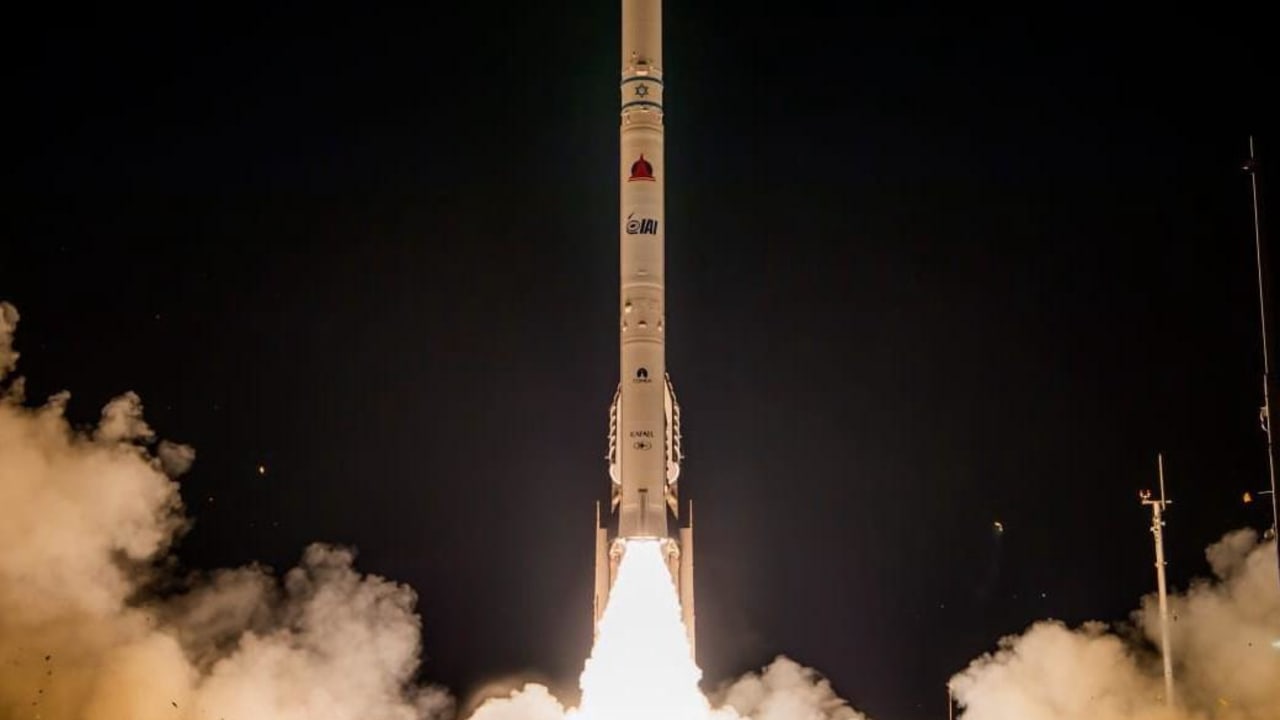
Israel is quietly developing new space‑based capabilities designed to give the country an edge in the next war with Iran, Avi Berger, head of the Space Office at the Defense Ministry’s Directorate of Defense Research & Development (MAFAT) told Defense & Tech by The Jerusalem Post.
Speaking during Israel’s Space Week, Berger said the lessons of recent conflicts have pushed Israel to accelerate innovation in orbit.
“We knew right away that we had to build and create new surprises for the next war,” he said. “Whatever was deployed in June won’t be enough next time. The IDF now has new capabilities – and we can’t forget that the enemy will be different next time around, too.”
Six months after Israel’s Rising Lion and America’s Operation Midnight Hammer, tensions in the Middle East are once again at an all-time high, driven by US military deployments and Iran’s murderous crackdown on protesters.
Israel’s space capabilities play a key role in the Jewish state’s strategic military capabilities. They are a real “eye in the sky,” keeping a close watch on Israel’s enemies from afar, 24/7.

Space as Israel’s operational backbone
Israel first forayed into space 45 years ago to retain an early-warning capability along the border with Egypt. Since then, Israel has joined the prestigious space club and is one of only 13 countries with indigenous launching capabilities.
For Israel, the launch alone is a great achievement. It is carried out to the west, against the rotation of the Earth, so that its trajectory takes it out over the Mediterranean Sea, thus avoiding enemy territory during the launch period.
The satellite technology, as well as the launcher, which according to some reports launches the Jericho ballistic missile and can place up to 380 kilograms into orbit, is not something Israel wants falling into enemy hands. The electro-optical reconnaissance satellite with advanced capabilities is also a feat of engineering, would be a gem of intelligence should it be obtained by countries like Iran. That would, of course, be a disaster for Israel.
As a result of launching westward, Israeli satellites operate in retrograde orbits and decrease the launcher’s payload capacity, as it requires more thrust to place the satellite into orbit compared to it flying eastwards.
Berger emphasized that Israel’s presence in space is driven by necessity. The shock of October 7 accelerated this shift when the state understood that the country was dealing with seven active fronts.
“We are in space for Israel’s and the IDF’s operational needs,” he said, adding that satellite constellations now form the backbone of the country’s intelligence‑gathering architecture.
“A single constellation can cover everything from Gaza to Iran. It doesn’t matter which front ignites – you have intelligence.”
These constellations generate gigabytes of imagery across the Middle East, enabling real‑time data extraction and rapid retasking of satellites. “All of this is powered by what I call ‘AI on steroids,’” he added.
Though Iran and its nuclear and ballistic missile projects are of top concern for Israel, the advanced satellites have likely monitored much more than that, such as Iran’s malign activity throughout the Middle East, including the trafficking of weapons to Hezbollah, as well as to the Houthis in Yemen.
Last year, Berger said that the June war with Iran had underscored the critical need for space superiority.
“The war with Iran has further sharpened our understanding that we must dramatically increase investment in developing and maintaining Israeli superiority over our adversaries in space,” he said, in August, at the DDR&D-led International DefenseTech Summit, organized in collaboration with the Yuval Ne'eman workshop for Science, Technology & Security at Tel Aviv University.
Berger added that “in accordance with the ministry's strategy, our objective for the coming years is that Israeli space capabilities will be present at every point in the Middle East, collecting intelligence and providing alerts around the clock and in all weather conditions. Space is a decisive component in ensuring the IDF's freedom of action.”
The Israeli satellite constellation was a “full partner” in all operational activity “before, during, and after Operation Rising Lion [with Iran],” he said, explaining that “Over the 12 days of war, we collected tens of millions of square kilometers of extremely high-quality imagery, day and night. Targets were built in real time, and critical communications were provided with high availability to support strike operations discreetly and without risking our forces.”
A changing global space battlefield
Since the establishment of the Outer Space Treaty in 1967, space was understood to be of no one country’s domain and that its use and exploration should be for peaceful purposes.
“Space should be accessible to all countries and can be freely and scientifically investigated,” the treaty reads.
Space has become crucial in the modern world, and Berger told D&T that the global space environment has transformed dramatically in the past decade.
“Elon Musk’s entry into the space sector changed everything,” he said. “Space became more accessible.”
The war in Ukraine has further blurred the lines between civilian and military space assets. Systems such as Starlink and Maxar demonstrated how commercial platforms can shape battlefield outcomes. “Nations that can’t reach space themselves suddenly realized how vulnerable they are.”
But, he warned that the world, including Israel, must prepare for threats from major powers.
“Russia and China are active in space, and the moment they choose to use those capabilities, whatever they target is at risk.”
Building Israel’s space economy
Innovation, Science and Technology Minister Gila Gamliel echoed Berger’s assessment, framing space as both a security necessity and a strategic opportunity.
“Space has become a new line of defense,” she said at the opening conference of Space Week.
She pointed to Operation Rising Lion, Israel’s strike on Iranian nuclear facilities, as the first conflict in which satellites played a decisive role from start to finish.
“We proved our leadership in space innovation for security needs.”
Gamliel highlighted Israel’s growing international partnerships, including a decade‑long cooperation agreement with NASA and participation in the Artemis lunar program.
“Israel is proud to work alongside NASA, selecting Israeli companies to contribute to humanity’s return to the Moon,” she said.
The ministry also signed new space agreements with Azerbaijan and Hungary and is actively seeking Israel’s first female astronaut. “She will inspire a new generation of Israeli girls, and boys, to pursue scientific and technological careers.”
Today there are over 90 countries and dozens of private commercial companies operating in space.
According to The State of the Israeli Space Industry 2026 report published by Startup Nation Central during Israel Space Week, Israel’s space sector is evolving from a closed, defense-centric field into one that is more oriented toward the dual-use commercial sector.
The Israeli space technology landscape has some 90 companies: 50 active space companies and another 40 developing space-related applications. The report found that there has been a shift from the space satellites to the services built around it, “space-as-a-service” platforms.
The report found that there was a steady increase in the sector over the past decade, with a “particularly strong surge” between 2020 and 2023 with a growth of 66%, outpacing the 22% growth observed in the wider tech ecosystem.
“In 2026, space technology is no longer a niche market but a fundamental pillar of global economic and security infrastructure,” the report read. “By combining military-grade reliability with innovative in-orbit operations, Israel is solidifying its role as a strategic partner in the $600b+ global space economy. As space becomes an increasingly critical global utility, Israel’s space sector is well-positioned to deliver commercially relevant capabilities within the evolving orbital economy.”
Thinking outside the box
But Berger and Gamliel stressed that Israel must continue to strengthen its commercial and academic space ecosystem.
“Space is deep tech,” Berger said. “Access to space is expensive, and that makes it difficult for startups. Israel needs to help its start-ups break into deep tech and space.”
Gamliel pointed to the government’s flagship initiative: the new Space Center in Mitzpe Ramon, a NIS 60‑million “Space City” that will provide regulatory support and subsidized access to space infrastructure. “For the first time in Israel, companies will receive help at every stage, from regulatory guidance to launch,” she said.
Announced in December by The Israel Space Agency (ISA) and the Israel Innovation Authority (IIA), the national research and development laboratory intends to reduce the cost and complexity of accessing space for Israeli technology companies.
The initiative, called Access to Space, will be operated by Creation Space and will provide subsidized services for testing, launch, and in‑orbit operation of space technologies.
The laboratory will offer at least 35% discounts on market rates for launch and testing services and is expected to support the launch of a minimum of 15 experimental payloads within three years. The goal is to help companies move from laboratory development to operational deployment in space.
Berger added that Israel’s universities need specialized facilities and stronger research and development (R&D) infrastructure so that smaller companies can reach orbit.
Nevertheless, D&T has understood that Israel’s space ecosystem still has far to go to reach the stars again. Start-ups don’t have the same access to R&D infrastructure or support as do the larger companies like Israel Aerospace Industries (IAI) or Elbit Systems.
As Israel expands its military, scientific, and commercial presence in orbit, both leaders made clear that space is now essential to national survival.
Gamliel framed the moment as part of a broader human shift, telling the crowd that “people are going to space not as isolated pioneers, but together.”
For Berger, Israel “always has to think outside the box. We don’t have any other choice.”