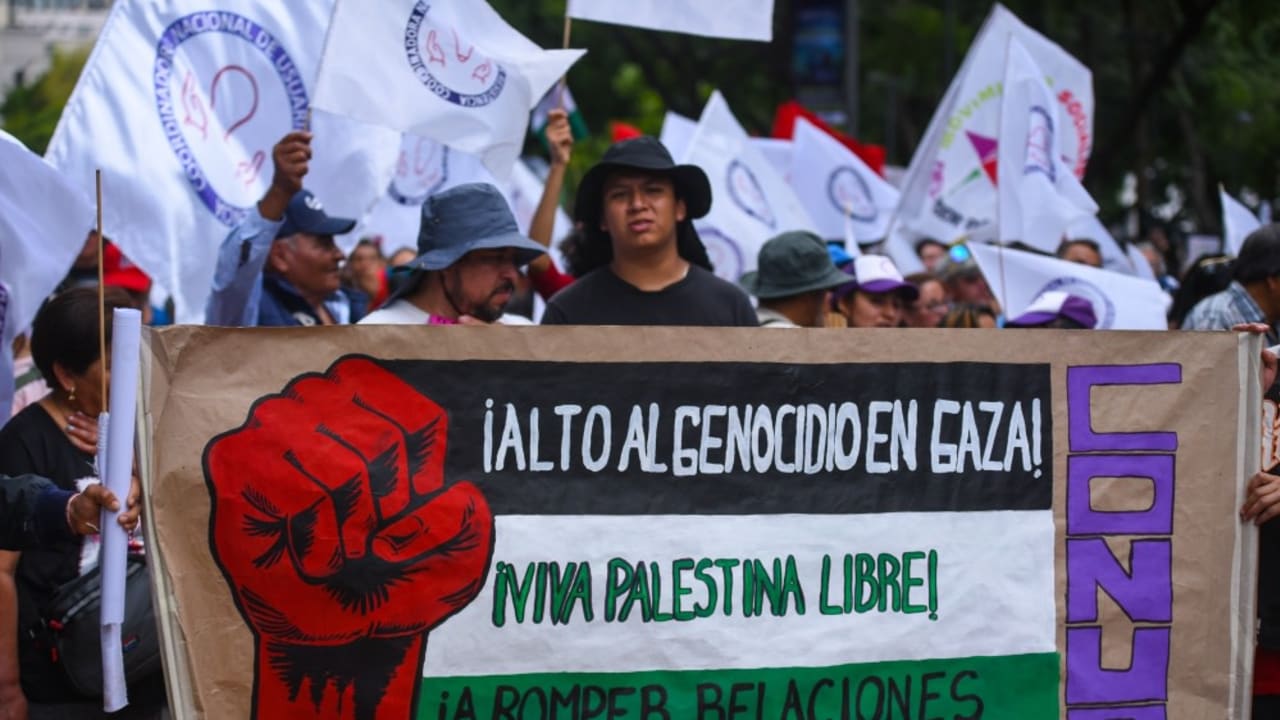
Around a thousand people took part in the "Mexico for Palestine" march in the country's capital of Mexico City on Sunday, demanding an end to the war in Gaza and the cessation of diplomatic and cultural relations between Israel and Mexico.
The march began at the Angel of Independence and traveled to the Hemicycle to Juárez, along the way passing the Foreign Ministry and the Museum of Memory and Tolerance.
The protesters were almost all clad in keffiyehs, and were carrying Palestinian flags, as well as signs and figures of infants to represent the children killed during the war. Many of the signs and posters focused on Israel's "genocide" or featured common slogans such as "From the river to the sea." Three more unusual posters stood out: one featured slain Hamas member and Al Jazeera journalist Anas al-Sharif depicted as Jesus on a cross; another featured the words "mejor cerdo que sionista" [better a pig than a Zionist]; another held a sign saying "Jesus was Palestinian" in front of a Starbucks.
Palestine monument erected in Mexico City
The protesters also erected a monument to Palestine, featuring the silhouette of Israel, the colors of the flag and the words "from the river to the sea." The organizing groups have warned that they will reinstall it if it is taken down.
The Latin American Alliance for Palestine against Apartheid held a cultural event in front of the Foreign Ministry in which plays, poetry, and musical and theatrical acts took place.

The Secretariats of Citizen Security (SSC-CDMX) and Government (SECGOB) both reported that the turnout was around 1000, despite the organizing groups claiming there were more.
According to SSC, police set up a formation before the start of the march in order to remove objects that could be used for violent purposes, such as retractable batons, chains, fireworks and firecrackers.
However, the protesters became confrontational, leading officers to retreat and watch from a distance instead, the agencies added.
Eleven protesters were treated by paramedics, and three policemen were wounded during the protest.
According to Mexican media, authorities of the Government of Mexico City notified local establishments and residents of the protest area before the event. Police were also equipped exclusively with preventive protective equipment, such as helmets, shields and fire extinguishers.
Two significantly smaller protests took place in the cities of Toluca and Oaxaca (100-strong) on the same day.