
The National Jewish Advocacy Center has filed an amicus curiae brief with the US Supreme Court, urging it to hear the case of Daniel Grand, an Orthodox Jewish man who was ordered by his city to stop hosting prayer services in his home.
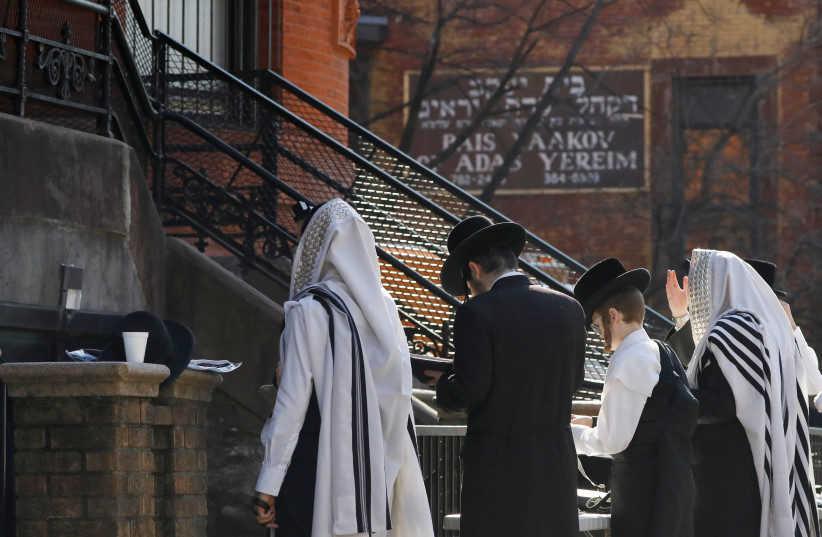
Daniel Grand is an Orthodox Jew living in University Heights, Ohio. In January 2021, he invited a small group of neighbors to his home for Shabbat prayer services, a minyan, the quorum of ten men that Jewish law requires for communal worship.
Since Orthodox Jewish law forbids driving on Shabbat, Grand could not travel to a synagogue. The home minyan was his only way to fulfill this religious obligation, and he added a 700-square-foot recreation room to his home in order to host the gatherings.
However, one of Grand’s neighbors complained, and the city issued a cease-and-desist order prohibiting Grand from using his home for prayer. The city warned him that using his home for religious assembly violated local zoning laws.
The city also told Grand that his house is located in a single-family home district and that “the use or operation of the premises as a religious place of assembly and/or in operation of a shul or synagogue is not permitted under the city’s ordinances.”
Mayor Michael Dylan Brennan then publicly encouraged Grand’s neighbors to watch his home and report any sign of Jewish worship to the authorities. A neighbor set up cameras pointed directly at Grand’s house, and the city’s police began driving by regularly.
When Grand challenged the city’s cease-and-desist order and other discriminatory conduct under the First Amendment and the Religious Land Use and Institutionalized Persons Act (RLUIPA), the federal courts kicked out the case, ruling that a court cannot hear such a claim until the homeowner has applied for a special-use permit and been denied.
NJAC has now drafted and filed an amicus curiae brief on behalf of itself, the Union of Orthodox Jewish Congregations of America (Orthodox Union), and the National Council of Young Israel. This brief is a legal document filed by non-parties with a strong interest in a case, providing information or expertise to assist the court in its decision-making.
Minyan prohibition fits antisemitism pattern, brief says
NJAC’s brief explains why a minyan is not merely a preference but a religious commandment; why the Sabbath driving prohibition makes home-based prayer uniquely necessary for Orthodox Jews; and why the facts of this case, the speed of enforcement, and the Mayor’s call for neighbor surveillance “fit a documented pattern of antisemitic zoning enforcement that courts have recognized for decades and need to more firmly address.”
“What happened to Daniel Grand is not an isolated incident,” said Rabbi Dr. Mark Goldfeder, CEO of NJAC. “It is the latest chapter in a long and documented history of municipalities using zoning laws to suppress Orthodox Jewish religious practice. Taking can be compensated with money – a lost Shabbat prayer cannot. The Constitution does not require a Jewish man to wait for a bureaucracy to finish deliberating before he can pray with his neighbors in his own home.”
“This case deserves Supreme Court review because, across the country, Jewish religious practice has repeatedly been constrained through the neutral application of rules in ways that disproportionately burden visible Jewish life,” added David J. Benger, Litigation Counsel at NJAC.
“When cities treat a home minyan as a land-use violation rather than a constitutionally protected exercise of faith, they risk repeating a broader historical pattern in which Jewish religious practice is singled out under the guise of regulation. The First Amendment does not allow that result.”