
Italy's parliament is expected to hold a final vote in the coming weeks on whether to formally adopt the International Holocaust Remembrance Alliance working definition of antisemitism.
Italy's Senate passed the bill adopting the IHRA definition into Italian law by a vote of 105–24, with 21 abstentions, on March 4, 2026. The bill was then approved by the Constitutional Affairs Committee of the Chamber of Deputies on September 30, clearing it for the final parliamentary stage. Most recently, on October 2, the bill entered general debate in the Chamber of Deputies.
According to press agency ANSA, the bill is expected to receive final approval after the vote on the electoral law, in the first half of October 2026.
Opposition to the bill persists
The current text of the bill would enshrine the IHRA working definition of antisemitism, including its examples, in law while explicitly preserving freedom of political criticism and expression. The final version dropped provisions from the original draft that would have introduced criminal measures and restrictions on demonstrations.
Yet, despite the revisions, the bill still faces staunch opposition.
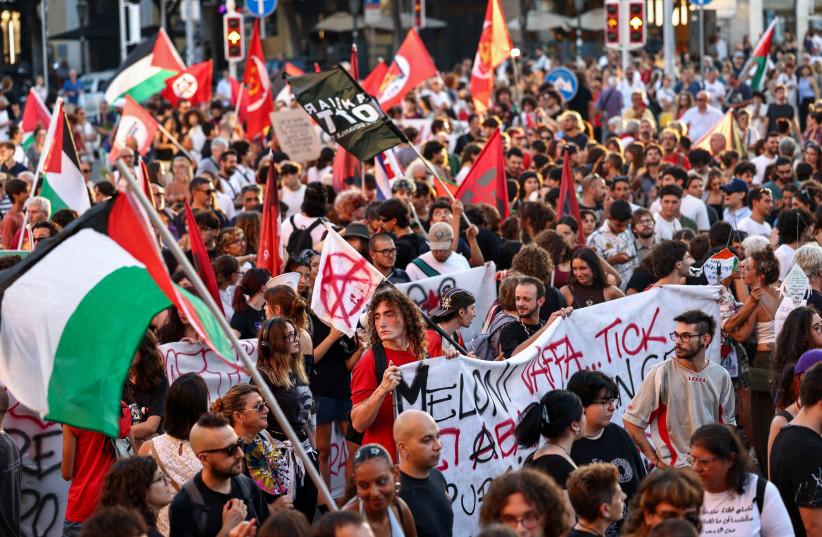
On Thursday, hundreds of protesters gathered outside Milan's La Scala Opera House with signs saying “No to the antisemitism bill,” “Criticizing Israel is not antisemitism” and “Protest is a right."
Critics say the bill will prevent condemnation of Israel and quash Palestinian protest.
A lot of the criticism has also been directed at Prime Minister Giorgia Meloni's government's refusal to introduce economic and diplomatic measures against Israel in the same way that other European nations have.
The Democratic Party, which is the main center-left opposition in the country, is expected to vote against the legislation. It also boycotted last week's preliminary committee vote.
However, Emanuele Fiano, a Jewish member of the DP, rebuked his party for its opposition to the bill.
'An impassable boundary'
"The Democratic Party has decided to vote against the bill on antisemitism, which was approved by the Senate and is now being examined by the Chamber of Deputies. If that decision is confirmed, for me it will represent an impassable boundary," he wrote last week.
"I cannot accept that combating antisemitism should be presented as an obstacle to criticism of the Netanyahu government, the Israeli army or settler violence," he said, calling such criticism "legitimate and necessary."
He stressed that, while those opposed to the bill argue that referring to the IHRA definition could become an instrument of censorship, Article 1 of the text expressly preserves freedom of political criticism and freedom of expression.
"So what is the Democratic Party seeking? What identity chimera?" he questioned.
The Union of Italian Jewish Communities (UCEI) called for the bill to be passed, calling it "a democratic antibody against prejudice and hatred."
Livia Ottolenghi, President of UCEI, addressed all deputies ahead of the discussion and vote on the bill in the Chamber of Deputies in the coming days.
“The bill, which defends democratic values and combats antisemitic hatred, should not be assessed according to political affiliation, but according to its contents," she said.
"It responds to a democratic principle and safeguards fundamental rights, elements which make this a cross-party issue. It does not contain criminal provisions, but only guidelines aimed at preserving the democratic values of the Italian Republic.”