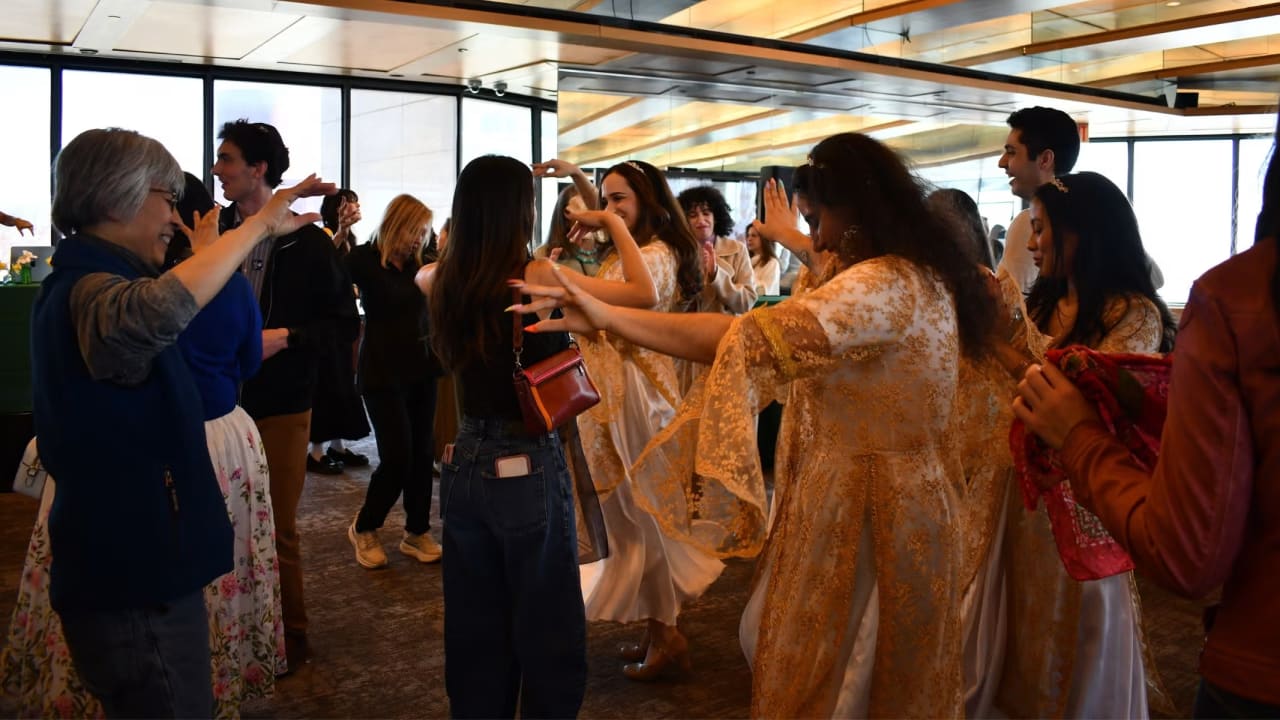
Sharon Nazarzadeh had no idea when she put a Nowruz celebration on the calendar again at the Museum of Jewish Heritage in Manhattan just how poignant the festivities would be.
Nazarzadeh first marked the Persian spring equinox festival at the museum, where she is events director, in 2024. She was inspired by her own family’s traditions, imported to the United States from Iran in 1978, just before the Islamic Revolution that turned Israel into Iran’s enemy and drove most Jews from Iran. Her grandfather had been the chief rabbi of Tehran.
This year, the festival unfolded under the shadow of war, with the United States and Israel jointly battling Iran’s Islamic Republic regime. Iranians in the diaspora now have some tentative hope that there could be a change for the better in their homeland, while the estimated 8,000 to 15,000 Jews who remain inside Iran are thought to be in new peril.
“With every Nowruz, with every new day, we say, ‘Okay, this is the time to move forward. This is the time of rebirth, a new beginning,’’ Nazarzadeh said. “Nowruz means ‘new day.’ And this is my wish, of course, for all Iranians, whether they’re living in diaspora or living in Iran or elsewhere.”
The Persian holiday, more than 3,000 years old, is celebrated by Iranians of all religious backgrounds. For Iranian Jews, the celebration of this holiday typically falls between Purim and Passover. It’s a joyous celebration marked by food, dance, and visits with family.

The museum’s festival, held more than a week after the equinox but before the end of the 12-day Nowruz period, drew more than 500 people to sign up to celebrate both Nowruz and Purim, the Jewish holiday that recalls a story from ancient Persia.
Nowruz events at the museum festival
A DJ played Iranian music throughout the day, and dancers in traditional Persian costume moved at the center of the room, leading guests in choreography taught by Persian dance artist and bellydancer Nikki Farahanchi.
Visitors could take backgammon lessons; watch a screening of “Mashhad,” a short film about Jews living in the Iranian city; or browse and shop from vendors selling jewelry, books, matzah covers, ceramic dishes, and calligraphy artwork. Artist Dahlia Raz shared a history of henna, the natural dye used in Persian skin designs, while Mehrnam Rastegari performed on the kamancheh, a Persian fiddle that’s played with a bow.
In a quieter room, children made paper flower crafts and Play-Doh plates for the haft-sin table - the symbolic table with seven ritual items that is a centerpiece of Nowruz festivities.
“Especially during these tough times, it’s important that we keep this tradition,” Iranian community activist Betty Emamian, who delivered a talk about Nowruz, said in an interview. “We do have heavy hearts. Our hearts are with the brave men and women of Iran. Of course, we pray for them, and we stand with them. So the tone is a bit somber, but it’s important to keep our heritage and culture and honor it as well.”
Nazarzadeh has been responsible for putting on a wide range of cultural events at the museum, including the multicultural Mishpacha Festival, the Jewish Book Festival, and the Lunar Festival celebrating Asian Jewish culture. But Nowruz is personal.
“When I see everyone gathered around the haft-sin table, and going into the events hall, trying Persian food, going to the Persian tea station, talking to one another - for me, that’s the most joyous,” she said.