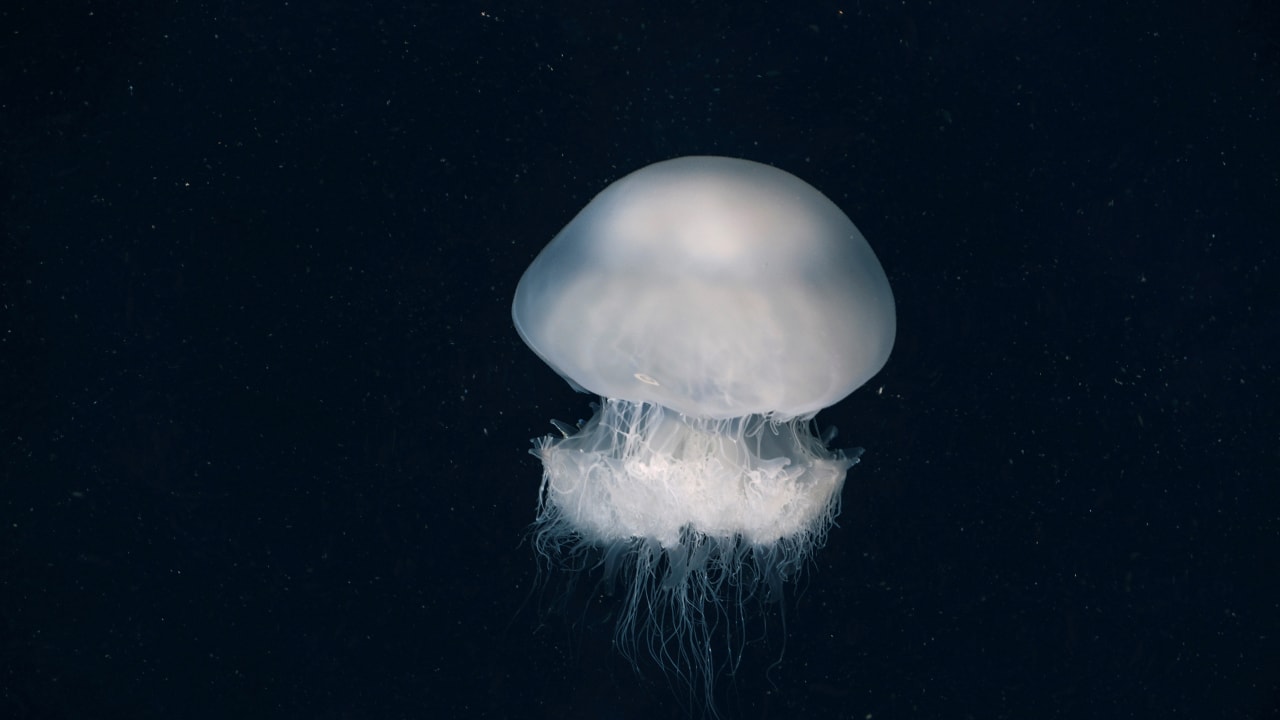
A rare giant phantom jellyfish was spotted off the coast of Argentina during a mission led by Argentine researchers in early February.
The researchers were aboard the Schmidt Institute of Oceanography’s FALKOR research vessel, which spent several weeks exploring deep-sea ecosystems along the country’s coastline.
The footage was taken by a remotely operated underwater vehicle (ROV) at a depth of approximately 250 meters below the sea’s surface.
The jellyfish has a bell size of up to one meter in diameter, and its four arms can reach lengths of up to about ten meters.
The team documented a large coral reef along the country’s coastline and several other reef complexes, as well as 28 species that researchers believe may be new to science, including worms, corals, sea snails, and other species yet to be identified.

Team's goal was to find cold vents
The team’s main goal was to find cold vents - areas where gases and chemicals are released from the seafloor, feeding the area’s biodiversity. They found the cold vents in an area of more than one square kilometer, more than twice the size of the huge coral reef.
"We did not expect to see such a level of biodiversity in the Argentine deep sea, and we are so excited to see it teeming with life," the expedition's lead scientist, Dr. Maria Emilia Bravo of the University of Buenos Aires and the National Council for Scientific and Technical Research, said in a statement.
"Seeing the biodiversity, ecosystem functions, and connectivity between them unfold together was amazing. We opened a window into the biodiversity of our country only to find that there are so many more windows left to open," she added.
"We have collected an unprecedented number of chemical, physical, and biological samples that will be used to understand relationships in the water in the coming years," said Dr. Melissa Fernandez Sabriny of the Argentine Institute of Oceanography and the National Council for Scientific and Technical Research.
"These samples represent a unique opportunity to understand not only how extraordinary these extreme ecosystems are, but also how vulnerable they are."
The team didn’t just find biodiversity but also litter, including fishing nets and other bits of plastic waste that had been carelessly left to float out to sea, polluting natural habitats. They even found a piece of tape with a Korean sticker, raising questions about how it ended up in Argentine waters.
The Environment and Climate Change portal is produced in cooperation with the Goldman Sonnenfeldt School of Sustainability and Climate Change at Ben-Gurion University of the Negev. The Jerusalem Post maintains all editorial decisions related to the content.