
Wine guys love wine to the depth of their being. To them, it is more than a drink.
It’s not just fermented grape juice or liquid grapes. Wine can be a window into all kinds of worlds. These include agriculture, archaeology, economics, gastronomy, geology, history, politics, religion, technology, and peoplehood.
It gives insight into the “people of Israel” and the “places of Israel,” from the first sprouting of the Jewish people in biblical times to the start-up Israel of today. Above all, we like to talk about wine and share experiences to enthuse others… and be enthused.
Wine also has a wide-ranging literature. You only have to see the number of wine books in a wine lover’s private library to understand what is obvious to me: wine is aspirational. We love to read about wine, learn about it, and immerse ourselves in the wine stories of others. Some of us like to read about wine and talk about it as much as drink it.
In the next few months, some books will be published that should be on every wine professional’s and wine lover’s bookshelf.
Hugh Johnson’s Pocket Wine Book
Hugh Johnson’s Pocket Wine Book, edited by famous wine writer Margaret Rand, is the largest-selling wine book in the world. It is not new. The first one was published in 1977.
Englishman Hugh Johnson is the world’s most famous and prolific wine writer. He remembers James Mitchell saying to him: “You know, Hugh, everything anybody really needs to know about wine could go into a little book like this…” and pulling out his diary. (Once there really was something called a pocket diary!) This was the invention of the Pocket Wine Book, published by Mitchell Beazley, and it has continued every year since then.
The Pocket Wine Book is a mini-reference book for anyone who buys wine – in wine stores, restaurants, or on the internet. It is a comprehensive up-to-date annual guide that has retained its popularity despite the accessibility of online information.
Hugh Johnson never believed in giving wines scores, but he does rate wineries from one to four stars.
Explanations are in brief note form and in British understatement, though the experts contributing cover the world. The book is close to being a kind of Michelin Guide for wine, with information about wineries and wines, grape varieties, matching food to wine, and the best values and vintages.
Even Israel gets a mention. Where else will you find a ranking of 45 Israeli wineries ranked by an international book? The entry includes large commercial wineries, small wineries, and boutique wineries; some kosher, others non-kosher. It also gives a heads-up about new-ish, tiny wineries of interest, which are below the radar.
Included are wineries owned across the spectrum: from haredi (ultra-Orthodox) to liberal Jews, right-wing settler wineries from the Central Mountains Region to left-wing kibbutz wineries, Israeli Arabs, and Christian Monks. This is part of why I say “Wine is the beautiful Israel.” Wine represents the rich mosaic of Israelis and the Land of Israel.
In Israel, we act very loudly in wine. We are active on social media like a wine giant. So it is a wake-up call to see our relative importance. In the Pocket Wine Book, Israel is part of the Eastern Mediterranean Region, and we are allocated a total of one and a half pages.
At the beginning, Israel did not feature at all, but slowly and steadily we found a voice. We were first mentioned in the 1980 edition, but it was only a few lines. The Golan Heights Winery was the first Israeli winery to be awarded stars in the late 1990s and the first to be awarded three stars. Domaine du Castel was the first to be awarded four stars in 2008.
In the new book, there are three Israeli wineries with four stars outright, and another three which earn two or three to four stars. Hugh Johnson’s Pocket Wine Book 2027, published by Mitchell Beazley, was released last week.
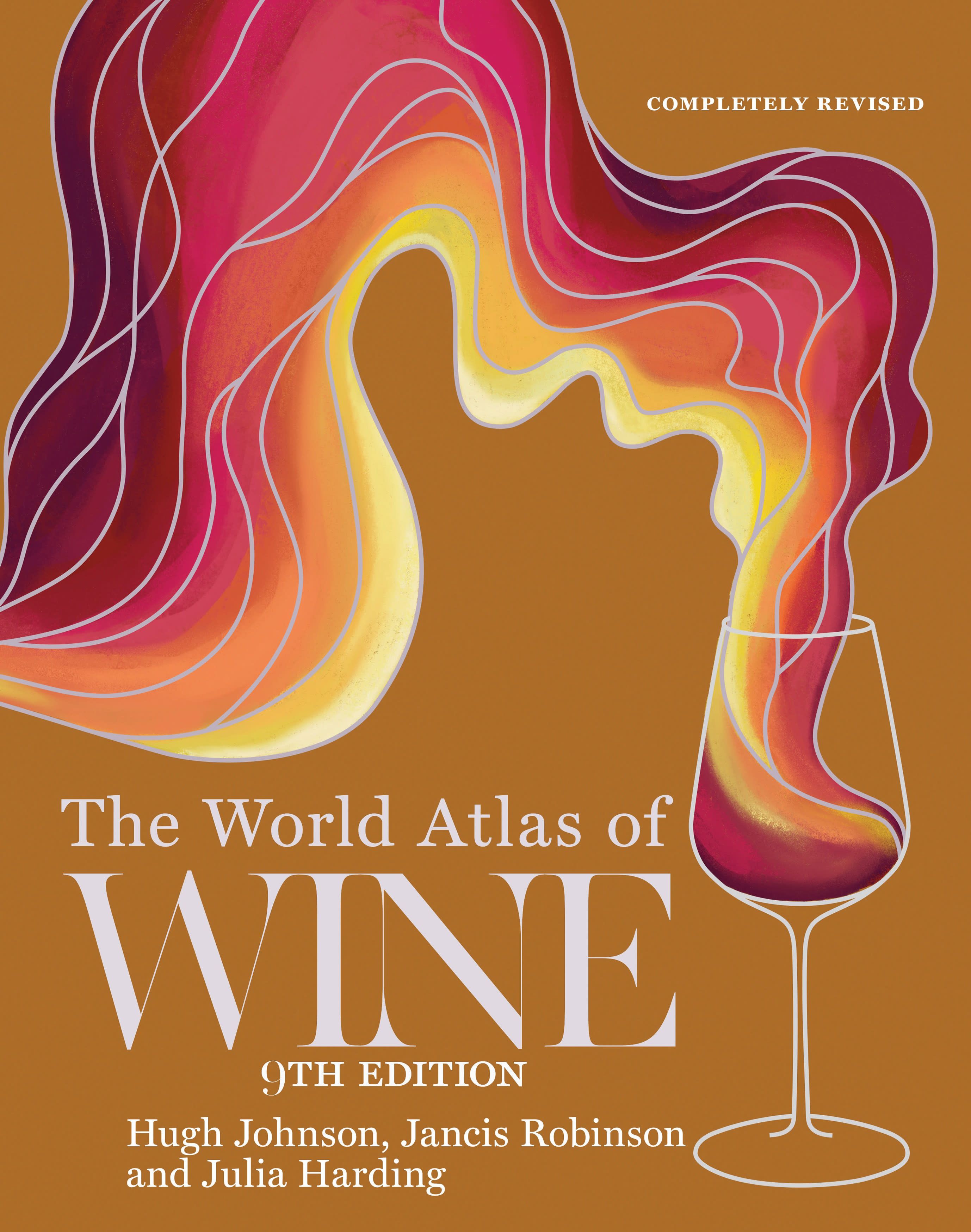
The World Atlas of Wine
IT WAS IN 1971 that Hugh Johnson wrote the first The World Atlas of Wine. He believed that wine was liquid geography. The publisher, James Mitchell, was interested in the idea of matching precise cartography to viticulture. Hugh Johnson liked the idea of mapping the main vineyards and vineyard areas.
It took him two years of travel, research, and writing, and it became a classic. Other editions followed. It was reprinted four more times between that first edition and 2001. Each time, the content advanced considerably as the wine world expanded in terms of quality and awareness.
In the early 2000s, Jancis Robinson MW, today’s most famous wine critic, joined him as co-author. This certainly made the ultimate dream team. Three more editions were published, and they are not reprints. The texts are rewritten, and the maps are updated, and they somehow manage to squeeze in all the new wine information that has come to light since the last edition.
Israel used to feature in the World Atlas alongside our neighbors in a page headed “Eastern Mediterranean.” From the eighth edition published in 2019, we were honored with our own full page and map! This is repeated in the ninth edition as well, except the maps and texts have been totally updated to take into account changes in the last seven years.
The ninth edition of The World Atlas of Wine by Hugh Johnson, Jancis Robinson MW, and Julia Harding MW will be published on September 24, 2026.
The most serious tome in the wine lover’s library is The Oxford Companion to Wine edited by Jancis Robinson MW. This is the one wine professionals studying for the WSET Diploma or Master of Wine use as a textbook. It is the ultimate in wine expertise and scholarship, and it covers every aspect of wine, written by the relevant world experts in every field.
The contract for the first edition was signed in 1988, and after years of graft, it was published in 1994 to acclaim throughout the wine trade. It won every book prize possible.
Since then, there have been four new editions. The latest is the fifth edition, which was published in 2023. It has more than 4,000 entries from over 250 global experts and is over one million words in total. The subjects of particular interest to us are “Israel” and “Kosher,” each of which has its own entry.
Any wine professional, expert, or connoisseur will have this book and is likely to purchase each new edition as soon as they come out. The fifth edition of The Oxford Companion to Wine is edited by Jancis Robinson MW, Julia Harding MW, and Tara Q. Thomas, and published by Oxford University Press.
If The Oxford Wine Companion is too academic for your needs, there is a new wine encyclopedia being published which is geared more to the wine lover. This is The Encyclopedia of Wine: A Definitive Guide to the World of Wine, edited by David Williams and published by Dorling Kindersley, which will be released in October.
An alternative is The New Sotheby’s Wine Encyclopedia by Tom Stevenson and Orsi Szentkiralyi, published by National Geographic. Both are excellent, comprehensive, and bulging with information. The only difference is that the Dorling Kindersley book is brand new and up-to-date. The Sotheby’s book was published in 2020.
So if you are buying a present, it is a better bet to choose the newer book. However, both are thoroughly recommended. All the books recommended are available from the publisher, bookstores, or Amazon.
The Bible of Israeli Wines
THOSE INTERESTED in wine books on Israel have a smaller choice in English, but there have been a few I picked up over the years that I still have and occasionally refer to.
The first one was The Bible of Israeli Wines by Michael Ben Joseph, published by Modan Publishing in 2002. I know the author as Mimi. He is in his 90s and still occasionally attends tastings. He wrote the first serious wine books in Hebrew that brought many into the wine world in the 1990s.
The book is way out of date, but it is like a time capsule of Israeli wine at that time. Furthermore, some of it still reads well. I still dip into it occasionally. If you find a copy in a book sale, it is a worthy purchase.
The next book worth having is The Ultimate Rogov’s Guide To Israeli Wines published by Toby Press. The late Daniel Rogov, a food and wine writer initially for The Jerusalem Post and later Haaretz, was Israel’s most important wine critic. He published his annual wine guide, and I still return to it.
It is useful for checking out winery stories and when certain wines were launched. However, if you only have one, it would be the last edition before he passed away, published in 2012. The best bet is a secondhand bookshop.
Then there is a series of publications of The Wine Route of Israel, with its striking green vine leaf cover. It was edited by Eliezer Sacks and published by Cordinata. The last English edition was in 2015. The essays, including a comprehensive history of Israeli wine, are still relevant. The sister book Wine of Israel, also by Sacks, was published in 2020 by Cordinata.
Both of these may be found at winery visitors’ centers, and Cordinata still has a few.
Wine Journey: Israeli Adventure
THE NEWEST and most up-to-date book is Wine Journey: Israeli Adventure by Itamar Gur, Guy Haran, David Silverman, and Roni Saslove. It is a paperback that was first self-published in 2021.
It proved popular, and an updated edition was printed in 2025. This format is practical and primarily for tourists, but there is a lot of information about Israeli wine, too. The book may be found in winery visitors’ centers or can be purchased online: www.israeladventure.wine
For a fun read, I recommend two books that cover two Israeli success stories. The Golan Heights Winery celebrated its 40th anniversary in 2023, and Domaine du Castel had its 30th year in 2022. These are Israel’s two most famous wineries, and the stories will warm the cockles of your heart.

Golan Heights Winery: Forty Years of Quality, Innovation and Authenticity and Domaine du Castel: The Biography are still available (if you are quick) at the relevant winery visitors’ center. Both books are self-published, and they have something else in common: they both won major awards at The Gourmand Awards, the Oscars of cookery and wine books.
These are the wineries that Israel put on the international wine map. Wine lovers, Zionists, or anyone interested in Israel will enjoy a good read and an insight into the Israeli wine industry.
In case anyone is in the know, I can confirm some involvement of sorts in many of the publications mentioned, but that is not relevant, and I make the recommendations on merit alone.
What I will claim ownership of is the ultimate Israeli wine book that was written but not published. I had a formal agreement to write a book with a major international specialist wine publisher. The book was to include Cyprus, Lebanon, and Israel, which was a unique approach and an exciting joint venture.
Unfortunately, Israeli and Jewish academics, artists, scientists, and authors are experiencing tough times due to Israel’s image abroad. Boycotts, cancellations, and unpleasantness are the order of the day.
After the work had been completed, the agreement was canceled – retroactively, to my surprise, regret, and disappointment. I was told verbally that it was because of Israel’s image. This is where we are. The book on Israeli wine has been written. Let’s hope we can find a way amid the opposition to get it published. Until then, invest in a wine book.
Dive in! Happy reading! ■
The writer is a wine trade veteran and winery insider turned wine writer, who has advanced Israeli wines over four decades. He is referred to as the English voice of Israeli wine. www.adammontefiore.com