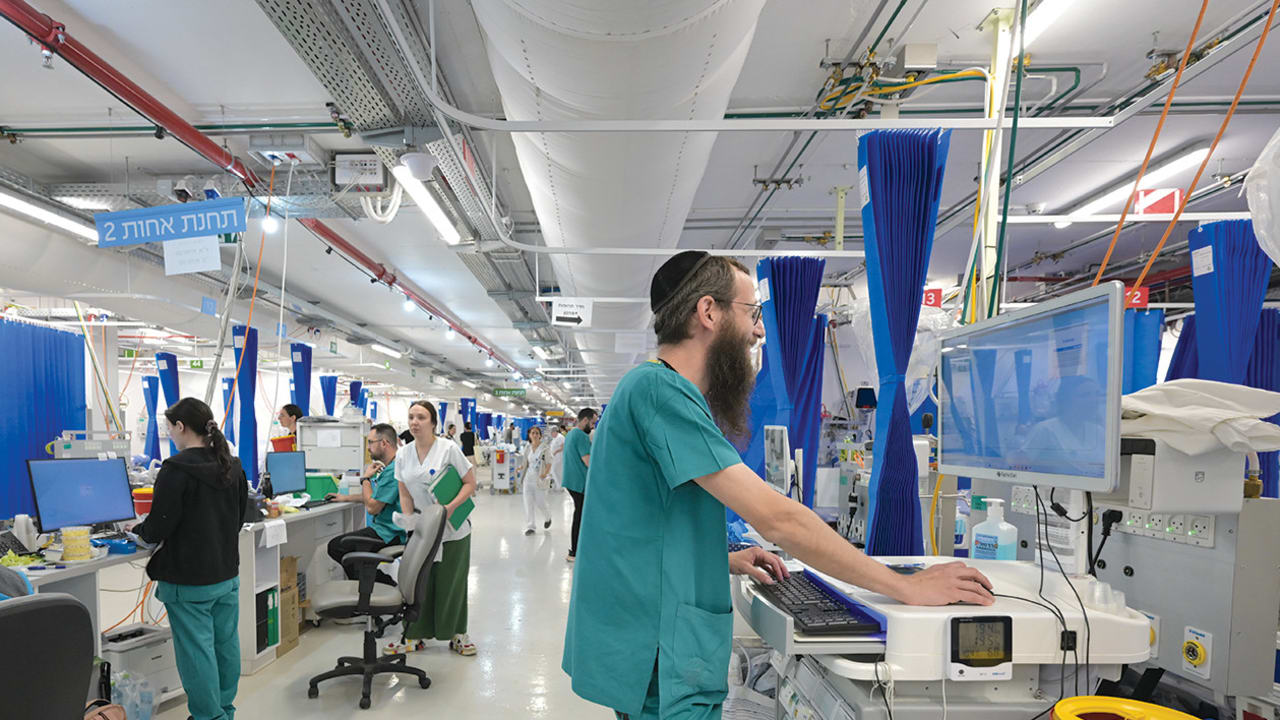
Since the start of Operation Rising Lion on June 13 until the ceasefire declared on Tuesday, the Israeli healthcare system has operated in an emergency mode and has dealt with unprecedented numbers of wounded, evacuees, the homeless, and the mentally ill.
The main emphasis has been on providing immediate treatment for emergencies, evacuating patients, reducing hospital capacity, and ensuring the continuity of basic treatments.
According to the Health Ministry, 3,345 wounded have arrived at hospitals. Of these, 23 are in serious condition, 111 are in moderate condition, 3,043 are in mild condition, 144 are suffering from anxiety, and 22 others whose condition has not yet been determined. As of yesterday, at the end of the fighting, 98 wounded were still hospitalized. Another 28 were being treated in the emergency room. Three of the wounded died during hospitalization.
One of the most serious incidents occurred, as we recall, at Soroka Medical Center, which was directly hit by an Iranian missile. The affected ward had been evacuated a few hours earlier, following strict evacuation orders. As a result of the evacuation, there were no casualties in the ward itself, but the incident required a large-scale evacuation of patients. Seventy-eight patients were transferred to other medical centers and hospitals, including Sheba, Ichilov, Hadassah, Barzilai, Assuta Beer Sheva, Assuta Ashdod, and Beilinson. Rehabilitation patients were transferred to Adi Negev. Medical teams continued to treat the remaining patients while transitioning to operations in protected spaces.
During the fighting, 11,070 civilians were evacuated from their homes and housed in 97 reception sites across the country. 17 local authorities were forced to evacuate their populations due to Direct impact on homes. The Health Ministry deployed approximately 80 medical staff to make daily visits to the absorption sites to identify health needs. Emotional support was provided by approximately 100 therapists from the National Resilience Center.

The mental health sector also recorded an exceptional workload. The ER received 13,332 calls, the health insurance funds’ helplines received 3,679 calls, and the resilience centers received an additional 1,850 calls. Operating hours were extended, and responses were provided around the clock. An extensive information campaign was distributed in the media, with the participation of public figures, to encourage seeking mental health care.
During the operation, 1,036 additional protected hospitalization beds were established, in addition to the 2,234 beds established after the start of Operation Iron Swords in October 2023. There are currently 10,156 beds in general hospitalization, of which 7,240 are protected. In psychiatric hospitalization, 593 protected beds were added out of a total of 2,356 active beds.
A living healthcare system
The healthcare system operated in an emergency, canceling non-urgent outpatient activities, moving to remote control activities, and strengthening the provision of emergency services only. Health funds operated under protection restrictions and transferred some of the services to a telephone and digital format.
In order to enable the continuation of the activities of the medical teams, emergency dormitories were established for the children of healthcare workers. Approximately 3,000 children were placed in these frameworks, which continued to operate even during attacks.
During the fighting, 650 medical personnel were returned to Israel, out of 830 who were abroad. An additional 180 personnel returned yesterday on an organized flight.
The ceasefire announced yesterday is not the end for thousands of citizens who continue to live in hotels and are not expected to return to their homes anytime soon. Health funds and resilience centers are preparing to continue providing support to the evacuated populations.
The Health Ministry announced that it would conduct a comprehensive investigation into the actions taken during the operation in order to better prepare for future events. The hospitals, led by Soroka, are expected to undergo significant rehabilitation in the near future.