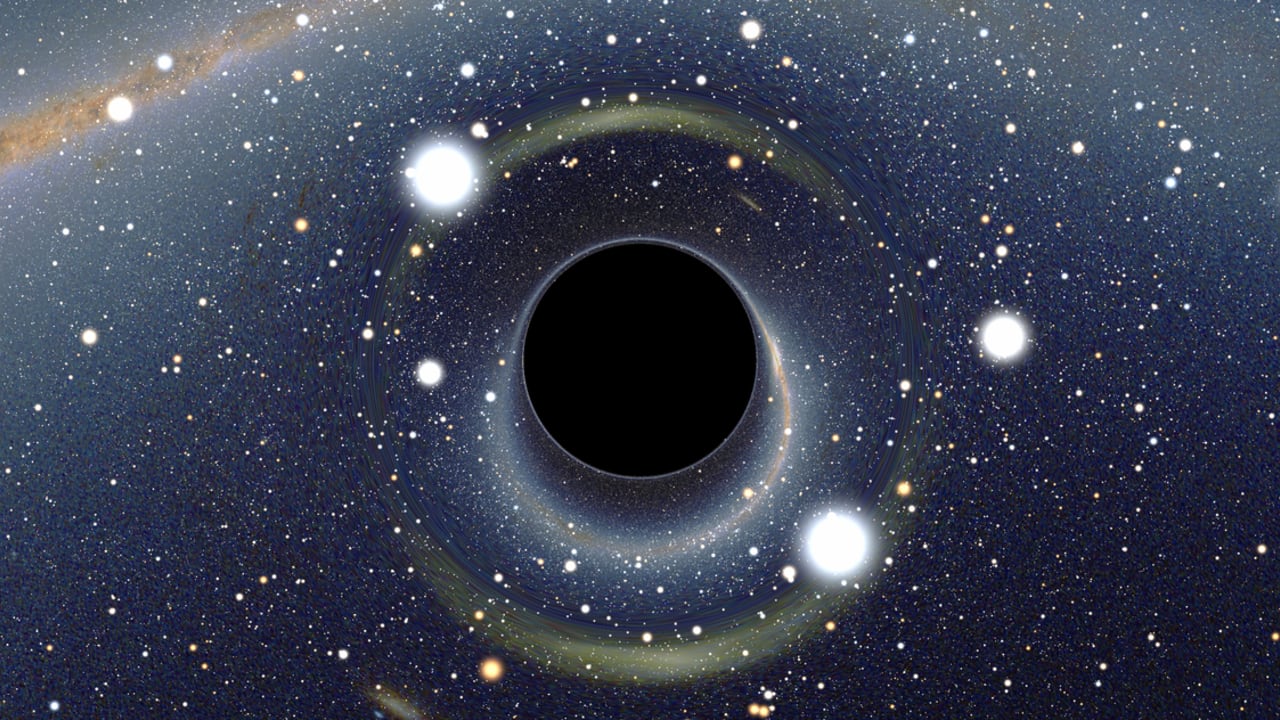
Scientists from Technion-Israel Institute of Technology have managed to measure the long-theorized Hawking radiation emitted by black holes through the use of a sonic black hole made in a laboratory.
However, scientists had yet to actually measure the Hawking radiation temperature in celestial black holes.
The study examined how Hawking radiation evolved through the sonic black hole's life, and was similar to the predictions for Hawking radiation in real black holes. This ended, however, when an inner horizon formed, meaning a spherical surface inside the sonic black hole where sound waves are no longer trapped. The radiation from this created additional Hawking radiation, rapidly growing beyond its spontaneous emissions.
“The experimental results of Prof. Steinhauer are of great importance and interest,” Prof. Amos Ori, a general relativity and black hole expert at the Technion Physics Department, said in a statement.
“Jeff measures stationary Hawking radiation emitted from a sonic black hole, in agreement with Hawking's theoretical prediction. This gives very significant experimental support to Hawking's analysis, which gets experimental approval for the first time in Jeff's experiments.”
However, Ori noted that these findings are also significant because they included the discovery of phenomena that were not part of Hawking's original analysis.
“The present experiment also showed that after a certain period, the radiation emitted from the system begins to intensify significantly, probably due to the development of stimulated radiation following the formation of the inner horizon,” he explained.
“The phenomena observed in this experiment immediately raise the following question: Can real black holes also emit strong stimulated radiation, as Jeff’s sonic black hole did in the experiment? To me, this is a fascinating question and is of critical importance to the physics of black holes as well as astrophysics and cosmology,” Ori said.
Steinhauer's next ambition seems to be to go beyond Hawking's original analysis.
“Our new long-term goal,” Steinhauer concluded, “is to see what happens when one goes beyond the approximations used by Hawking, in which the Hawking radiation is quantum, but space-time is classical. In other words, we would take into account that the analogue black hole is composed of point-like atoms.”