Jerusalem is known for its diversity. Walking down any given street, one hears a mix of languages – English, Spanish, French, Russian, and, of course, Hebrew and Arabic.
Noticing an opportunity to bring people together through this linguistic diversity, Avner Oland, a 28-year-old linguistics and business student originally from Tel Aviv, was inspired to found Jerusalang, now Jerusalem’s most popular and rapidly growing language exchange.
Jerusalang quickly became a social hub for thousands from across the religious and ethnic spectrum. Locals and newcomers, Jews and Arabs, students, soldiers, artists, ultra-Orthodox residents, and international visitors all come together under one roof.
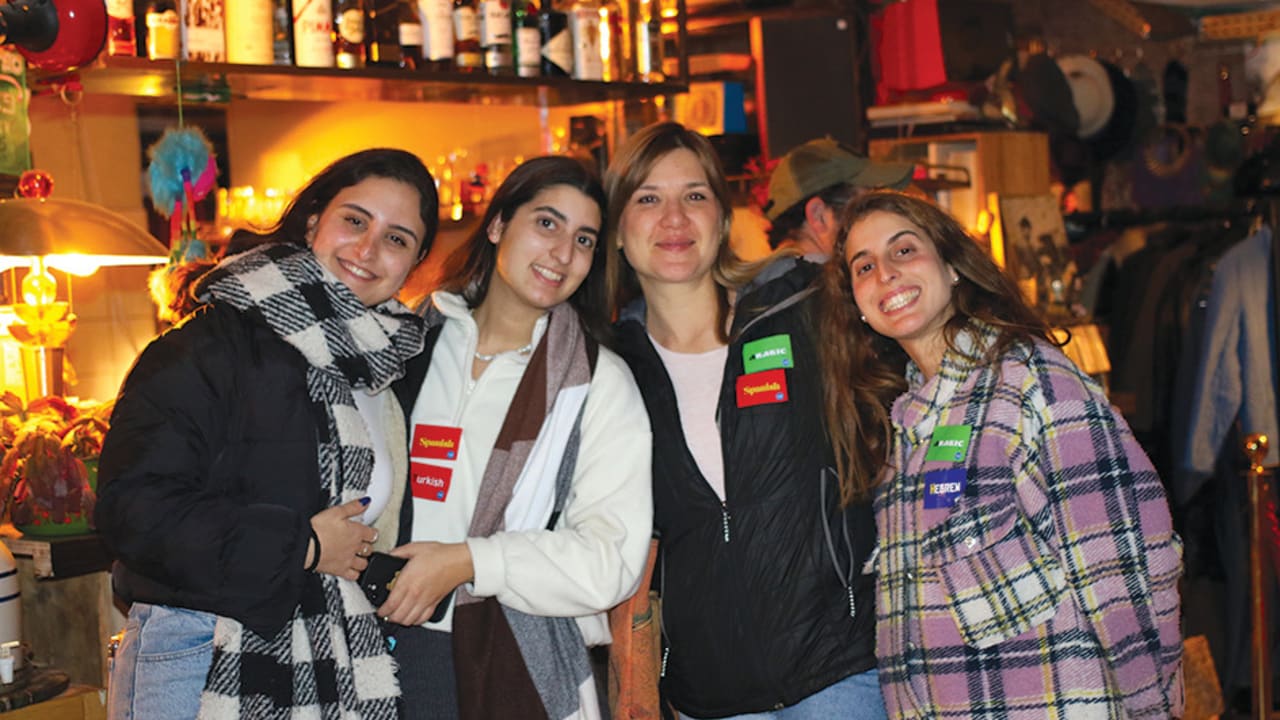
At the Jerusalang events, amid the clink of glasses and the low hum of music in a local bar, conversations shift seamlessly among Hebrew and Arabic, Spanish and French, and English and Russian. Stickers on attendees’ shirts indicate which languages they speak and which they want to practice.
Recently, the Magazine sat down with Oland in The Jerusalem Post recording studio to talk about the project that has brought together thousands of people from across Jerusalem.

From South America to Jerusalem
Oland’s fascination with language is lifelong. Raised in Tel Aviv, he speaks Hebrew as his native language, along with English, Spanish, Arabic, and some French. While traveling in South America, Oland attended a language exchange event for the first time. What struck him most about the people he met was the mix of “countries, different religions and cultures.”
That experience resonated deeply. “It was the first time I felt, this is me,” he said. “Drinks, people, and languages – it was the best combination for me to socialize, to meet new people.”
He recalled meeting some Palestinians in Argentina and speaking with them not as political symbols but as individuals. “We were talking about our lives, not in our country or in any of these situations [of conflict], which was a good way to start.”
When Oland moved to Jerusalem in 2023 to study at the Hebrew University, just months before the war, his idea had already taken shape. Walking through the city, he heard people speaking various languages; it felt like the perfect platform.
Simple format, big effect
Jerusalang officially launched in August 2023. The format is intentionally simple.
“We meet in local bars once or twice a week,” Oland explained. “It’s free. People can come during their free time whenever they want.”
At the entrance, participants pick up stickers listing the languages they speak or want to practice. “That’s kind of an icebreaker,” he said. “People know what to talk about, in what language they should talk to each other.”

During the war, tourism slowed, but the community held steady. Events continued to grow, fueled by word of mouth and WhatsApp groups that now include between 3,000 and 4,000 members.
Not just about language
“When people ask me, ‘Should I come? Could I practice my language?’ I usually say two things. First, ‘Yes, because you probably study a language that is spoken among the audience.’ And the other reason is that language is not all that is happening,” he said.
Jerusalang’s informal format of social interaction and cultural exchangehelps people feel at ease, Oland said. “Like the stickers concept and the fact that we meet in bars, and it’s free and you don’t have to sign up. It makes people more spontaneous,” he explained. “They come with less expectations. And they’re less focused on practicing a language.”
He is candid about what the events are – and aren’t. “It’s not the best place to learn a new language,” he said. “If you are a beginner and you want to become fluent in Arabic… don’t come to the events expecting to become a fluent Arabic speaker.” Instead, what happens is broader. The events are more about communication, mingling, and networking. “Language is just a way to transfer information from one to another,” he said.

Community in a time of war
After the outbreak of the Israel-Hamas War, Oland worried that the events would stop or that attendance would drop. He subsequently attended another language exchange event where around 80 people showed up. Oland and the organizers of the other exchange decided to merge their communities under one umbrella: Jerusalang.
Since then, attendance has continued to grow. The crowd has been notably diverse: Arabs from Jerusalem, as well as the North and South, Muslims, Christians, and Jews, international students, and even ultra-Orthodox Jews who come to speak Yiddish with native German speakers.
“This is the essence of Jerusalem,” Oland reflected. “This is the voice of the people.”
While political discourse dominates headlines, he sees something different taking place. “People are independent. They can think for themselves, and they can have their own opinions,” he said. “In these small but growing communities, this is kind of a global village.”
Over time, Jerusalang has become more than a social gathering; it has developed into a network. Through the events, people have found jobs, apartments, travel companions, and romantic partners. One couple, Oland recalled, made a pact to keep attending events together, no matter what the outcome of their relationship was.
Participants hail from all over – Iran, Turkey, China, Korea, and beyond. Conversations often turn to heritage and upbringing, uncovering unexpected stories and highlighting how varied people’s experiences are.
Running Jerusalang has also shaped Oland himself. Drawing on his background in languages and business, he has learned more about marketing, community management, and social media strategy. “I don’t think there was an event where I didn’t learn something new about someone or about something,” he said. Most of all, he has learned how to build and sustain a community – and what people are looking for when they come to his events.
Jerusalang has begun expanding beyond its original format, hosting various events such as a multilingual open mic night where participants sang and played music from their cultures, which included performances in Cantonese, Chinese, Italian, and Arabic. “Other cities deserve this community as well,” he said. He also believes it is especially important for Israelis to learn more Arabic. In a city often defined by divisions, Jerusalang provides a bridging space where interaction is not forced but is casual, human, and authentic.