The departure hall at Ben-Gurion Airport on Thursday morning looked unremarkable.
No frantic lines. No families dragging suitcases toward self-imposed exile. Flights were arriving from Bucharest, New Delhi, and Naples, and departing for Athens, Krasnodar (Russia), and Berlin. Coffee stands were busy. Security lines moved at their usual pace.
Likewise, at supermarkets. No run on canned goods, bottled water, or toilet paper. No noticeable hoarding of batteries or baby formula.
What there was, instead, were conversations – the same conversations that have been held for weeks.
“When will [US President Donald] Trump attack?” - “Is it going to be this weekend?” - “Should we postpone our trip?”

On President Isaac Herzog’s recent visit to Australia, the two questions journalists most frequently asked him were whether he would pardon Prime Minister Benjamin Netanyahu, and whether the delegation would be able to fly back to Israel or might it be stuck abroad because of an American strike on Iran.
Regarding the former, Herzog said the pardon process was following accepted procedure. As to the latter, he said he had no inside information about Trump’s war plans.
The Israeli reaction to the potential escalation
Israel is watching closely, assessing carefully, questioning – as the journalists did of Herzog – whether to adjust schedules and change plans.
But it is not panicking, and that distinction matters.
On paper, this moment is highly combustible. The latest round of US-Iran talks in Geneva this week ended inconclusively, with Tehran promising to return in two weeks with more detailed proposals.
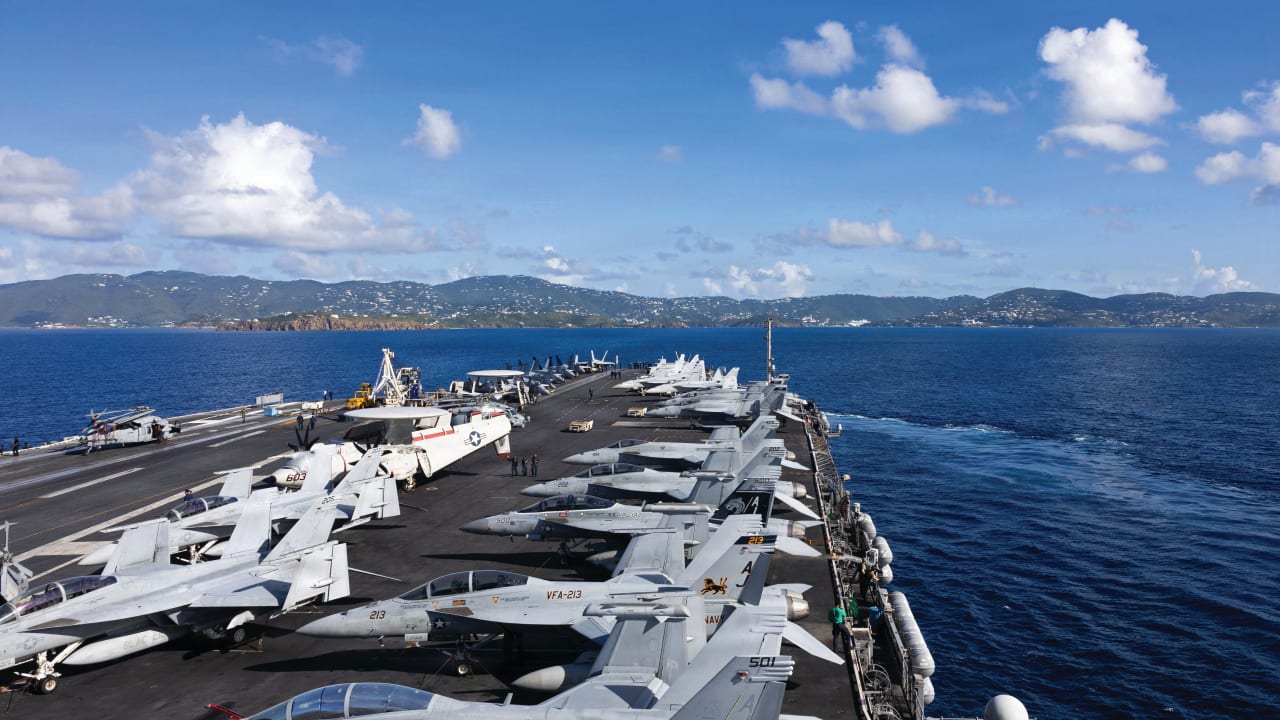
At the same time, Trump has assembled what he once described as a “massive armada” – two aircraft carrier strike groups, dozens of destroyers and cruisers, submarines, refueling tankers, more than 50 additional fighter jets in recent days alone, and layered missile-defense systems deployed across allied bases in the region.
The USS Gerald R. Ford, fresh from operations in the Caribbean, is making its way toward the Mediterranean to join the USS Abraham Lincoln. American B-2 bombers and other long-range aircraft are on heightened alert. Patriot and THAAD batteries have been repositioned. The IDF is on high readiness.
If one were sketching a prelude to war, this outline would fit the bill: overwhelming force put into position, making numerous options available.
And yet, in Israel – which the ayatollahs have promised would come under attack in such a war – there was no run on the banks, no hoarding of canned corn, no scramble for the exit doors.
Concern, yes; hysteria, no – though concern did edge upward somewhat this week.
Former Military Intelligence chief Amos Yadlin contributed to that uptick, saying in a television interview that people “should think twice” about traveling abroad this weekend. He outlined the variables he is watching: whether Washington extends negotiations; the position of the USS Gerald R. Ford; whether street protests resume inside Iran; and even the weather, to see if conditions are conducive to sustained air operations.
For a day or so, Yadlin’s comment nudged the anxiety level upward. His remark made online headlines and set WhatsApp groups buzzing.
The comment did not trigger panic. But it did frame the week’s developments as more immediate – and that framing was reinforced by the defense establishment.
Israeli officials stress calm, say country is prepared
Defense assessments reported on KAN underscored the seriousness of the moment: if Washington decides to strike, Israel would likely receive advance warning – though the public would not be informed, in order to prevent leaks that could jeopardize operational success. Quiet preparations would follow, similar to those conducted ahead of last June’s campaign against Iran’s nuclear infrastructure.
This is the language of preparedness. At the same time, the IDF moved to steady the atmosphere.
IDF Spokesman Brig.-Gen. Effie Defrin said on Thursday the military is at “maximum defensive readiness.” If attacked, he said, Israel will respond with force. But there has been no change in the overall situational assessment.
“There is no reason for unnecessary panic,” he stressed.
That combination – serious preparation and controlled messaging – is shaping the mood. Israelis believe two things at once: escalation is possible, and the system is prepared.
There is another reason the public reaction remains measured, and it has less to do with US aircraft carriers and IDF preparedness, and more to do with memory.
This is no longer theoretical.
Last June’s 12-day campaign against Iran’s nuclear and military infrastructure was unprecedented. It was not shadow or proxy warfare; it was overt. Iran retaliated directly with large-scale missile and drone fire. Israel’s airspace closed temporarily. Iran’s missiles sent millions scurrying to safe rooms.
And then daily life resumed.
The aftermath of the 12-day-war
Iran’s nuclear program was significantly damaged during that war, though current negotiations over that same program in Geneva belie Trump’s claim afterward that the program was “obliterated.”
Israel’s air force and air defense systems performed exceptionally well. Iran was exposed, after years of bombastic threats, as largely a paper tiger – capable of inflicting harm through ballistic missiles, but nowhere near as powerful as it had long boasted.
Lived experience tempers abstract fear. The experience Israelis have had with Iranian attacks over the last two years is rendering this current period one of unease, but not of panic.
Israelis have heard Iranian threats before, seen them acted upon – and lived to tell the tale. They appear to trust that if escalation comes, the army is ready, warning systems will function, and disruption – while serious – will be temporary.
Much has been said about how, in the eight months since the 12-day war in June, the Iranians have continued to manufacture and rebuild ballistic missile capabilities. Yet at the same time, as Brig.-Gen. (res) Ran Kochav, a former IDF spokesman and head of the Air Defense Command, said in a television interview this week, Israel has not been sitting on its hands.
Rather, he said, Israel Aerospace Industries is working 24/7 producing Arrow 3 and Arrow 2 systems. “We also learned, investigated, improved, deployed, and have received assistance,” he stressed.
Israel has learned many lessons from that war, Kochav said. The lack of public panic now suggests the public believes that as well.
The current potential for escalation with Iran
The burning question now is not “Can this happen?” – because it has happened before – but whether it will happen, and when.
To answer that, it is worth looking at the buildup of American forces, and recalling that a few months ago a similar – though smaller – buildup took place in the Caribbean. This is not the first time Trump has assembled overwhelming force offshore.
Last month’s Operation Absolute Resolve in Venezuela began with the deployment of the USS Gerald R. Ford carrier strike group, guided-missile destroyers, thousands of troops and advanced aircraft. The buildup escalated over months – maritime interdictions, strikes on regime-linked targets, financial pressure – before culminating in a swift raid that captured Nicolás Maduro.
That deployment was significant. The current one is larger.
Venezuela was a short-range regime-capture mission. The weaponry arrayed now in the Mediterranean is sufficient for a prolonged operation.
What stands out is the pattern: when force of this magnitude is assembled, it is meant to be usable. Or, as Sen. Lindsey Graham, who visited Israel this week, told Sky News Arabic: “All these ships aren’t coming here just because the weather is nice this time of year.”
It is this awareness that fuels attentiveness among Israelis, though not hysteria.
The slow progress of US-Iran talks
Diplomacy, meanwhile, limps forward. Iranian officials speak of progress and “guiding principles.” American officials emphasize that Tehran has not acknowledged key redlines, particularly the demand for a halt to all uranium enrichment. Iran signals willingness to move stockpiles or pause enrichment temporarily, but resists abandoning the capability altogether. Washington signals skepticism.
Between those positions lies a chasm.
Some Israeli analysts ask whether Trump is waiting for a political catalyst – renewed unrest inside Iran, perhaps – to provide added justification for a strike. In January, he publicly linked potential military action to Tehran’s crackdown on protesters.
For now, however, the streets of Tehran are not ablaze. So the armada waits, functioning as leverage – visible, credible, deliberate. It also creates expectations. Once force of this magnitude is assembled, backing down without substantial concessions becomes harder.
For Israel, one significant element of this moment is not the hardware in the Mediterranean but the capital of trust in the IDF at home. After the colossal failure of October 7, that is no given.
When the IDF says there is no change in public instructions, the public listens. When it says preparations are under way quietly, Israelis assume that is so and carry on with life as usual.
Israelis are not dismissing Iran’s threats. Officials have repeatedly emphasized that even if Israel is not directly involved in a US strike, Tehran would likely respond by firing toward Israel.
Yet the public hears those assessments and continues with its routine. And that may be the most revealing signal of all.
The Mediterranean bristles with destroyers and carriers. Geneva hums with diplomacy. Tehran issues threats. Washington issues warnings.
In Israel, flights regularly depart and arrive. Supermarkets remain stocked. The country prepares for escalation and proceeds as usual. The risks are real. But so is the memory of having faced Iran before – and endured.