
Israeli society is undergoing a subtle change that is manifesting itself in local projects, family offices, and nonprofit organizations nationwide.
More Israelis with financial means are stepping into philanthropy, according to Israel Prize Laureate and businessman Ronny Douek, and many of them are doing so with a new mindset shaped by the aftermath of October 7.
In an interview with The Jerusalem Post, Douek said the change had been building for years but accelerated sharply after the war began, when civil society organizations and philanthropic networks moved quickly to fill urgent gaps.
“It wasn’t that way five years ago, and it definitely wasn’t that way 20 or 30 years ago,” Douek said. “People saw how effective civil society and philanthropy were, and they wanted to be part of it.”
Douek, a longtime social entrepreneur associated with establishing initiatives such as Zionism 2000 and Sheatufim, described the day after October 7 as a turning point in how many Israelis understood the role of organized giving.
Douek also recalled a formative moment from an early visit to Cleveland in the 1990s, when he sat at breakfast with philanthropist Mort Mandel and federation professional Steve Hoffman and watched them argue passionately as equals.
He said the exchange left a deep impression on him as an Israeli, because he had not grown up with that kind of eye-level relationship between major donors and professional leaders. In his telling, the moment helped shape his understanding of how modern philanthropy should work: donors respect professional expertise, and professionals respect the responsibility and commitment of donors.
“On October 8, what happened here was a miracle,” he said. “The entire civil society mobilized for a joint effort that made a difference.”
In his view, that mobilization did more than provide emergency aid. It changed perceptions among Israelis who had the means to give but had not previously been deeply involved in philanthropy. Some donated. Some volunteered. He stated that the practical and effective work on the ground, particularly with children and youth, drew many in.
“Everybody has a child; everybody has a grandchild,” he said, explaining why resilience programs for young people became such a powerful entry point.
Douek: Israeli philanthropy matured in the wake of October 7
Douek framed this shift as part of a broader maturation of Israeli philanthropy. In the 1990s, he said, when he spoke about infrastructure organizations, changing the culture of giving, and pushing businesses to take broader social responsibility, many people saw those ideas as unusual.
Today, he said, more Israeli donors want philanthropy run with the same seriousness as business, including professional staff, clear goals, partnerships, and measurable results.
He also stressed that effective philanthropy should work with government, not instead of it.
“We are a catalyst, not a substitute,” Douek said. “You want to bring innovative ideas, proof of concept, and help build infrastructure that government and local authorities can later carry forward.”
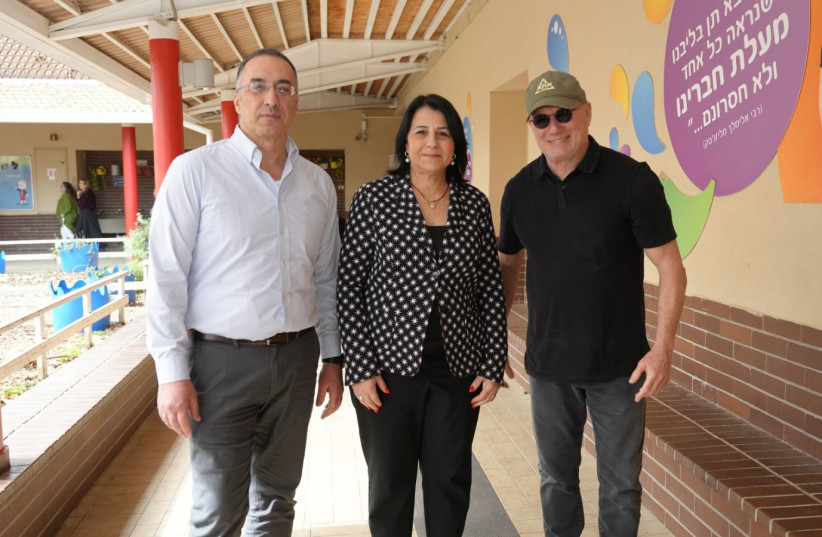
Douek recently inaugurated the first resilience room at the state religious school in the Merom HaGalil Regional Council, together with Dr. Orna Simhon and the Regional Council's head. The site is the first of 40 resilience rooms that Sheatufim plans to establish in frontline communities.
He also pointed to the difference between visible wartime giving and less visible long-term recovery work.
“An ambulance with a sign is amazing,” he said, “but a resilience center in a school is more modest,” while still producing deep and lasting impact.
Douek is also bringing that message to the Jewish Funders Network (JFN), where he is serving as a conference co-chair. He estimated that approximately 700 participants, including about 70 from Israel, will attend the annual gathering in San Diego.
JFN, a major network connecting Jewish philanthropists, foundations, and professionals, is presenting this year’s conference with a strong focus on the current crisis and on practical grant-making tools.
Conference materials highlight interactive programming, skill-building workshops, facilitated conversations, and a Shabbat gathering focused on integrating spirituality, meaning, and values into philanthropy. Featured speakers listed in conference materials include Scooter Braun, Mandana Dayani, and Marc Rowan, and the leadership section includes Elaine Galinson and Ronny Douek.
For Douek, that setting matters because it reinforces one of his core arguments: donors should not act alone when responding to Israel’s needs.
He said one of the biggest challenges after October 7 is the sheer number of worthy causes and initiatives competing for support. His advice, especially for newer donors in Israel and the Diaspora, is to join networks, work with experienced partners, and focus on collaborative models that can coordinate with government and municipalities.
In his view, better philanthropy means methodical philanthropy, with shared goals, defined metrics, and clear timelines.
“We know how to measure success,” he said, adding that philanthropy should help build systems and eventually allow the relevant public bodies to take ownership.
The broader message Douek delivered is that Israeli philanthropy is changing because Israeli society is changing. The war exposed weaknesses in public systems, but it also revealed a deeper reservoir of civic leadership, private initiative, and social responsibility.
The first phase of giving was emergency response. The next phase, he said, is building the long-term resilience that will shape Israel’s future.