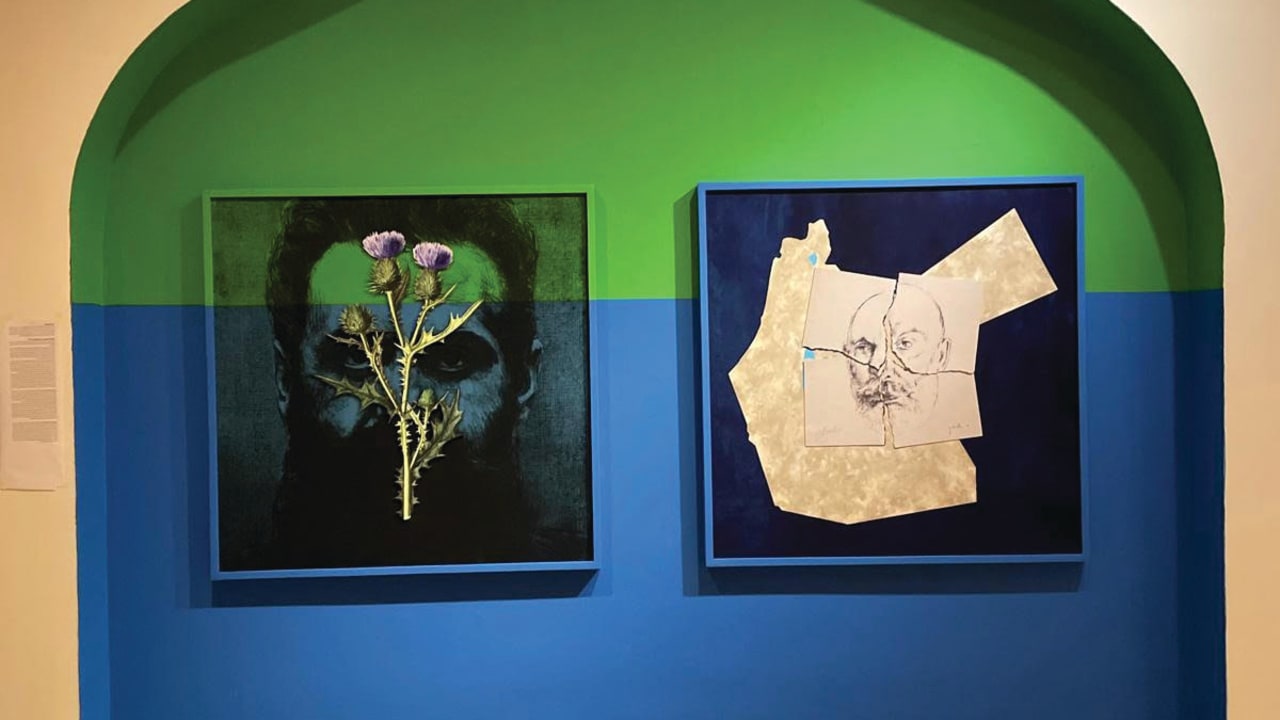
Can You See Its Beauty is a century-old dialogue between artist Gil Goren and German Jewish artist Hermann Struck, who emigrated to Mandatory Palestine in 1922 and whose home in Haifa houses the Hermann Struck Museum.
Blending printmaking, painting, tapestry, installation, video, photography, and weaving to explore identity, Zionist heritage, and collective memory, the exhibition covers four rooms of the museum, showcasing portraiture, landscape, and mixed media pieces, including signature installations, such as Six Portraits, The Meeting, Gaza, Europe, Two Lies, and a video installation capturing a virtual encounter between the two artists.
The exhibition strikes one as having been well-conceived; an aesthetically oriented individual might call it “pretty,” offset with the agony of the State of Israel, with internal issues and external threats.
Tackling deep, existential, extra-aesthetic issues
This dichotomy may be a result of Goren’s advertising and branding experience, where attention to precision, compositional unity, and sensitivity to line and color is evident. Simultaneously, it tackles deep, existential, extra-aesthetic issues: the construction of Israeli and Jewish identity over time, the possible loss of the original Zionist intentions of Herzl and others, and the ever-present scourge of war, violence, and terror.
Goren’s multi-media use is compelling: Photographs, poetry, and music culled from well-known Israeli culture and history, as well as the use of symbols – the golden raven, flowers that grow in Israel, and the Jew that carries Europe on his back, so to speak – all these testify to the indomitable spirit of the Jewish people and the recent reconstruction of the State of Israel.

This intersection of a long historic past, both religious and revelatory, as well as secular and cultural, is instrumental in forming a Jewish homeland. The tragedy of both internal discord and external enemies, however, is not lost, and there are references to October 7.
The question posed in the “dialogue” with Struck is whether the vision of the latter has been actualized 100 years later. The fact that the artworks speak within his very house and its beautiful ornateness, as well as the reimagining of a conversation between himself and the artist (and curator), suggests a transcendence of time and history and a kind of rejuvenated soul, for even amid terror, violence, and an uncertain sense of Jewish identity, there is yet beauty.
The light that is let in is precisely through the cracks, the dark crevices, the falls, and the seeming loss of hope and direction.
On the one hand, the exhibition is a celebration of Zionist pioneers and Jewish intellectuals, while on the other, it questions whether their vision has been truly realized, or perhaps, current culture and identity formations are scrambled. Hence, the artist cuts up and reorganizes Herzl with purple thistle, which visually fragments and recomposes the historic Herzl image in vibrant, contemporary colors.
Goren’s general use of materials and presentation, assisted with the expertise of curator Shirley Meshulem, renders an exhibition that, even in its critique, somewhat, of a potential loss of Israeli direction and identity, suggests that indeed it is beautiful, that this story of a people across time and place, reviled, struggling for a sense of nationhood, is one of uncanny survival, intelligence, and unique destiny.
There are many items on display at this exhibition – a sort of stamp curio with powerful images in immaculate order and inviting the viewer to peer into the details with the use of magnifying glasses, a nice experiential touch.
In general, the exhibition focuses on both loss and memory, as well as continuity and ongoing dialogue. It suggests, perhaps, a way forward even amid the uncertainty and cultural oasis of sorts, and my sense is, having been in conversation with both artist and curator, that this is a celebration of our country, whatever the future may bring.
The exhibition runs until February 7, 2026.
Hours: Sunday, Tuesday & Wednesday: 10:00–16:00, Thursday: 10:00–18:00, Friday: 10:00–14:00