
‘To be a painter, you have to learn painting. To be a painter, you have to come to the studio morning after morning, no matter how you woke up, and paint.”
Tsuki Garbian says this simply, almost offhandedly. It sounds plain enough, but it carries the core of his practice. For him, painting is not a lifestyle or a position but a discipline: a daily, almost monastic commitment to working, looking, and repeating.
In his new solo exhibition, A Very Still Life at Rothschild Fine Art in Tel Aviv, that discipline becomes visible as a negotiation between historical weight and the fractured, urgent present.
Garbian’s development as a painter is inseparable from his insistence on seriousness. A graduate of Hamidrasha – Faculty of the Arts, he speaks warmly of the institution while also expressing criticism.
“Art schools today are very busy confusing you,” he says. “They make you feel like you have to go where everyone is going now, not to the place that actually pulls you.”

Finding the foundation of art
After completing his studies, Garbian sought what he calls “the knowledge,” enrolling in master classes with artists David Nipo and Aram Gershuni.
“I realized I didn’t know anything,” he recalls. “I had to say to myself: ‘I don’t know enough. I needed to learn from someone who has the knowledge.’”
Above all, drawing became foundational. “For me, drawing was the most important part of becoming a painter.”
That seriousness took material form in a decade-long immersion in monumental drawings that acted as an archaeological dialogue with the Old Masters. Garbian describes this work as an excavation.
“I was digging underneath paintings,” he explains, “a real archaeology.”
Using folders of X-ray, infrared, and radiographic images of canonical works, he studied the hidden stages of painting: revisions, abandoned compositions, sometimes even earlier paintings reused beneath the visible surface.
“Sometimes you discover a painting that was never commissioned,” he says. “The canvas was reused. There’s recycling. Things are buried underneath.”
From this research emerged an aesthetic language, not neat, not immediate, that borrows from the logic of radiography: exposed substrata, overlapping figures, and images that feel both constructed and unearthed.
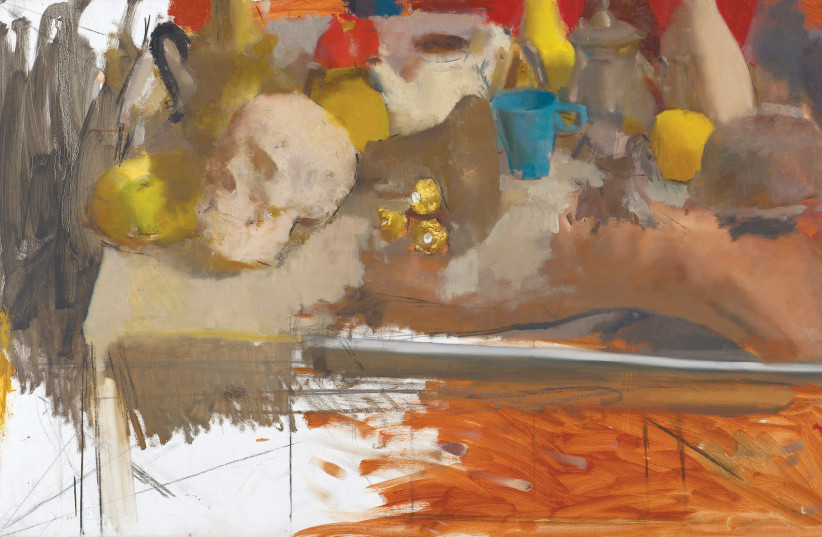
Traces of that decade remain in A Very Still Life, though the exhibition marks a shift toward painting and color. Garbian deliberately leaves earlier layers visible: burnt sienna, orange, raw underpainting.

The importance of imperfection
“It’s important that the painting doesn’t feel too wrapped,” he says. “If everything is finished perfectly, it’s dead.” Leaving areas open or “frayed” is not negligence; it is conviction. “You have one crazy area, and then you have to unravel other areas,” he explains. “Good painters know how to do that. It takes courage to go against the classical teachers who want every inch of the canvas treated the same.”
The exhibition’s Hebrew title, Teva Domem Me’od, comes directly from Yehuda Amichai’s poem “Emek Habarzel.” Garbian cites the poem’s final image, in which the speaker imagines his organs arranged after death “like a bowl of fruit from paintings of other centuries.”
“That line stayed with me,” he says. “It’s still life, but very still.”
The phrase collapses the distance between the biological and the pictorial, between the living body and one of art history’s most codified genres. This tension, flesh and form, mortality and composition, runs throughout the exhibition.
It is most explicit in the portraits of Garbian’s father. Painted after his father fell ill and lost half a lung, the works show him seated in the studio, reading aloud from The Iliad.
“It was part of his speech therapy,” Garbian explains. “He had to train his tongue, his breathing.” The sessions were physically demanding. “Forty minutes, maybe two sessions. It was very hard for him.”
For Garbian, the scene carries a deep personal reversal. As a dyslexic child, he had been forced by his father to read aloud, an experience marked by resistance and anger.
“He didn’t understand why I couldn’t read or write properly,” he says. “I hated it at the time.”
However, that discipline ultimately turned him into a reader.
“It worked in my favor,” he admits. “I thank him for it to this day.”
In the paintings, reading becomes shared labor, a space where illness, memory, and paint converge.
Garbian’s return to painting, after being distracted from it at art school, is also tied to direct observation. While he uses photography in some works, he insists that something fundamental changes once observation takes over.
“I started from a photograph,” he says of one portrait, “but then the colors didn’t work for me. So I painted her directly.”
Once that shift happens, he claims, there is no going back. “When I started working from direct observation, I said, ‘That’s it. You can’t return to photography. You can’t build something that way anymore.’”
Photographs may establish structure, but the painting only comes alive through sustained looking.
During months of wartime paralysis, that looking was reactivated through human presence. Leila, a photographer who entered his studio to document a previous exhibition, became a central figure in the new works.
“She brought life into a place that almost...” he pauses, then continues, “I felt that I, too, was a bit depressed from the war.” She arrived early, stayed long hours, moved through the studio with ease. “She put in a breath of life,” he says.
Other figures followed, such as Kayla, a professional model. Yet even here, realism is subordinate to painterly logic. “Fidelity to reality is less important,” Garbian states. “I stretched parts of the body to serve the painting. It has to look right for the painting.”
A new series of interior paintings extends this logic into space. Ancient rooms in an Italian house in Rome appear alongside views of Garbian’s own studio. These are not descriptive interiors but constructed thinking spaces.
Garbian manipulates scale and perspective, sometimes working with a mirror on the floor to adjust relationships within a meter-by-meter canvas.
“The relationships of 70x70 can’t be the relationships of a meter by a meter,” he explains. “So everything changes. You rebuild it.” The interior becomes a stage where paint reflects on itself, its weight, its decisions, and its limits.
A Very Still Life ultimately asserts painting as an act of resistance against haste, trend, and closure. Garbian does not treat the canvas as a window on the world but as a site of struggle, where looking is physical and meaning is layered.
Through deconstruction and reconstruction, exposure and restraint, his work insists that virtuosity and thought are partners, not opposites.
Painting, in his hands, is neither nostalgic nor ironic. It is a way to survive the present while carrying the past, morning after morning, brushstroke by brushstroke.■
The exhibition is on display until March 7 at Rothschild Fine Art, 2 Moshe Maor St., Tel Aviv.
rgfineart.com/exhibition/tsuki-garbian-life-likeness