
There’s ne’er a dull moment at the Israel Museum. The expansive arts repository on the Jerusalem hilltop is constantly vamping, revamping, and keeping us on our toes as it unfurls an endless stream of works, across all sorts of stylistic and genre domains and cultural fields. The museum’s winter season was recently launched with the opening of five exhibitions, with the presentation fare covering a broad swath of thematic, aesthetic, and cultural bases.
One of the more intriguing and surprising offerings is the spread of ancient maps in the exhibition titled Fact, Faith, and Fantasy: Maps of the Holy Land from the Chinn Collection.” The latter references the fact that the items on display come from a slew of works painstakingly collated by British philanthropist Sir Trevor Chinn and his wife, Lady Susan Chinn.
The exhibition was devised by Ariel Tishby, who serves as the museum’s curator of the Norman Bier Section for Maps of the Holy Land. He notes the contradictory, nay misleading, essence of the maps of yesteryear up front.
“Despite the use of terms like ‘true’ and ‘real’ in their titles, they are inherently selective, reflecting a certain way to view and interpret the world,” Tishby says.
It seems that charts relating to this part of the world, channeled through the politically driven religious prism of the Christian superpowers of the day, fell quite some way short of accuracy.

“Maps of the Holy Land were conceived primarily as a ‘geographical stage’ for the events described in the Scriptures,” Tishby adds, “making those narratives come alive and reinforcing Christian belief.”
The Chinn Collection makes for impressive, if not a little bemusing, viewing. The exhibits date back across more than four centuries and include rare or one-off exemplars, several of which are making their first public appearance.
The maps reflect multifaceted and even multidisciplinary philosophies, and often challenge the viewers to orient themselves accordingly.
There are some basic assumptions to consider and, possibly, reexamine. “Why, for example, do we always consider north as being upwards?” Tishby poses. “In olden times, east was the guiding direction. Just think of the word ‘orientation’ – orient means ‘east.’”
The man has a point. That is something I and, no doubt, the vast majority of the rest of us have never questioned.
And without the benefit of modern technology, satellite-guided navigation, for example, folks often created maps based on guesswork, from the comfort of their own offices or residential workspaces back in Amsterdam, London, or Cologne, without even visiting the region in question.
“Taking a trip from, say, northern Europe to the Middle East was considered to be fraught with danger,” Tishby observes. “So some cartographers preferred to stay at home,” he adds with a wry smile.
That take on the perceived, or actual, risk involved in visiting this neck of the global woods, sadly, resonates to this very day.
Hence, you might get a map of the Levant with a coastline that leans far more to the horizontal than is the actual case. You then get subsequent editions based on the initial erroneous chart, and the ‘fake news’ conveyor belt chunters merrily along, churning out far from precise end products. There are a couple of such specimens in the well-named Fact, Faith, and Fantasy collection.
Promised land on early modern maps
Somewhat tautologous pairing – is conveyed visually in, for example, a map dating from around 1700 attributed to Dutch engraver and publisher Justus Danckerts the Elder and his professional counterpart son Cornelis Danckerts the Younger, who is said to have been particularly skillful in the art of map plate engraving and etching. The work, titled “New Map of the Promised Land,” which the wall text tells us was inspired by a certain Jan van Doetechum the Younger, who died in 1630, has our coastline running seemingly latitudinally, with east pointing where we would assume north to be.
The mistakenly duplicated predicament was further complicated by the fact that there were generally several stages, and professionals, involved in the mapmaking process, including a cartographer, a printer, a publisher, and an engraver, each of whom may have fallen prey to a lapse in concentration and attention to detail.
The latter’s all-important role gets an airing in the exhibition, with the inclusion of a copper plate of a chart made by an Italian fellow by the name of Giovan Battista du Gentilino somewhere around the cusp of the late 17th century and early 18th century. It is an extremely rare specimen crafted for a series called “Itineraries and Peregrinations of Jesus Christ,” which came out in 1736. The title underscores the religion-leaning agendas that dictated the output of cartographers of the day, with the holy city of Jerusalem often the visually directional lodestone.

In addition to the intriguing details that appear on the works, one is immediately and inescapably aware of the aesthetic content of the maps. Such decorative elements as cherubic figures with puffed cheeks indicating the wind direction are a delight to see.
“From the perspective of 21st-century Jerusalem, visitors can appreciate how the Holy City was perceived by European believers of the past,” Tishby notes.
Accuracy shortcomings notwithstanding, Fact, Faith, and Fantasy offers compelling and attractive viewing, particularly in an age when very few of us eschew GPS technology on our cellphone screens and, instead, unfold a physical spreadsheet-sized map to find our bearings as some of us in the seniors league once did.
Anything by Anselm Kiefer is going to draw the eye, tug on the heartstrings, and fire the imagination. The 80-year-old German multidisciplinary artist has produced – and continues to churn out – his fair share of striking works that challenge accepted artistic practice as much as they grab the viewers by the lapels, shake them up, and draw them into the thick of the creative action.
Kiefer’s contribution to the Israel Museum’s winter rollout is a towering totemic installation called Ages of the World, as he continues to grapple with his country’s troubled past, as well as other ongoing destructive episodes in various quarters.

It is, says curator Orly Rabi, very much a give-and-take dynamic. “Kiefer, naturally, works with our free association, beyond the spheres of thinking he brings himself.”
There is, indeed, an abundance of aesthetic and textural elements, vignettes, and slivers to fire our imagination in what might be crassly termed a pile of objects that have ostensibly outlived their usefulness to humankind. The monumental structure – all 5-plus meters of it – incorporates a number of canvases painted by the artist who, eventually, saw fit to dispense with them as individual artistic entities and provide them with a new lease of life, as bricks in this site-specific recreation of the original work, initially tailored for the Royal Academy in London in 2014.
It’s a fair bet that most artists would blanch, if not have an unmitigated apoplectic fit, if anyone so much as suggested they attack a work they painstakingly created and refashion it. But hale and hearty Kiefer is evidently made of sterner stuff. In truth, “desecrating” his paintings that have been lying around gathering dust for a while, until their number comes up, has been part and parcel of his oeuvre for some time. Over the years, he has made a habit of revisiting earlier works and manipulating them into something very different, with absolutely no holds barred.

“History is a material,” he said in a 2016 documentary film about him. “It’s like clay. You can form it as you want it. You can abuse it.”
That shines through in Ages of the World, which also contains books and sunflowers, liberally caked in dust, clay, and other seemingly undesirable detritus.
The blatant disrespect for books in the work naturally tugs on the Holocaust-related memory bank. Kiefer has repeatedly referenced that satanic chapter in his country’s not so distant history, and continues to put probing questions out there through his art.
“He feeds off the world of mythology and Jewish literature. But he also sees war and, of course, destruction. Kiefer engages in history on numerous levels. He is very interested in the history of the 20th century and Germany’s Nazi past. That is also here [in Ages of the World].”

That and much more, which is consummately echoed and complemented through works by a range of artists in the display spaces adjacent to the high-ceilinged hall with the dystopian marriage of substances, shapes, and artistic techniques that convey a multi-layered message about events of the past and where they may very well be leading.
The auxiliary exhibits include a stirring panoramic work by 60-year-old Berlin-based British artist Tacita Dean, best known for her filmic output, which, like the Kiefer centerpiece, more than suggests a post-apocalyptic eventuality.
The brace of pigment prints by New York-based British photographer Adam Fuss takes us into the realms of hyper-realism. Even standing no more than 10 centimeters away from the large frames, it was impossible to discern that the prints were just that – flat photographs of ashes rather than three-dimensional creations. Here, too, ferality is the name of the game.
The visual subject matter is, in fact, the result of Fuss’s decision to set fire to his personal documents, prompted by the trauma of his son’s abduction. At the time, Fuss said he was moved to burn his “paper skin” – official recognition of our physical existence in this world. It is an intense affair that walks the slim line between the corporeal and the ethereal, and casts an unforgiving light on the fragility of our mortal coil.
Existential brittleness also features prominently in the “Break of Dawn” collection of creations by 77-year-old Yudith Levin, curated by Amitai Mendelsohn.
This is something of a retrospective, displaying works from across the artist’s five-decades-and-counting creative pathway.
The exposed nerve ends hit you in no uncertain manner in, for example, Airplane, a recent work Levin produced almost 70 years after her older brother died in a military plane crash. She was seven years old at the time, and that left an indelible scar on her and on her art, with aviation elements recurring across her oeuvre.
While she was a student at Hamidrasha Art School in Herzliya, 18 years on from that fateful day, she put together two photography-related installations in which she juggles with the wonder of air travel and the helplessness of the pilot when something goes wrong.
Humanist politics also comes through in that context as Levin references the IDF’s heavy aerial bombardment of Gaza during the recent war there.
Levin dips into mythology and humankind’s fascination with the ability to defy the Earth’s gravitational pull, in a large canvas called Icarus; and regional violence reappears in an emotive abstract with a title that grabs you unceremoniously by your heartstrings – Pieta for the Nova Victims (Because No One Could Comfort). That fundamentally human sentiment reemerges in a far more nuanced item, from 1996, Levin called Three Bullets Pierced Her Heart, and in a number of pieta-style works.
There are also several mixed disciplinary exhibits in the Levin show, and she reveals she has a whimsical side to her, too, in, for example, a bamboo and slat affair from 1977 called simply Bicycle. The minimalist arrangement combines a couple of rings – naturally, indicating the wheels – and a long diagonal piece that meets a couple of shorter slats, placed at right angles, at the top right-hand corner. That suggests an arrow shape in a subtle reprise of the flight theme.
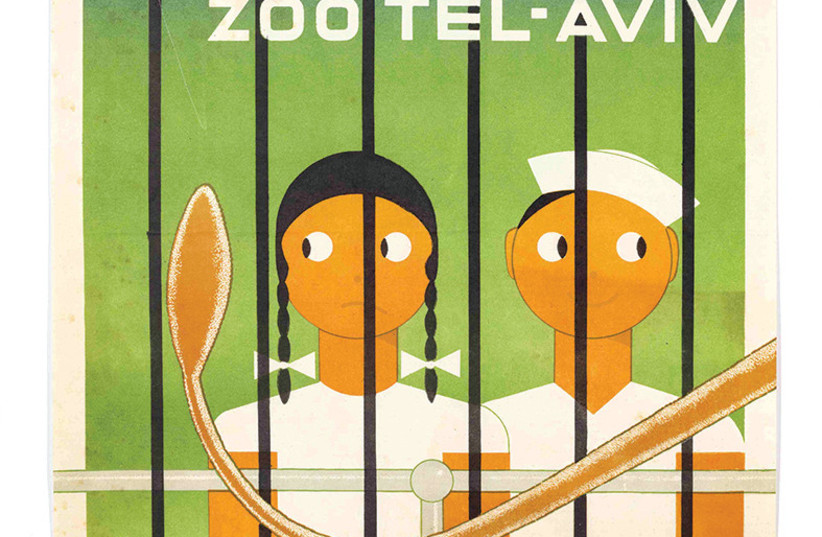
And if it is striking graphic illustrative gems and pristine lines you are looking for, you will get that in abundance in the section devoted to works by Pesach Ir-Shay. The collection, which goes by the self-explanatory name of A Creative Type: The Graphic Work of Pesach Ir-Shay, under the curatorship of Rami Tareef, is a celebration of color, incisive design, compositional precision, and aesthetic brilliance.
The spread takes in a broad sweep of visual angles and topical directions, including charming advertising posters, which belie the crass financial profit-oriented objective behind the exercise, concise minimalistic sculpture, and pictorial efforts that convey the subject matter across the broadest possible emotional arc, which somehow marries the starkness of the artist’s reality at the time with sumptuous polychromatic fusions and oxymoronic interplay.
Ir-Shay was born in Hungary and made aliyah in 1925. Fatefully, however, he returned to his country of birth four years later and was caught up by the Holocaust and was deported to Bergen-Belsen in 1944. He escaped on the famous, or infamous, Kastner train and eventually made his way back here, where he worked as a graphic designer, including on numerous projects for the leading Zionist organizations of the day.
Among the alluring, commercially appealing fare, which also incorporates Hebrew fonts created by Ir-Shay, the exhibition features the “Postcards from Bergen-Belsen” series of postcards.
How he managed to procure the raw materials for the set, let alone produce such arresting and high-quality artistic results, is anyone’s guess.
The postcard format, in itself, infers that the artist had a darkly humorous and, no doubt, psychologically robust side, as he – as it were – plays around with the idea of sending out missives to relatives and friends as one would from a holiday resort.
The cards tell a remarkable tale of physical and emotional survival, and include such basic and comical elements as the barracks, a weekly “menu,” children’s “fashion,” and even a makeshift synagogue Ir-Shay designed and managed to cobble together at the camp.
The museum’s winter exhibition set is completed by the late Lea Nikel’s Path to Eden dynamic spread of abstract works, curated by Adina Kamien, four decades on after her previous showing there.
And anyone who has spent time outdoors at the hilltop spot will, no doubt, have taken in the inviting aesthetics of the Billy Rose Art Garden created by Japanese-American artist Isamu Noguchi for the museum’s opening in 1965.
Noguchi called the creation “Oasis,” and designed the alfresco domain as a manifold space for contemplation infused by a yin-yang balance of matter and spirit, and cross-cultural influences, dipping into historical, current, and future climes.
For more information: https://www.imj.org.il/en