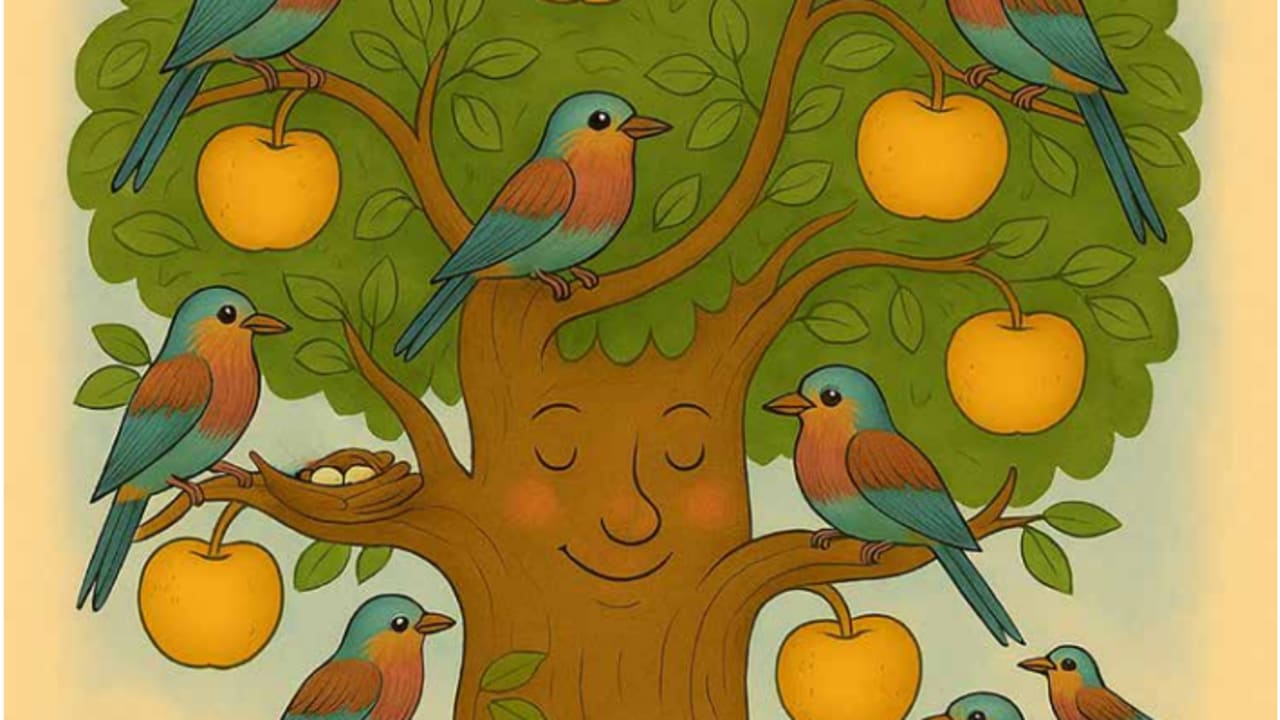
Chasya Leah Raher’s earnest dedication to the welfare of children everywhere is a leitmotif in her own life, as well as the engine for her magical children’s book, The Morning the Apples Began to Sing.
This book’s dedication is “to the Jewish children of the world and to every child, wherever you may be, with love.”
For the author, whose father was a psychoanalyst, “The importance of writing stories that fuse Jewish teachings, traditions and symbols with love and fantasy to ignite the hearts and imaginations of Jewish children cannot be overestimated.”
In an interview with the Magazine, Raher notes, “I am a believer in the power of a story. Indeed, I am alive due to the power of stories.”
She begins: “My great-grandfather, in Nezhin Geberna, a shtetl located near Kiev, was a shoemaker. He was also a storyteller. Many of his customers were wealthy non-Jews. There was one customer who used to visit my great-grandfather, even when his shoes did not need repair, just to listen to his stories.

“One spring day, the customer came to my great-grandfather and told him he knew there was going to be a pogrom. He offered to hide my great-grandfather and his wife and children on his farm.
“My great-grandparents had 13 children. This righteous gentile hid the entire family. My grandmother and her sister were little children and were hidden in a Russian oven. My great-grandmother was hidden in a pigsty. She contracted pneumonia because it was cold, but this wonderful man saved my whole family at great risk to himself.
“Subsequently,” Raher says, “I owe my life to this man who so appreciated the value of a story and life itself.”
Given the fact that her ancestor was such a masterful storyteller, she muses, “Perhaps it is not a coincidence that I am a writer of stories myself.”
She considers her book to have been co-authored with her “inner child.”
“I try to honor her,” she says. “The story comes from her imagination and gives voice to her feelings, thoughts, and observations.”
Raher explains that despite growing up in the 1960s, “when a lot of emphasis was put on looks, I always thought that my best feature was my imagination.”
Working in a shelter for battered woman
As an adult, in Baltimore, before making aliyah, she worked in a shelter for battered women and children, where she created a program “using children’s books as a foundation, together with music, movement, and hands-on visual and culinary arts and original, non competitive games. Through the use of these mediums, coupled with the power of enchantment and the colors and textures contained within the stories themselves, the stories came to life.”
Raher knew that by creating an experiential relationship between the children and the stories, the meaning and the significance of the stories would stick with them possibly for a lifetime.
She recalls, “They were inner-city children; 99% of them were African American. The stories were a haven, allowing the children to journey to and imagine beautiful, loving, and peaceful worlds – and a safe place to experience and express the spectrum of emotions that the darker, more dangerous world they were forced to contend with evoked. As much as I gave them, they gave me so much more.
“On the last day of working at the program,” she says, “I brought the kids Something from Nothing, which is a Jewish book.”
The children had not known until then that she was a Jew, but when they heard the story and saw the illustrations of the Jewish people, they made the connection. She chose the story as the finale of the program because she understood that “it exemplified what these children were being tasked with doing” and she wanted them to know that she “saw them and understood their circumstances and would always remember them and hold them in [her] heart, as well as wanting them to see [her] for who [she] was.” In a city riddled with racism, Raher says, the story brought her and the children in the shelter “together in a moment of mutual love, understanding, and respect that transcended prejudices and distrust.”
“It is my hope and prayer that my stories, in a small way, will help bridge worlds that are divided and contribute to a world of peace and coexistence,” she says.
Children’s literature was her own refuge as a child, “both reading and creative writing.” She found it easy to find hidden meanings in stories.
A comment that stuck with her came from an interview that British TV host David Frost had with Maurice Sendak, author of the 1963 children’s book Where the Wild Things Are. Sendak answered a question by saying, “I don’t write children’s stories, I write stories.”
“It’s never just a children’s story,” Raher says, “though it can be focused on the needs and innate magic of kids.”
“Children’s literature can be a safe place for parents and children to consider things they might not be comfortable considering in ordinary circumstances,” she explains.
Without giving the plot away, it is safe to say that The Morning the Apples Began to Sing is a story with a number of messages.
“The first is that there is nothing easy or simple about being a child. This is symbolized by the voice of the little girl who confronts the parents when they and their children find themselves in a seemingly impossible situation,” Raher explains.
“If something appears to be lacking, we are challenged to go deeper in and find what we are failing to see,” the little girl says. The message in that, according to the author, is “not to panic; the refuah [healing/solution] has already been placed there, and it is up to us to trust that it is there, even if it is not immediately apparent.”
The grown-ups in the book believe that they have their children’s best interests at heart when they sell the birds that had always lived in the golden apple tree, but they are misguided. There is a distorted emphasis on the value of material things as a source of happiness. “So one of the messages is bringing into question how much we value material possessions,” the author explains.
“Another message, represented by the birds, is that we have a responsibility as stewards to the Earth and to the animals, to honor and respect Nature. The parents forgot and were only awoken by the apples singing. But the birds understood that the children had known this all along.”
Unusually, the book is what Raher calls an “I Can Draw It Myself” edition. There are no illustrations, except for an unexpected one on the last page (“Like the surprise at the bottom of the cup,” she says). Thus, the readers are invited to use their imaginations and illustrate the books themselves on the beautifully framed blank pages (with instructions), interspersed with the fascinating tale of magic and moral clarity.
Raher calls this approach her “resistance” in a world “where books are being banned and in which AI is beginning to diminish the individual’s confidence in their own skills and creativity.”
“I hope my book will empower every child to believe in themselves and experience the gratification of authentic self-expression,” she says.
She also wants children “of all faiths and nationalities” to benefit from her stories, and she hopes that they are also read “by children – and their parents – who may not have much contact with Jewish people, and help counter the many erroneous and harmful misconceptions of Jews and Jewish culture that are generated by antisemitism.”
THE MORNING THE APPLES BEGAN TO SING
I Can Draw It Myself edition By Chasya Leah Raher
Lulu Press
40 pages; $20
Graphics by Amy Sirota, Eitan Marchand, and Tzipporah Esther Rosensweig