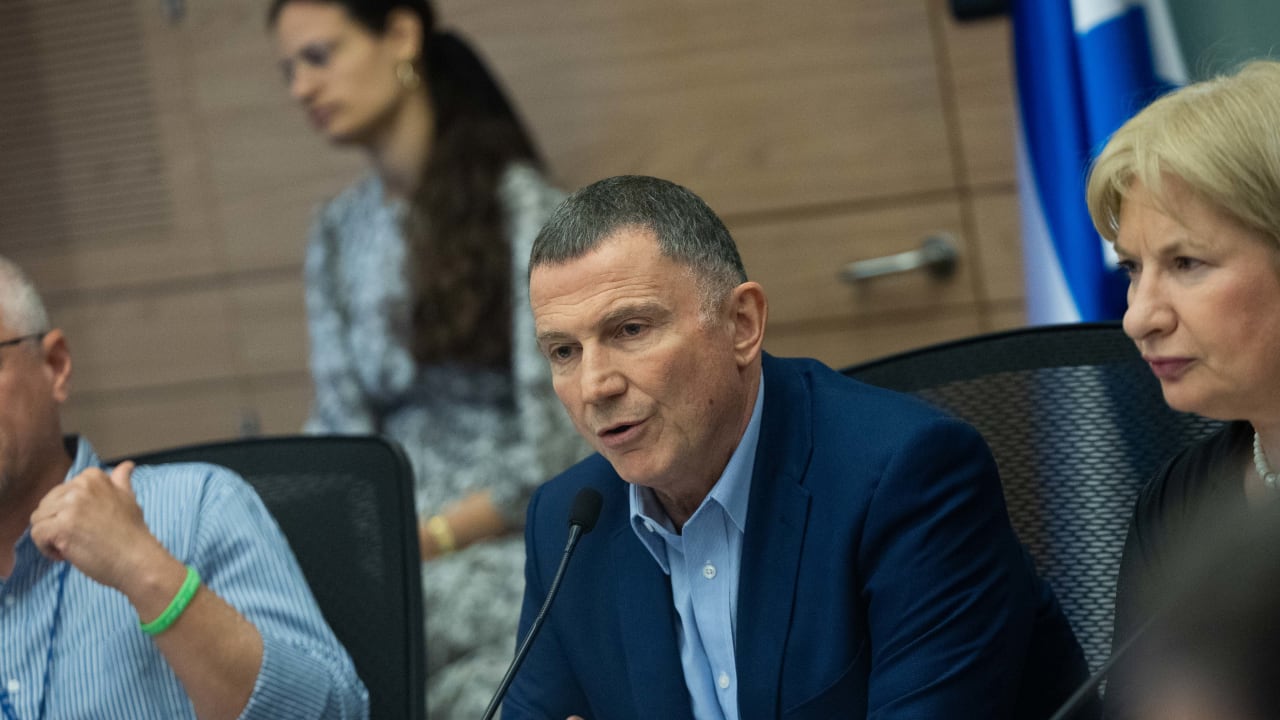
In a press conference in the Knesset on Tuesday afternoon, Knesset Foreign Affairs and Defense Committee chairman Yuli Edelstein called on haredi politicians to exhibit “national responsibility” and refrain from toppling the government over their insistence to exempt at least half of eligible haredi men from IDF service.
“This is not the time to dismantle the right-wing government. The future of the state is not a political game, especially when the security challenges we face are more serious and existential than ever,” Edelstein said.
The press conference came after haredi representatives on Monday rejected Edelstein’s proposal for a new bill, arguing that the proposal contradicted agreements that were reached on June 12, a day before Israel’s attack against Iran.
Edelstein pitched himself as the antithesis of the haredi approach.
“Out of concern for Israel’s security, I acted with national responsibility throughout [the war], and thwarted every attempt to topple the right-wing government during this sensitive period. There were such attempts and constant threats,” Edelstein said.

The committee chairman said that on June 12, he had “worked hand-in-hand with the prime minister to prevent the dissolution of the Knesset,” which allegedly could have jeopardized the attack. While some agreements were indeed reached, there were still many details to work out, and Monday’s proposal included the culmination of his team’s effort to do so, Edelstein said.
“Last night, I met extensively with the Prime Minister and representatives of the ultra-Orthodox parties and presented them with the draft of the law as I believe it should be, ready for submission. This is a law that meets the IDF’s needs, ensures the expansion of the combat recruitment base, reduces the burden on those serving, and guarantees that anyone who enters the army as ultra-Orthodox will leave as ultra-Orthodox,” Edelstein said.
While a spokesperson for Edelstein said that his proposal would not be published, “The law is based on principles we’ve discussed all along and includes several essential clauses that cannot be compromised: Effective personal sanctions [on draft dodgers], institutional sanctions if targets are not met, high recruitment targets with rapid growth, and effective oversight and enforcement mechanisms. Without these, it won’t be a Draft Law—it’ll be a bluff,” Edelstein said.
No 'perfect solutions' to the issue
He concluded that over his 30 years in the Knesset, he had learned that there were no “perfect solutions,” but that In my nearly 30 years in this building, I’ve learned that politics offers no “perfect solutions”, but that there are still “moments greater than us, the elected officials.”
“Throughout this process, I’ve kept in mind the bereaved families and the wounded soldiers—physically and emotionally—as we continue to act and hope for the return of the 50 hostages, both living and fallen. The public will not forgive those who fail to rise to the occasion and unite for one shared goal: the security and future of the State of Israel,” Edelstein said.
The previous exemption for haredi men officially ended with a High Court ruling in June 2024, and since no new bill has passed, the current legal status requires the enlistment of all of the approximately 80,000 eligible haredi men.
In a letter to Prime Minister Benjamin Netanyahu on Monday, Attorney-General Gali Baharav-Miara wrote that the government was legally required to use more tools in its power to enforce the law against draft-dodgers.
Baharav-Miara wrote that the fact that the government was increasing the burden on some parts of the population while not doing all in its power to recruit other parts, was a “severe” violation of the constitutional principle of equality.
Asked by the Post why his committee was not focusing on the government’s failure to enforce the existing law, Edelstein said that his committee was “tracking and demanding from the IDF and the defense ministry a periodical report” on draft progress. The results have been “not good,” and this was the justification to try other avenues such as his proposed bill.
In response to additional reporters’ questions, Edelstein admitted that his proposal included “certain compromises,” but insisted that it provided a real solution that would lead to an increase in draft numbers.
Openly questioned Netanyahu's commitment to advancing controversial draft law
In an interview on Tuesday evening, MK Dudi Amsalem openly questioned Prime Minister Benjamin Netanyahu's commitment to advancing the controversial military draft law, suggesting the prime minister must choose between passing the legislation or firing senior Likud MK Yuli Edelstein.
Speaking to the ultra-Orthodox radio station Kol Berama, Amsalem was asked whether Netanyahu truly intended to bring the draft law to a vote in the Knesset. “I think so,” Amsalem replied, “but if in the end he does not fire Edelstein and this law fails to pass in the Knesset, then apparently he does not really want it.”
Amsalem added that clarity would come soon. “In two weeks, with the start of the Knesset’s summer recess, we’ll know,” he said, implying that Netanyahu’s resolve — or lack thereof — will soon be tested.
His comments come as coalition tensions continue to mount over the draft issue, which has long been a source of friction between the ultra-Orthodox parties and other factions within Netanyahu’s right-wing government.
Ultra-Orthodox fury at Edelstein
After negotiations on advancing the draft law collapsed last week — leading United Torah Judaism (UTJ) to withdraw from the government and with Shas expected to follow suit in the coming days — Edelstein convened a press conference in which he sought to reassure the Haredi public.
“Anyone who enters the army as a Haredi will leave the army as a Haredi,” Edelstein declared, urging ultra-Orthodox parties not to break up the coalition.
But his remarks only inflamed tensions further. In a sharply worded statement on Monday, Shas and UTJ accused Edelstein of deceit and political sabotage, claiming he has repeatedly undermined efforts to forge a compromise.
“MK Yuli Edelstein stood before the cameras today and brazenly lied to the public,” the factions charged. “For a year and a half, he has misled negotiation teams, rabbis, reservists, military and security officials, and all those working sincerely to achieve a balanced and respectful arrangement on this sensitive issue.”
They accused Edelstein of “sabotaging every possible proposal” and said that just this week he had upended key understandings by introducing “a series of new restrictions and humiliations,” which they claimed harmed Torah students and damaged the trust between Likud and its ultra-Orthodox partners.
“It is no coincidence that he refuses to reveal the draft law he allegedly agreed to,” they added, “because he knows it would expose the extent of his violations and deceptions.”
“The Israeli public must know the truth: Yuli Edelstein is playing political games on the backs of those who serve, cynically exploiting the pain of bereaved families, deepening divisions within the national camp, and single-handedly bringing down the right-wing government. Likud and right-wing representatives should condemn him for this behavior,” the statement concluded.
June 12 agreements
Edelstein also blamed the haredim for violating the June 12 agreements, which he said included a pledge not to take steps against the government or coalition during the operation against Iran. However, “even before the planes landed [after attacking Iran,” haredi politicians issued new threats, Edelstein charged.
The June 12 agreements stipulated that an increasing quota of haredi draftees would enlist annually, with the ultimate goal of 50% of each graduating class within five years.
The bill included a series of sanctions that would apply to draft dodgers gradually, with some relatively light sanctions applying immediately, and heavier sanctions added at six-month increments.
Financial sanctions would also be applied to yeshivot that do not reach draft quotas. In the meantime, current sanctions against draft dodgers, which include blocked funds to yeshivot and the cessation of state-subsidized daycare, would be lifted.
The head of the Finance Ministry Budget Department, Yoav Gardos, wrote in a letter to FADC legal advisor Miri Frenkel-Shor on July 2 that the agreement would actually serve as an incentive not to enlist and not to work, and in effect perpetuate the issues that it set out to solve.
Gardos pointed out that the idea of quotas may already be a nonstarter, since they did not place a specific requirement for individual haredim to enlist.
In addition, Gardos explained that the immediate sanctions would not significantly affect many young haredi yeshiva students. In the meantime, the law’s passage will free up funds to yeshivot and to parents that are currently frozen because of students’ draft evasion.
In Tuesday’s press conference, Edelstein dismissed Gardos’s letter, claiming that the letter was “based on rumors” and that the finance ministry’s approach in the committee had been “we do not like haredim, and haredim should go work.”
Shas, UTJ joint statement
Ultra-Orthodox Shas and United Torah Judaism (UTJ) factions issued a joint statement accusing Likud MK Yuli Edelstein of deliberately undermining negotiations over a potential compromise on the military draft.
In the joint statement, Shas and UTJ charged that Edelstein had "brazenly lied to the public," and for the past year and a half has "misled negotiation teams, rabbis, reservists, military and security officials, and all those genuinely working to achieve a balanced and respectable arrangement."
The factions claimed that while Edelstein presented himself as advancing a "compromise framework," he had in fact repeatedly sabotaged every proposal. They cited what they described as an "unprecedented and serious move" last week, when Edelstein allegedly revered key agreements and introduced "a series of new restrictions and humiliations," which they say harmed Torah scholars and undermined trust between Likud and its ultra-Orthodox coalition partners.
"It is no coincidence that he refuses to reveal the draft law he supposedly agreed to," the factions said, accusing Edelstein of breaching understandings and deceiving his political partners.
They warned that Edelstein was "playing political games on the backs of those who serve, cynically exploiting the pain of bereaved families, causing a severe rift in the national camp, and singlehandedly bringing down the right-wing government.”
Lapid responds
Opposition leader Yair Lapid swiftly responded to the ultra-Orthodox factions’ statement, accusing them of hypocrisy.
“It takes boundless chutzpah from Shas and UTJ to speak of ‘political games on the backs of those who serve’ and ‘cynical exploitation of the pain of bereaved families,’” Lapid said.
He pointed to the ongoing war, in which hundreds of IDF soldiers have been killed, noting that while “every morning we wake up to casualty announcements, their voters sleep peacefully.”
Lapid charged that the ultra-Orthodox factions are “the only ones playing political games,” accusing them of encouraging draft-dodging, discriminating “between one blood and another,” extorting budgets, and shirking their responsibility to defend the country during wartime.