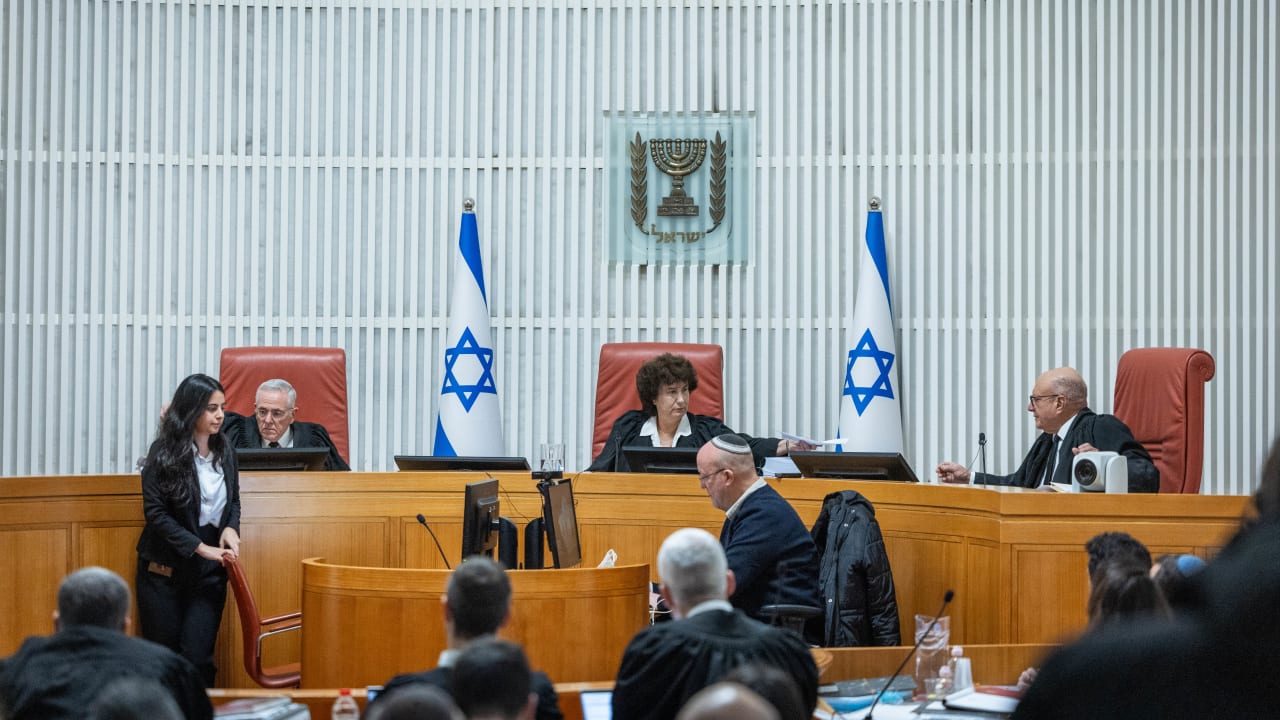
The government on Sunday told the High Court of Justice that it has no legal authority to compel the establishment of a state commission of inquiry into the failures surrounding Hamas’s October 7 massacre, saying that such a move would constitute an unprecedented breach of the separation of powers.
In a response filed following a court order that was issued earlier this month, the government said the decision whether to establish a state commission – and when – lies exclusively with the government under the Commissions of Inquiry Law, and cannot be dictated by the judiciary, even in the wake of a national catastrophe.
The filing frames the dispute first and foremost as a constitutional question, asserting that judicial intervention would strip the executive branch of a power explicitly reserved to it by law.
According to the government, the High Court may review the legality of its decisions, but it cannot substitute its own judgment for that of the cabinet by ordering the creation of a commission.
Only after laying out that threshold argument did the government turn to respond to questions of timing and circumstance. It said that Israel remains in the midst of a multifront war, with senior political and security officials deeply engaged in ongoing operations, hostage negotiations, and strategic decision-making.

Forcing them into a formal commission process now, the government argued, would risk harming national security and impairing the government’s ability to function.
The government stressed that its position does not amount to opposition to an inquiry in principle. Rather, it said, the issue is who decides – and under what legal authority.
In its response, the government said it wished to emphasize that Israeli law does not impose a deadline for establishing a state commission of inquiry, and noted that previous commissions examining wartime failures were formed only after hostilities had concluded.
Simultaneously, the government pointed to ongoing internal investigations being conducted by the IDF, the Shin Bet (Israel Security Agency), and other security bodies, as well as oversight by the State Comptroller’s Office, as evidence that lessons are already being examined through existing mechanisms.
These processes, the filing argued, allow for operational learning without the sweeping disruption associated with a full public commission.
Petitioners challenging the government’s position argue that such internal probes lack independence and public legitimacy, particularly given that many of the officials whose decisions are under scrutiny remain in office.
They maintain that only a state commission of inquiry – with subpoena powers and public transparency – can credibly examine the political, military, and intelligence failures that led to the deadliest attack in Israel’s history.
The High Court’s decision to order the government to explain why it won’t establish a state commission of inquiry signaled concern with the government’s open-ended refusal to commit to any framework or timetable for accountability.
During earlier hearings, justices questioned whether the government’s stance risks turning postponement into permanence, and whether meaningful responsibility can be established absent an independent body.
The dispute has become one of the most emotionally charged legal and political battles since October 7. Families of the fallen and of hostages, reservists, and civil society groups have taken to the streets demanding a state commission “now,” while polls show broad public support for an independent inquiry.
October Council criticises decision
The Sunday position drew sharp criticism from the October Council, a coalition representing bereaved families, survivors of the October 7 attack, former hostages, families of hostages, wounded soldiers, and residents of Gaza border communities.
It accused the cabinet of deliberately obstructing efforts to uncover the truth about the failures that led to the attack.
“From the founding of the state until today, no Israeli government has done so much to prevent, by every possible means, the investigation of the truth,” the council said. “Instead of safeguarding Israel’s future, an entire government is occupied day and night with concealment, whitewashing, pitting bereaved families against one another, and fleeing responsibility.”
“We – the bereaved families, wounded soldiers, Nova survivors, captivity survivors, families of hostages, and residents of the Gaza border communities – say to the Israeli government: You do not have the authority to refuse to establish a state commission of inquiry into October 7,” the statement continued.
“This is an extreme, egregious act that risks bringing about the next massacre, and, in the pages of history, the blood of the victims will be recorded as being on your hands.”
At its core, the case is no longer only about timing or procedure. Instead, it is about where authority lies after a national failure – and whether accountability for October 7 will be determined by the government that presided over it, or by an independent body empowered to examine its actions.
The High Court is expected to decide in the coming weeks whether to accept the government’s constitutional argument, issue further directives, or set parameters that could force the issue back onto the agenda – all while the coalition continues to push for a political state commission of inquiry, and elections loom.