Israel is still a year out from mandatory elections in October 2026, but with the balloting likely to come a few months earlier, political jockeying is already shifting into high gear.
The maneuvering is no longer theoretical; it is happening now in public statements, private meetings, and those ever-present opinion polls.
For an opposition seeking to dethrone Prime Minister Benjamin Netanyahu – who has served in that position just under 18 years since 1996 – there are two guidelines worth following.
First, don’t engage in over-the-top hyperbole. Second, offer more than vacuous slogans.
If those are the guidelines, then the leaders of the opposition already need a reboot.

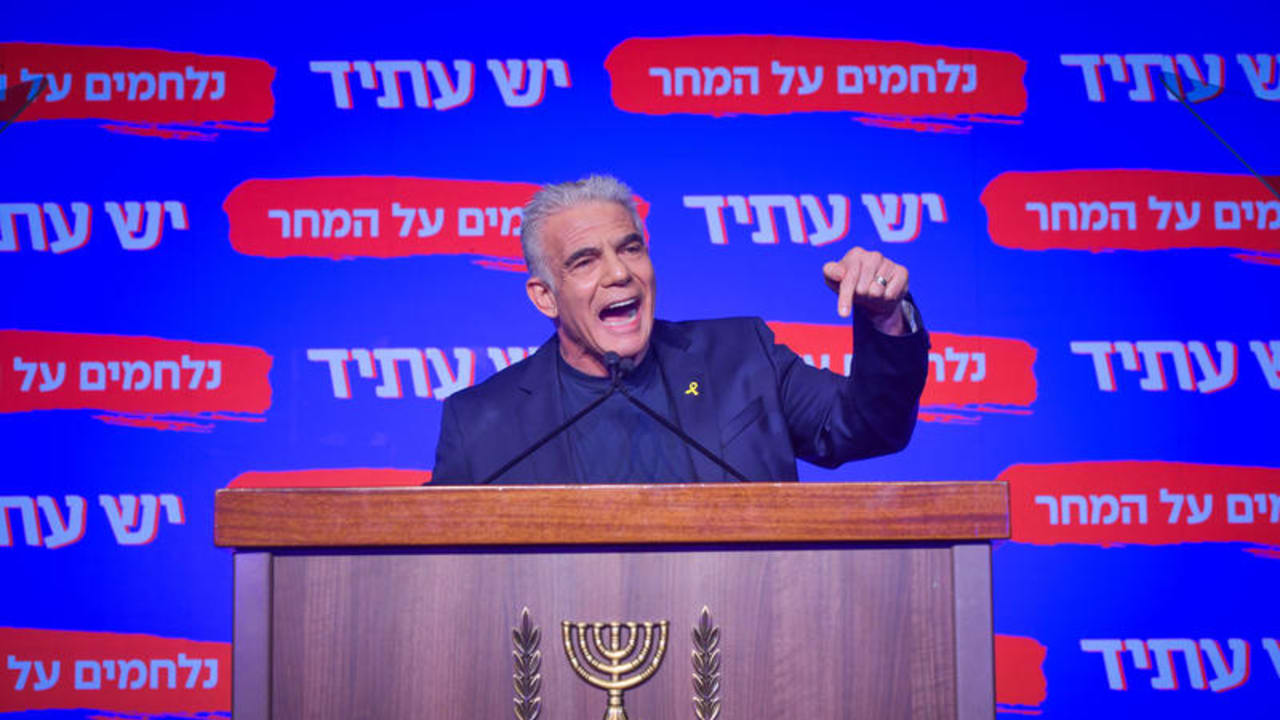
Take Yair Lapid. The Yesh Atid leader told his party last week that if Netanyahu wins the elections again, “it will be the end of Zionism. The state will collapse. We are the only ones who can save it.”
Really? The end of Zionism? Only Lapid can save it? This is not just rhetorical inflation – it is an exaggeration that stretches credulity. The only way to defeat Netanyahu and prevent another right-wing coalition is to peel away voters from that camp, or at least from those in the middle who could be persuaded to jump either way.
Telling them that voting for Netanyahu spells the end of the Zionist project is not going to lure them across. It may fire up Lapid’s faithful, but it will not broaden the base.
Lapid is free to argue that Netanyahu is unfit, that he bears responsibility for the October 7 massacre, and that the trajectory the country is on is dangerous.
Those are powerful claims. But to say that another Netanyahu victory will spell the end of Zionism undermines Lapid’s credibility as someone grounded, pragmatic, and capable of adequately reading reality.
The second guideline – avoid vacuous slogans – is also being violated. Former prime minister Naftali Bennett met on Sunday with Gadi Eisenkot, a former IDF chief of staff and MK. Afterward, they released a statement saying they had discussed “the deterioration of Israel’s international standing, and actions toward creating a new and better leadership for Israel, one that will unite the people, strengthen security, and rebuild the country.”
Lovely. But what does that even mean? Everyone wants to unite the people, strengthen security, and rebuild the country. The tricky question is how. That’s the part missing from Bennett’s rhetoric – deliberately missing.
And that is the essence of his political method: Issue broad slogans, present the bare bones, but never add the flesh. It keeps all doors open and offends no one.
He talks about hostages, about drafting haredim into the army, about restoring Israel’s standing. Who – except for the haredim – opposes that? But the devil is in the details, and Bennett prefers not to go there. And Bennett is not alone.
This is part of a larger behind-the-scenes maneuvering among the opposition parties: call it rearranging the furniture. The thinking seems to be that if the sofa – Lapid’s party – is moved here, the easy chair – Liberman’s party – shifted there, and the table – a theoretical Bennett-Eisenkot party – nudged into a new place, the room will suddenly feel more attractive and inviting.
It is the same furniture and the public knows it
Eisenkot now wants to gather Bennett, Liberman, Lapid, and Yair Golan’s The Democrats Party into a “Change Bloc” that could present itself as a responsible, Zionist alternative.
Lapid himself has been floating similar ideas, envisioning a front that can credibly challenge the Netanyahu-led Right.
But here, too, questions abound. Could Bennett, who is firmly opposed to a two-state solution, sit comfortably alongside Golan, who is as far to the left as Bezalel Smotrich is to the right? How is Liberman – with his hawkish, secular-nationalist bent – going to coexist in a bloc with Golan?
Polls suggest that such alliances could reshuffle the map. A Channel 12 survey last week gave Bennett 19 seats and Eisenkot 12, with Liberman’s Yisrael Beytenu and The Democrats at 11 each. A combined Bennett-Liberman list would even emerge as the largest party with 30 seats, edging out Likud.
But the overall math still leaves the opposition short: Without the Arab parties, the numbers hover around 59-60 mandates, tantalizingly close but still not enough to form a government.
Which raises the central problem: Are the opposition leaders merely rearranging the same worn furniture, or are they offering something genuinely new?
Perhaps what the opposition really needs is not new configurations but new furniture altogether – fresh faces and fresh voices. The public knows Lapid, Bennett, Liberman, and Eisenkot all too well. Their records are not abstractions. Israelis have lived under their leadership in various capacities for years and have seen the results.
Enter Yossi Cohen, the former Mossad director. Cohen gave a few high-profile interviews in recent days and dangled himself out there as a possible prime minister. At one point, he called Likud his “natural home,” but only in a “new format” that would require “a massive replacement of those sitting inside it.”
At another, he lashed out at Netanyahu for failing to take responsibility for the October 7 massacre. “He should have announced an election date immediately,” he said.
On the surface, Cohen offers precisely what the opposition lacks: the sheen of novelty combined with the aura of competence. He has the credibility of someone who delivered daring operations, including the theft of Iran’s nuclear archive and secret diplomacy that led to the Abraham Accords.
He projects determination and confidence. He looks like someone who can steady the ship in a storm.
But Cohen also comes with baggage. During the last decade, he was head of the National Security Council and then of the Mossad – roles that place him squarely inside the establishment he now criticizes. He insists Netanyahu must be held responsible for the October 7 massacre, but he, too, was part of the groupthink that led up to that catastrophe.
No sooner had he told Channel 12 in an interview Saturday night that he opposed the mechanism for transferring Qatari money to Hamas than a tape emerged Monday morning on KAN News from a 2022 conference in which he praised the transfer of those funds, called Qatari moves a “blessing,” and lauded the emir of Qatar for delivering them.
If this is the new piece of furniture, it is unclear how long it will hold up.
Liberman himself met with Eisenkot last Thursday in a meeting focused on building a strategy for the opposition’s Zionist parties. Maariv quoted a source close to Liberman as saying, “The principle is that the four parties must function like an orchestra – each plays a different instrument, but all play the same melody.”
But an orchestra only works if it produces harmony. At the moment, what is emerging is a jumble: Lapid declaring the end of Zionism, Bennett talking in empty slogans, Liberman pushing to play first violin, Eisenkot searching for his place, and a question mark over whether Golan even fits in this particular orchestra.
For voters, the question is whether this opposition will coalesce into a credible alternative that can truly challenge Netanyahu, or whether it is simply reshuffling old furniture in a room the public already rejected.
With elections likely less than a year away, the time for rearranging is limited. To win, the opposition will need not only recognizable names and slogans but also substance, credibility, and perhaps a genuine new face who can convince Israelis that he – or she – can chart a better course.
Whether Israelis will buy the same furniture in a different arrangement, or demand something altogether new, is the question that will define the next election.